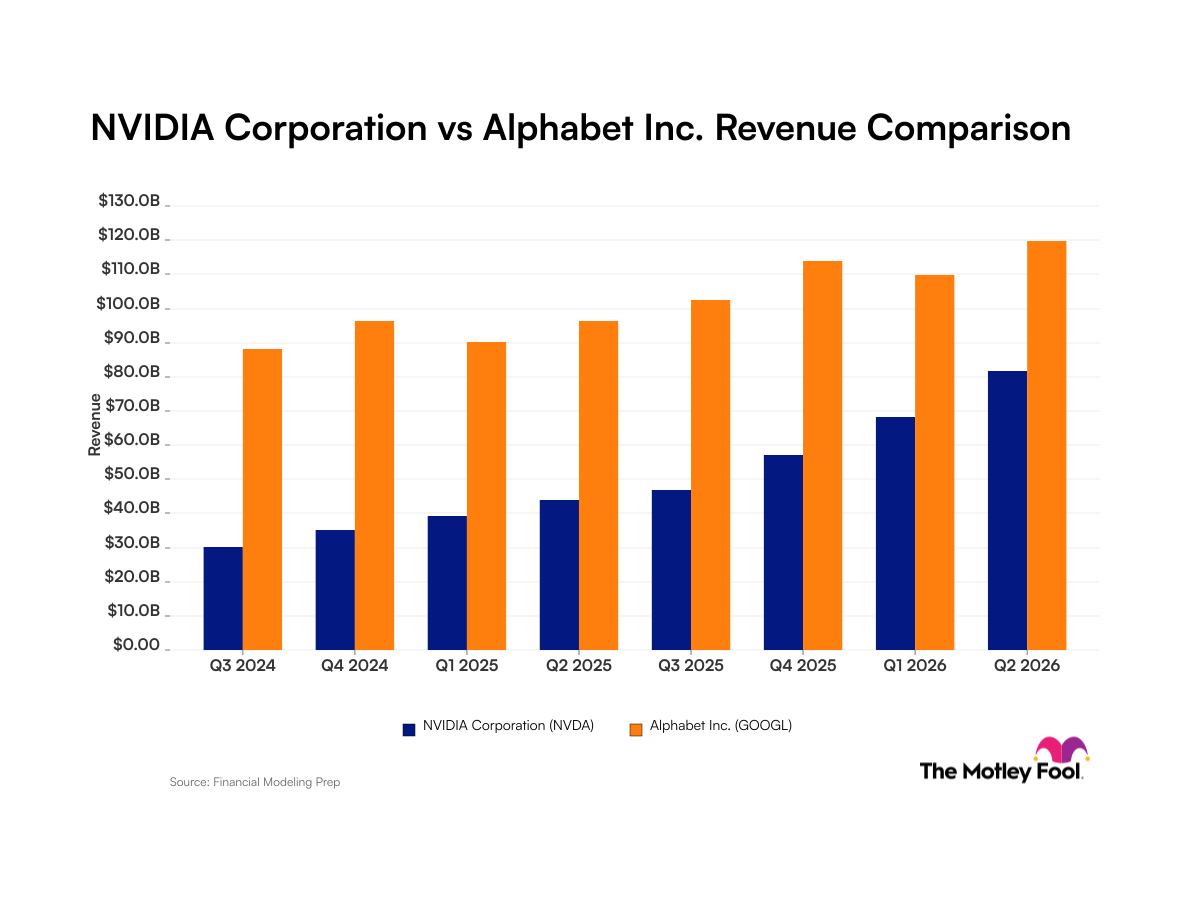
Nvidia's Q2 2026 revenue reached $81.6 billion with a 72% net income margin, while Alphabet reported $119.8 billion with a 94% margin for the same quarter.
Nvidia is showing steady quarter-over-quarter growth fueled by AI hardware demand and has forecast revenue to accelerate to $91 billion next quarter.
Alphabet's Google Cloud division is also benefiting from AI adoption, with 82% year-over-year revenue growth and a customer order backlog exceeding half a trillion dollars, demonstrating both companies are successfully capitalizing on the AI market expansion.
What happened
Nvidia reported Q2 2026 revenue of $81.6 billion (quarter ended April 26, 2026) with a net income margin of 72%, while Alphabet posted $119.8 billion for the same period (quarter ended June 30, 2026) with a 94% net income margin. Nvidia introduced new computational processors in June 2026 and forecasted revenue to accelerate to $91 billion in the next quarter.
Why it matters
Nvidia is showing consistent quarter-over-quarter revenue growth driven by massive demand for its AI offerings, signaling sustained momentum in the semiconductor market. Alphabet's Google Cloud division grew 82% year-over-year to $24.8 billion in Q2, with a backlog of customer orders exceeding half a trillion dollars (up from $462 billion in Q1), demonstrating both companies are capturing significant share in the AI market—though Alphabet's advertising business masks the strength with seasonal fourth-quarter spikes.
What to watch
Nvidia's forecast to reach $91 billion in the next quarter will be a key indicator of sustained AI-driven demand. Alphabet's Google Cloud backlog expansion and Nvidia's new Vera Rubin AI platform are expected to drive ongoing sales growth for both companies.
Nvidia and Alphabet reported their Q2 2026 financial results in late July 2026, revealing divergent but complementary narratives within the artificial intelligence market. Nvidia, which primarily generates revenue by selling advanced graphics, computational, and networking solutions for gaming and high-performance computing, reported revenue of $81.6 billion for the quarter ended April 26, 2026, alongside a net income margin of 72%. The company introduced new computational processors in June 2026 and provided forward guidance indicating that revenue is expected to accelerate to $91 billion in the next quarter. Over the trailing two years, Nvidia's quarterly revenue has grown consistently: from $30.0 billion in Q3 2024 to $35.1 billion in Q4 2024, $39.3 billion in Q1 2025, $44.1 billion in Q2 2025, $46.7 billion in Q3 2025, $57.0 billion in Q4 2025, $68.1 billion in Q1 2026, and finally $81.6 billion in Q2 2026. This pattern of sequential increases underscores what investors and analysts describe as "massive demand" for Nvidia's artificial intelligence offerings.
Alphabet, which earns most of its revenue from digital advertising services, cloud computing infrastructure, and consumer hardware, reported revenue of $119.8 billion for the quarter ended June 30, 2026, and achieved a net income margin of 94%—the highest of the two companies. While multiple law firms announced securities fraud investigations into the company in July 2026, Alphabet's financial momentum remained strong. The company's quarterly revenue progression tells a similar story of growth, though with more volatility: $88.3 billion in Q3 2024, $96.5 billion in Q4 2024, $90.2 billion in Q1 2025, $96.4 billion in Q2 2025, $102.3 billion in Q3 2025, $113.9 billion in Q4 2025, $109.9 billion in Q1 2026, and $119.8 billion in Q2 2026. The seasonal pattern is evident—fourth quarters spike due to increased advertising spending—but the underlying trend is also upward.
The most striking aspect of Alphabet's results is the performance of its Google Cloud division, which is where customers access Alphabet's proprietary AI models. In Q2 2026, Google Cloud revenue grew 82% year-over-year to $24.8 billion, and the division's customer order backlog climbed to over half a trillion dollars, a significant increase from $462 billion in Q1 2026. This backlog is a leading indicator of future revenue, signaling that enterprise customers are committing substantial resources to Alphabet's cloud and AI infrastructure. The rapid expansion demonstrates that Alphabet is successfully capturing its share of clients in what the article describes as "the burgeoning AI market." While Alphabet's overall revenue is larger than Nvidia's, its advertising-driven business masks the full magnitude of its AI momentum; the Google Cloud acceleration reveals that AI-related sales are growing far faster than the headline revenue number suggests.
Together, the two companies illustrate how AI adoption is fueling growth across the value chain. Nvidia supplies the essential hardware—the semiconductor chips and systems that enable AI computation—while Alphabet and other hyperscalers (large cloud providers) build services on top of that hardware and sell access to customers. Nvidia's steady quarter-over-quarter growth and the introduction of its Vera Rubin AI platform position the company to continue benefiting from this demand. Alphabet's Google Cloud backlog, meanwhile, suggests that large enterprises are locking in spending on cloud AI services, which will in turn drive demand for more Nvidia hardware. For retail investors, the comparison underscores that both the infrastructure layer and the service layer of the AI market are capturing significant value, and both companies are positioned to sustain growth momentum into the coming quarters.
Nvidia and Alphabet represent two distinct pathways for capturing value from the AI boom, yet both are demonstrating strong momentum. Nvidia's business model—selling advanced graphics, computational, and networking solutions—has resulted in steady quarter-over-quarter revenue acceleration, with Q2 2026 revenue of $81.6 billion representing the latest step in a consistent upward trajectory from $30.0 billion in Q3 2024. This predictable growth pattern, combined with the company's 72% net income margin, reflects the fundamental scarcity and high demand for the hardware that powers AI systems. Alphabet's story is more complex. Its larger absolute revenue ($119.8 billion) is heavily influenced by its digital advertising business, which experiences seasonal fluctuations—notably fourth-quarter spikes driven by holiday spending. However, beneath that cyclicality lies a powerful emerging business: Google Cloud, which grew 82% year-over-year in Q2 and accumulated a customer order backlog exceeding half a trillion dollars. This backlog signals that enterprise customers are committing to Alphabet's AI infrastructure at scale. Both companies benefit from a virtuous cycle: Nvidia supplies the hardware Alphabet (among other customers) uses to deliver AI services, and both capture revenues from the downstream demand. The introduction of Nvidia's Vera Rubin AI platform and Alphabet's continued cloud expansion suggest this symbiotic relationship will sustain growth, though Nvidia's more focused product strategy and transparent quarter-over-quarter acceleration may explain investor preference for its stock at the time of publication (Nvidia +2.93% vs. Alphabet +6.73% on the reporting date).
AI-summarized, only the topics you pick — one digest a day via Email, Slack, or Discord.
Free · takes 30 seconds · unsubscribe anytime
Ask AI anything about this article. Q&As are published on this page for other readers too.
Asia Vital Components expects global AI server demand to strengthen in the second half of the year, with liqui…

Meta's fair value estimate was trimmed from approximately US$828.80 to approximately US$754.10 in updated anal…

Nvidia has reduced its planned financial backstop for an OpenAI data center project in Ohio to less than $120…

Protolabs, based in Maple Plain, Minnesota, operates a digital manufacturing platform that converts CAD files…

Embassia has built a platform that converts a company website into an autonomous agent capable of discussing…

Bank of America flagged that Broadcom's chip-financing vehicle could reach $370 billion of senior debt by mid-…

The AI news that matters, in one minute each morning.
Sign up free