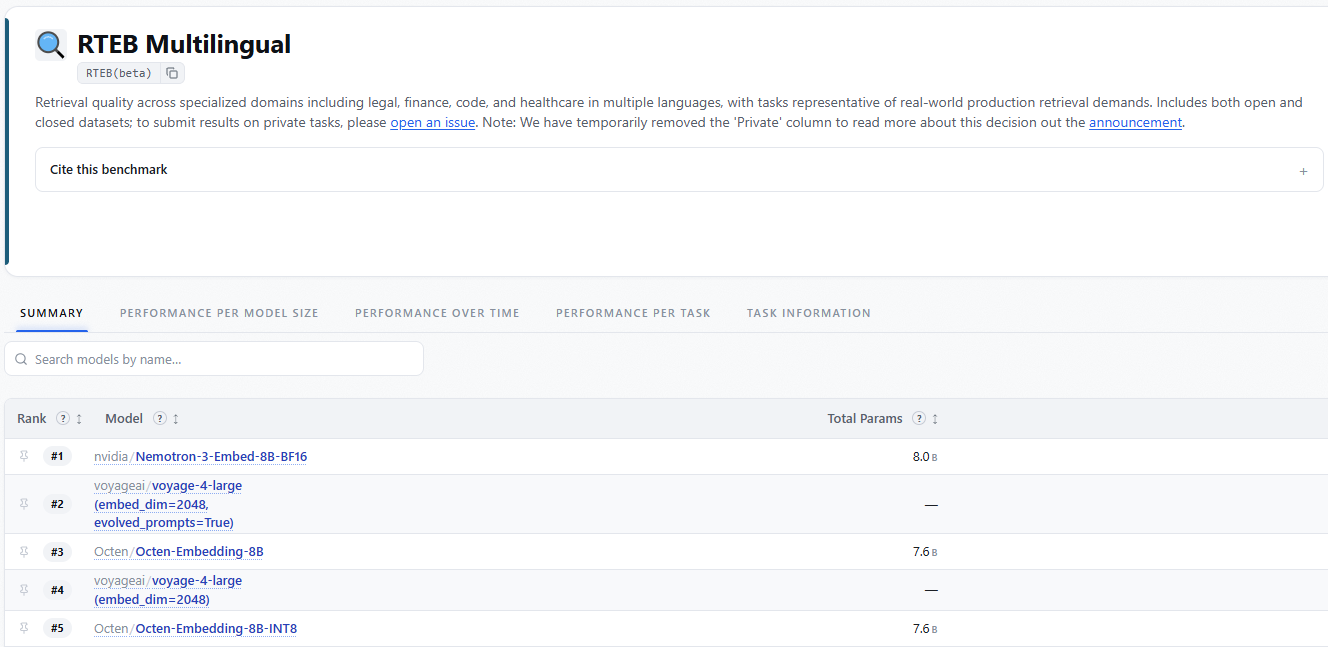
What happened
NVIDIA released Nemotron 3 Embed, a collection of three open embedding models for retrieval tasks. The flagship 8B model ranks #1 on the RTEB leaderboard, scoring 78.5% on RTEB and 75.5% on MMTEB Retrieval. Two smaller 1B variants—one standard and one optimized for NVIDIA Blackwell hardware—deliver lower-cost and higher-throughput options, with the 1B BF16 reducing error rate by 27% over its predecessor on RTEB.
Why it matters
In agentic AI workflows, poor retrieval wastes token budget by forcing agents to re-query and carry irrelevant context into reasoning steps. The new models improve retrieval accuracy while reducing estimated downstream token cost per query, helping enterprises run production-scale retrieval-augmented generation (RAG) and agent memory systems with better accuracy and lower operating cost. The models come with open weights, fine-tuning recipes, and support for 32k context windows across multilingual and code retrieval tasks.
What to watch
The 1B NVFP4 variant, optimized for Blackwell hardware, delivers up to 2× higher throughput than BF16 while retaining 99%+ of BF16 accuracy. The models are available today on Hugging Face, deployable as NVIDIA NIM microservices, and already being evaluated by enterprise partners including Automation Anywhere, Boomi, IBM, Mem0, and Palantir.
Summaries like this, in your inbox every morning.
Retrieval is foundational to agentic AI systems: when an agent cannot find relevant context quickly, it burns token budget on repeated searches and reasoning loops that carry noise forward. NVIDIA's Nemotron 3 Embed models address this by offering state-of-the-art retrieval accuracy across a range of deployment scenarios. The 8B flagship model's #1 RTEB ranking (78.5%) establishes the collection's quality ceiling, but the real production value lies in the 1B variants, which compress that quality into smaller footprints through structured pruning and knowledge distillation. The distillation strategy is noteworthy: the 1B models are not trained from scratch, but derived from a 3B Ministral backbone that undergoes two rounds of compression—first to 2B via NVIDIA's Neural Architecture Search engine, then to 1.14B via distillation from the 8B teacher. This pipeline allows the 1B BF16 to achieve 72.4% on RTEB (a 27% error reduction over its predecessor) while the NVFP4 variant adds Blackwell hardware acceleration for 2× throughput. The models carry production-ready features: 32k context windows for long documents and multi-turn agent histories, multilingual and code retrieval support, and fine-tuning recipes for domain adaptation. Early enterprise evaluations from Automation Anywhere, Boomi, IBM, Mem0, and Palantir suggest uptake momentum, with partners citing improvements in question-answering and agentic workflows.
Pick your industry and the AI tools you use, and get news related to your work every day.
Free · 30 seconds with Google · unsubscribe anytimeWhat is AIToday? →
Ask AI anything about this article. The AI reads this article, earlier AIToday articles, and Wikipedia, and cites its sources. Q&As are published on this page for other readers too.
Chunghwa Telecom president Rong-shy Lin said the shift from conversational AI to autonomous AI agents is resha…
Apple and Meta said they would jointly release a new open-weight AI model designed to run on high-end Macs, ai…
A writer and entrepreneur opened his daily to-do list and found 156 items, and concluded that an AI assistant…

A Zenn contributor sorted AI use into three modes — AI as an assistant, AI running alongside people, and AI th…

A non-engineer operator says one person ships four smartphone apps on Google Play, three on the App Store, wit…
The walkthrough points the CLI at a local mock via the ANTHROPIC_BASE_URL environment variable

