What happened
Black AI, a University of Tokyo-launched startup, said on the 25th it raised a seed round from Incubate Fund and did not disclose the amount; its Physical RSI Lab lifted a dual-arm robot's success from 1 in 21 trials to 18 in 21.
Why it matters
The result suggests self-improving control programs can cut the need for hand-coded instructions and demonstration data — the main burden of conventional robot programming — and the company plans to release its self-improvement framework and offer it as a service, which could let manufacturers apply it to their own material-handling systems.
WHO IT HITSManufacturers running material-handling and pick-and-place lines are the most directly affected. The successful 18-in-21 trials came on a dual-arm robot in simulation-trained pick-and-place and pin-insertion tasks, and Black AI is already applying Physical RSI to a manufacturing customer's material-handling algorithms.
Summaries like this, every morning.
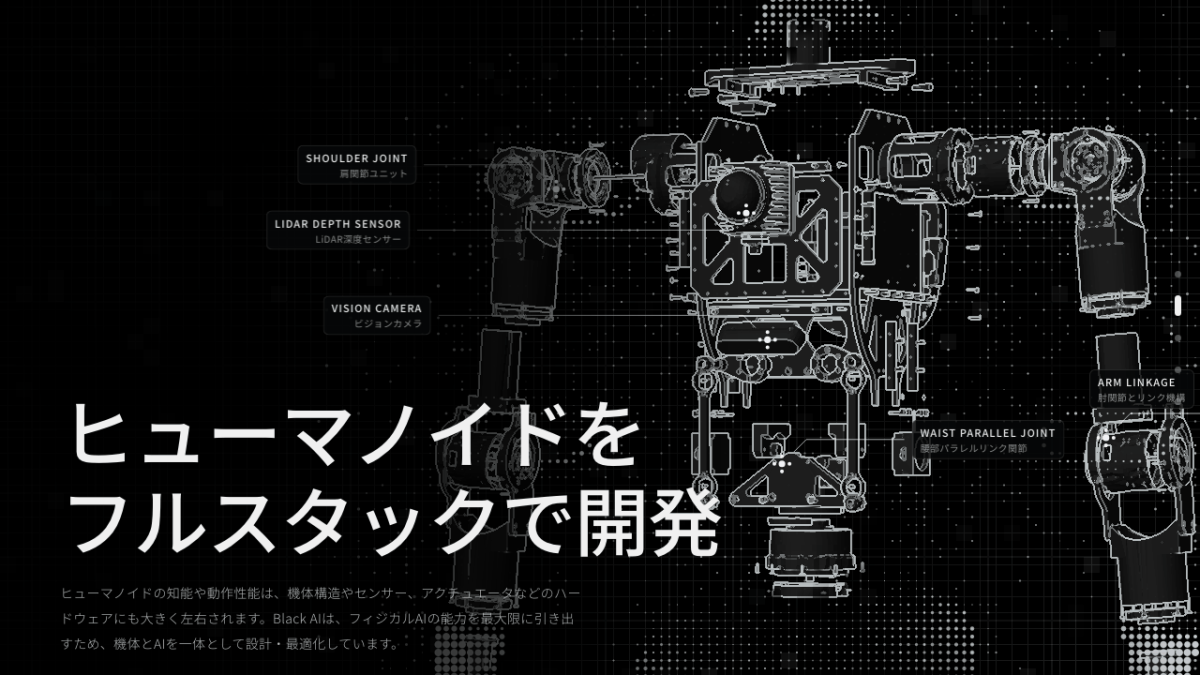
Black AI's approach is full-stack: it designs the humanoid's mechanical structure and hardware in-house alongside its AI models and motion and whole-body control. The company argues that a humanoid's intelligence and movement quality depend not just on the AI model but heavily on hardware such as sensors and actuators, so it designs the body and AI together to get more out of the AI's capabilities.
Within a short time of founding, Black AI completed a prototype of its own design. It is now training motion and control models in simulation. The company's basic research is aimed at a new AI architecture that integrates robot perception, reasoning and action, with a "Zero-shot" ability to handle unknown environments and tasks without prior learning or individual teaching — addressing conventional robots' limits in adaptation and versatility, which require complex programming and teaching for each task.
Its progress is not only simulation. Black AI has started the "Physical RSI Lab" on the 11th, where a coding agent writes control programs for a robot and learns from failures, reducing the human burden of one-on-one instruction and the work of collecting demonstration data. In the dual-arm pick-and-place and pin-insertion tests, running a simulation-trained self-improved control program on the real machine placed all parts only once in the first 21 trials; after the agent measured the real machine and corrected the simulator and other tools to match, that rose to 18 of 21. The company is now applying Physical RSI to a manufacturing customer's material-handling algorithms.
Pick your industry and the AI tools you use, and get news related to your work every day.
Free · 30 seconds with Google · unsubscribe anytimeWhat is AIToday? →
Ask AI anything about this article. The AI reads this article, earlier AIToday articles, and Wikipedia, and cites its sources. Q&As are published on this page for other readers too.
THA president Asako Nishiyama will join the first session of 未来共創CROSS on December 1, 2026, at NCB Hall in Fuk…

The Digital Agency said a public call for Japanese-made large language models for ガバメントAI 源内 in 令和9年度(2027年度)…

Meta Platforms and Alphabet look like discounted buys, with Meta trading at 20x forward earnings and Alphabet…

CME FedWatch shows a 100% chance of a rate hike on Dec
NVIDIA said on November 27 that its RTX Spark compact desktop is on sale from ASUS, Dell and MSI, with a 20-co…
Foreign investors net-sold NT$1.09 trillion (about $33.1 billion) of Taiwanese shares in November, beating Oct…