What happened
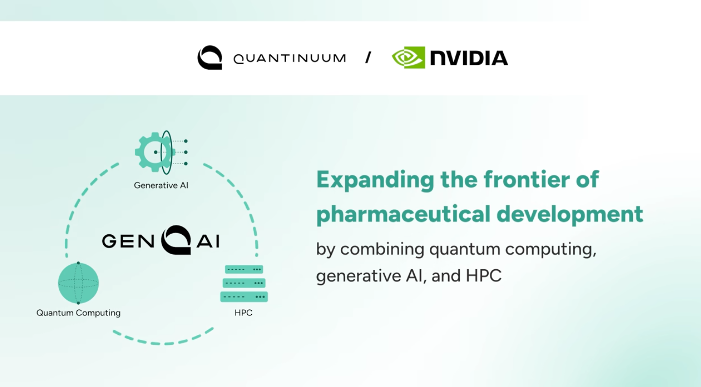
Researchers from Quantinuum, NVIDIA, and Pfizer validated a Generative Quantum AI (GenQAI) framework that combines classical supercomputing, generative transformer models, and quantum processors to automate quantum circuit synthesis for pharmaceutical research. The team trained a model called ADAPT-GQE on quantum chemistry datasets and demonstrated it by predicting ground-state quantum circuits for imipramine, a tricyclic antidepressant, then executing them on Quantinuum's 98-qubit Helios-1 trapped-ion hardware.
Why it matters
Standard quantum algorithms like ADAPT-VQE require evaluating thousands of operator gradients at each step, making calculations for systems exceeding roughly 15 qubits computationally prohibitive. The GenQAI framework bypasses this bottleneck by using fine-tuned transformer models to synthesize complete circuits in a single forward pass, achieving 3 to 4 orders of magnitude speedup while matching or exceeding the ground-state accuracy of traditional training data. For pharmaceutical companies, this could mean faster computational validation of drug candidates and shelf-life stability models.
What to watch
The collaboration has established an open-source reference framework for automating utility-scale quantum computational chemistry. The pre-print study is available on arXiv, and technical details are available on the Quantinuum Blog.
Summaries like this, in your inbox every morning.
The collaboration addresses a fundamental computational wall in near-term quantum chemistry: variational quantum eigensolvers (VQEs) like ADAPT-VQE require iterative optimization loops that scale poorly beyond roughly 15 qubits, making them impractical for many real-world molecules. By training generative transformer models on classical GPU-accelerated quantum chemistry simulations, the team has demonstrated that neural networks can learn to propose efficient quantum circuits without the expensive gradient-evaluation feedback loop. The use of Group Relative Policy Optimization to refine the model's outputs suggests the framework can also improve upon its own training data, pointing toward a self-improving automation pipeline.
The choice of imipramine as a test case is deliberate: as a standard pharmaceutical benchmark, its ground-state properties are well-characterized, allowing the researchers to validate accuracy claims. Running the circuits on Quantinuum's commercial trapped-ion hardware rather than a simulator demonstrates that the approach is not purely theoretical—it produces circuits that execute successfully on real quantum processors. By releasing this as an open-source reference framework, the collaboration signals intent to become a community standard for quantum-assisted drug design, potentially accelerating adoption across the pharmaceutical industry.
Pick your industry and the AI tools you use, and get news related to your work every day.
Free · 30 seconds with Google · unsubscribe anytimeWhat is AIToday? →
Ask AI anything about this article. The AI reads this article, earlier AIToday articles, and Wikipedia, and cites its sources. Q&As are published on this page for other readers too.
Chunghwa Telecom president Rong-shy Lin said the shift from conversational AI to autonomous AI agents is resha…

Apple and Meta said they would jointly release a new open-weight AI model designed to run on high-end Macs, ai…

A writer and entrepreneur opened his daily to-do list and found 156 items, and concluded that an AI assistant…

A Zenn contributor sorted AI use into three modes — AI as an assistant, AI running alongside people, and AI th…

A non-engineer operator says one person ships four smartphone apps on Google Play, three on the App Store, wit…
The walkthrough points the CLI at a local mock via the ANTHROPIC_BASE_URL environment variable

