What happened
Foundational Industries, a startup founded by a former Alphabet executive, raised $25 million in seed funding led by BoxGroup and Zigg Ventures to design and operate factories entirely controlled by AI software rather than retrofitting traditional assembly lines with robots. The company's first products are data-center hardware for custom rack enclosures needed by AI chipmakers and cloud providers.
Why it matters
Founder David Winer argues that the U.S. cannot compete with China's manufacturing dominance by copying its model—China has invested over $1 trillion in advanced manufacturing over the past decade and maintains a dense industrial ecosystem. Instead, Foundational is betting that AI-native factories, built from software scratch with far more AI compute available in the U.S., can generate bills of materials and manufacturing processes in near-instant time compared to months of manual design work, offering a structural advantage against China's older-style automation that requires constant utilization to justify subsidies.
What to watch
The seed funding is explicitly not yet meant to build a full factory; Winer said the money will fund a "minimum viable product," with the entire factory already modeled in software using emulators. Customer names remain undisclosed, though the company serves data-center developers, neoclouds, and chipmakers seeking custom enclosures for new AI silicon with different voltage and cooling requirements.
Summaries like this, in your inbox every morning.
Foundational Industries represents a strategic bet that the path to American manufacturing competitiveness lies not in imitating China's approach, but in exploiting a fundamentally different advantage. Founder David Winer, who spent 25 years at Alphabet's Sidewalk Infrastructure Partners deploying over $1 billion in capital, explicitly rejects the conventional Washington wisdom that China's manufacturing edge stems from cheap labor and low-quality copying. Instead, he acknowledges that many Chinese factories are among the world's most advanced, and that China has backed this dominance with over $1 trillion in public investment over the past decade, creating a dense industrial ecosystem that enables rapid product launches.
Winer's core argument is that copying this model is neither feasible nor economically rational for the U.S.—"We just don't have the people or the skill sets to do it. And even if we did, it's probably not economically competitive to China." Rather than fight that fight, Foundational is building a different kind of factory system: one where AI takes a customer's "product intent" and generates a bill of materials and manufacturing process in near-real time, replacing months of manual design work. This approach depends on two American strengths: sophisticated AI models and far more AI compute available domestically than China can bring to bear.
Winer also identifies a structural vulnerability in China's model. Advanced Chinese factories, however automated, are still built around older-style automation that requires constant utilization to justify state subsidies—"They kind of need to feed the beast now." His thesis is that AI-native factories can be built cheaper and faster with each iteration, offering the U.S. a competitive advantage that does not require matching China's labor scale or industrial ecosystem density.
Pick your industry and the AI tools you use, and get news related to your work every day.
Free · 30 seconds with Google · unsubscribe anytimeWhat is AIToday? →
Ask AI anything about this article. The AI reads this article, earlier AIToday articles, and Wikipedia, and cites its sources. Q&As are published on this page for other readers too.
The Motley Fool argues Amazon is the AI company of the two, since AWS was just 21% of first-half 2026 revenue…

Hewlett Packard Enterprise stock is down 5% at $55.87

Cammarata reinterprets InceptionV1's cat-car neuron as a V-shape detector, not two unrelated concepts

OpenAI is launching the Rosalind Academic Plan, offering eligible research labs at US universities up to 30 fr…

Google Deepmind's Gemini 4 Argon scored 97.5 percent on ARC-AGI-3 at a cost of $4,800, second only to GPT-6 As…
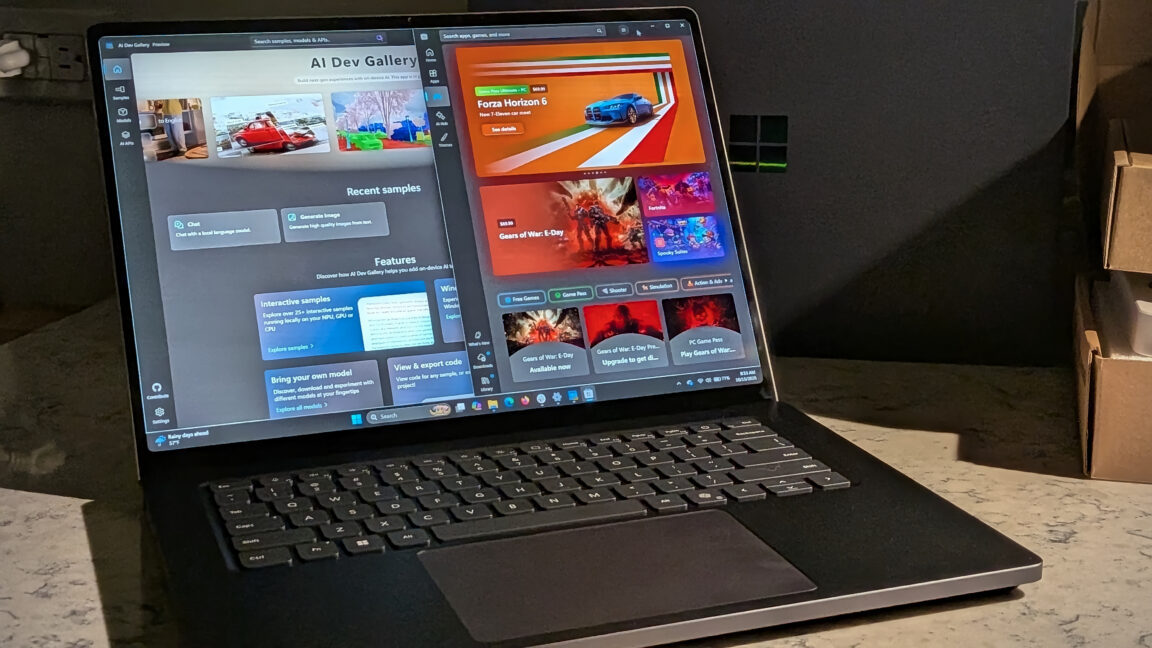
Microsoft's Surface Laptop Ultra, using Nvidia's RTX Spark platform, starts at $2,599 (up to $5,899)