What happened
AI agents can now plan and execute tasks from a goal, with GMO Internet Group reporting 71.4% business usage and saving 53.9 hours per employee monthly. Gartner predicts 40% of enterprise apps will have task-specific AI agents by 2026.
Why it matters
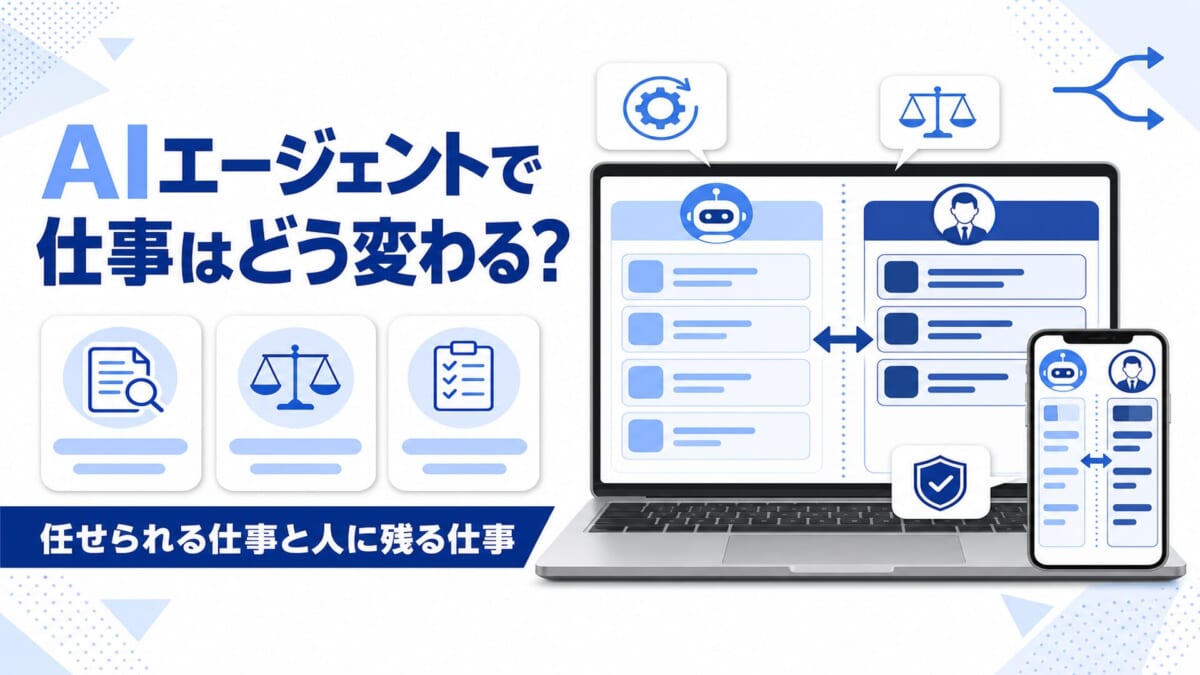
The article outlines 8 delegable tasks (research, meeting minutes, email triage, drafts, data aggregation, scheduling, data entry, code review) and 5 that stay with humans (final judgment, negotiation, novel problem setup, trust-based interactions, on-site checks). It provides 4 criteria to decide what to delegate: codifiable steps, reversibility, verifiability, and internal impact.
What to watch
The article also notes Gartner's prediction that over 40% of agentic AI projects will be canceled by end of 2027, citing cost increases and unclear benefits. It advises keeping human approval steps and limiting permissions.
Summaries like this, in your inbox every morning.
The article addresses a common worry: that AI will replace jobs. It argues instead that work is decomposed into tasks, and agents take over a portion, not the entire occupation. This is supported by Anthropic's data showing that as of November 2025, 52% of Claude.ai conversations assisted human work, while 45% delegated tasks entirely—less than half. The World Economic Forum projects a net gain of 78 million jobs by 2030, with 170 million created and 92 million lost, while 39% of skills change or become obsolete.
For non-technical managers, the practical takeaway is the 4-axis test: can the procedure be written down, can errors be reversed, can the output be verified, and is the impact internal? Tasks passing all four are safe to delegate first. The article also warns about risks: Gartner predicts over 40% of agentic AI projects will be canceled by end of 2027 due to cost and unclear benefits. It recommends limiting permissions and keeping human approval steps.
Ultimately, the article suggests that as delegation increases, the value shifts from doing tasks quickly to designing delegation and verifying outputs. It advises starting with one task that meets all criteria and expanding from there, while recording what you do with the saved time to show contributions in evaluations.
Pick your industry and the AI tools you use, and get news related to your work every day.
Free · 30 seconds with Google · unsubscribe anytimeWhat is AIToday? →
Ask AI anything about this article. The AI reads this article, earlier AIToday articles, and Wikipedia, and cites its sources. Q&As are published on this page for other readers too.
Vinci4D provides chip-design simulation software that trains on physics equations instead of customer data, an…

SEMI President and CEO Ajit Manocha told DIGITIMES that the semiconductor industry reached the US$1 trillion r…

Nvidia's AI Enterprise lists at $4,500 per GPU annually, and paid subscriptions add supported software, securi…

CoreWeave fell more than 25% this week, its debt yield briefly rose above 16% on Thursday, and SK Hynix droppe…

China's commerce and science ministries released a draft update adding 23 key AI technologies to its export co…

Anthropic told investors this week that it is making 85% gross margins, a figure the columnist calls a cash co…