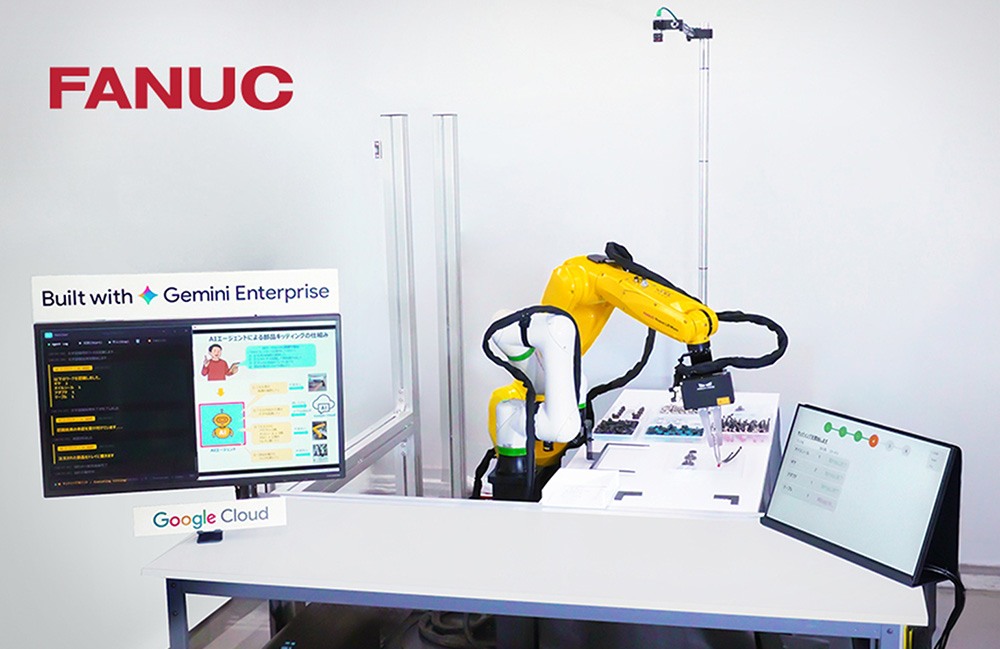
FANUC announced a strategic collaboration with Google to advance physical AI—the integration of cognitive intelligence with physical action—across its robot product lineup using Google's AI technologies.
FANUC robots support the Robot Operating System (ROS) industry-standard platform and offer compatibility with Python programming, high-speed communication interfaces, and PLC operation interfaces, enabling manufacturers to deploy physical AI for production. The lineup ranges from small robots with a 3 kg payload to large robots with a 2.3-ton payload, plus the CRX collaborative series.
Since FANUC released its physical AI system at the International Robot Exhibition in Tokyo last December, the company said it has shipped more than 1,000 robots for physical AI-related applications as customer demand has grown.
Ask the AI about this article →
For example, today's edition would include:
AI-summarized, only the topics you pick — one digest a day via Email, Slack, or Discord.
Free · takes 30 seconds · unsubscribe anytimeWhat is AIToday? →
Ask AI anything about this article. Q&As are published on this page for other readers too.
World Labs, the AI startup co-founded by Fei-Fei Li, released Atlas, a multimodal world model that creates det…

TCL CSOT is investing in indium phosphide (InP) laser chips, a key component for AI data-center optical interc…

Anthropic reset the 5-hour and 1-week usage limit windows for its AI service Claude on September 1, in connect…

Google announced Google Pics on September 1, an AI-powered image generation and editing tool for Google Worksp…

Geek+ reported interim results for the six months ended 30 June 2026

Japan's AI strategy, backed by a $640 billion government pledge, is facing a reality check in Kitakami, a city…