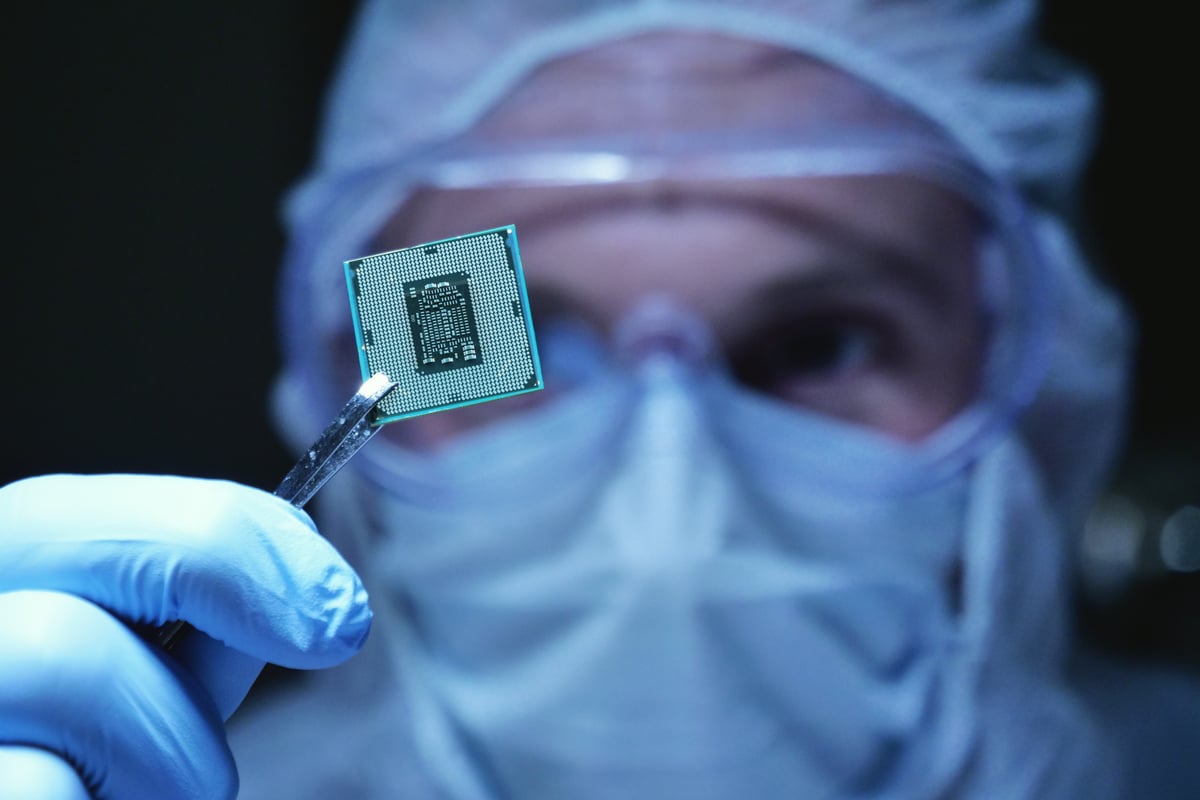
An analyst predicts that TSMC and Broadcom will each reach a $4 trillion market capitalization by 2028 or 2029, roughly doubling their current valuations.
Both companies are positioned as essential suppliers to the AI industry—TSMC manufactures chips for virtually every AI computing firm, while Broadcom designs custom AI chips for major hyperscalers.
Strong chip demand projected through 2029–2030 and Broadcom's AI semiconductor business forecast to generate more than $100 billion in 2027 support the growth case.
What happened
An analyst projects that Taiwan Semiconductor Manufacturing Company (TSMC) and Broadcom will each reach a $4 trillion market cap by 2028, roughly doubling from their current valuations of $2.2 trillion and $2 trillion respectively, driven by sustained AI chip demand.
Why it matters
Both companies are core suppliers to the AI industry—TSMC manufactures logic chips for nearly every AI computing company, while Broadcom designs custom AI chips for hyperscalers like Alphabet. TSMC's CEO noted strong chip demand through at least 2029 to 2030, and Broadcom's AI semiconductor business is projected to generate more than $100 billion in 2027, signaling years of sustained growth ahead.
What to watch
TSMC is valued at $733 per share at a 30× P/E ratio applied to Wall Street's projected 2028 earnings of $24.46 EPS, implying 71% upside; Broadcom at $638 per share (52% upside) based on projected 2028 earnings of $21.28 EPS. TSMC is already trading at a 30× P/E, while the analyst believes Wall Street is underestimating Broadcom's custom AI adoption impact.
The analyst's thesis centers on two hardware suppliers positioned to double in market value by 2028 or 2029, propelled by structural demand for AI chips. TSMC, currently valued at $2.2 trillion, manufactures the logic chips that power nearly every AI computing company in the industry, including Broadcom. During TSMC's latest earnings call, CEO C.C. Wei stated that chip demand looks strong through at least 2029 to 2030, providing multiple years of growth visibility. Management underscored its confidence by announcing another $100 billion investment in Arizona facilities, signaling that production capacity expansion remains necessary to meet demand.
Broadcom, presently a $2 trillion company, operates from a different playbook. Rather than producing general-purpose graphics processing units (GPUs), it partners with AI hyperscalers—including Alphabet—to design and manufacture custom AI chips tailored to specific workloads. These purpose-built chips can outperform GPUs in certain applications while lowering the cost per unit of compute, making them attractive to capital-intensive hyperscalers. CEO Hock Tan told investors that Broadcom's AI semiconductor business will generate more than $100 billion during 2027, representing a major increase from current levels.
To reach $4 trillion, both companies require significant valuation expansion. The analyst applies a 30× price-to-earnings multiple to 2028 earnings projections, reasoning that their above-average growth, strong execution, and market position justify such a multiple. Wall Street analysts project TSMC will earn $24.46 in earnings per share (EPS) for 2028; at a 30× multiple, that prices the stock at $733 per share, representing 71% upside from current levels and yielding a market cap of $3.74 trillion—just short of the $4 trillion target. The analyst notes, however, that TSMC has consistently outpaced Wall Street's growth projections and expects the company to surpass the threshold with modest outperformance.
Broadcom presents a similarly tight calculation. Wall Street expects $21.28 in 2028 earnings, which at a 30× P/E yields a stock price of $638, implying 52% upside. However, the analyst argues that Wall Street is substantially underestimating the impact of custom AI chip adoption across multiple hyperscalers, which could drive several years of strong earnings growth. The analyst also highlights that only two long-term 2028 estimates exist for Broadcom, suggesting bearish analysts may be skewing sentiment. By 2029, the analyst expects both companies will have decisively crossed the $4 trillion threshold.
The $4 trillion market cap club remains highly exclusive, with only four current members including Alphabet. The analyst's case rests on two hardware suppliers whose fortunes are tightly bound to continued AI industry expansion. TSMC's dominant position—its logic chip fabrication processes are used by nearly every AI computing company, including Broadcom itself—creates a structural moat; management's announcement of an additional $100 billion investment in Arizona facilities signals confidence that production constraints will remain the limiting factor, not demand. Broadcom's strategy diverges: rather than competing broadly, it partners with hyperscalers like Alphabet to build custom AI chips that offer better performance and capital efficiency than general-purpose GPUs. This specialization, if adopted widely, could unlock the multi-billion-dollar revenue growth needed to justify a doubling of market cap.
The analyst's valuation assumes a 30× price-to-earnings multiple applied to 2028 earnings estimates. For TSMC, this yields $733 per share (71% upside), pricing the company at $3.74 trillion—just shy of the $4 trillion threshold. For Broadcom, it yields $638 per share (52% upside). The analyst acknowledges that TSMC has historically outpaced Wall Street projections, and notes that Broadcom's analyst coverage is thin (only two long-term 2028 estimates), potentially biasing sentiment downward. By 2029, the analyst expects both companies will have crossed the $4 trillion mark.
AI-summarized, only the topics you pick — one digest a day via Email, Slack, or Discord.
Free · takes 30 seconds · unsubscribe anytime
Ask AI anything about this article. Q&As are published on this page for other readers too.
Hygon Information posted a 66.5% increase in first-half 2026 revenue, driven by accelerating AI deployment and…
Vanguard's July Market Perspectives report argues that as AI productivity gains spread beyond the tech sector…

Airbnb, Booking Holdings, and Expedia have climbed nearly 40% at the median since May 19, while hotel chains C…
GSI Technology's Vice President of Sales Didier Lasserre said Gemini-II hardware is now in production and that…
AppLovin Corporation (NASDAQ:APP) reported second-quarter revenue of $1.92 billion, missing analyst estimates…

Suzhou Novosense Microelectronics, a Chinese analog chipmaker, expects to return to profitability in the first…
The AI news that matters, in one minute each morning.
Sign up free