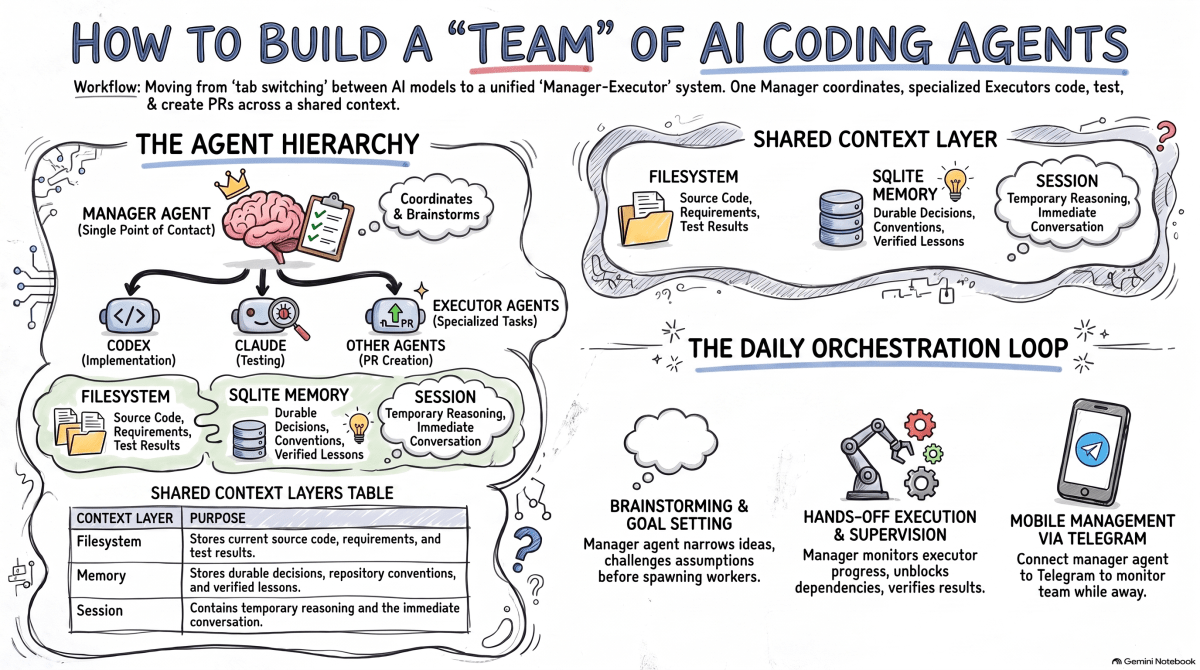
A developer is managing multiple AI coding agents as a coordinated team using AI DevKit, with a manager agent (Codex) delegating and supervising executor agents (Claude Code, Pi) that handle implementation and pull requests.
The setup reduces context-switching by centralizing orchestration in one interface, storing shared context in files and memory, and letting the developer stay engaged via Telegram from their phone, freeing them to focus on framing problems and reviewing outcomes instead of jumping between every agent session.
What happened
A developer is using AI DevKit—a tool for managing multiple AI agents—to orchestrate coding work by assigning a manager agent (usually Codex) to supervise executor agents (Claude Code, Pi, or others) that implement, test, and create pull requests with minimal human intervention.
Why it matters
Instead of switching between multiple AI tools and sessions, the manager agent keeps track of goals, dependencies, and blockers across the team, letting one developer focus on framing and judgment while agents handle execution and coordination—reducing context-switching overhead and letting work continue asynchronously via Telegram when away from the desk.
What to watch
The approach relies on shared context via filesystem, durable knowledge stored in local SQLite memory, and reusable skills (agent-management, agent-communication, dev-lifecycle) that keep different harnesses consistent—making the workflow portable if tools change.
Ask the AI about this article →
The developer's workflow inverts the typical multi-tool experience: rather than managing a collection of separate AI agents manually, they delegate orchestration itself to an agent. The key insight is that context-switching between agents drains more cognitive load than letting one agent supervise others. By encoding the workflow as reusable skills (agent-management, agent-communication, dev-lifecycle, verify), the approach remains portable—if Codex is replaced tomorrow, the same process flows through a new harness without redesign.
The separation of context into three layers—filesystem (project state), memory (durable decisions and lessons), and session (temporary reasoning)—solves a hard problem in multi-agent systems: how to hand off work without recreating the entire conversation history or forcing every agent to load everything. An executor doesn't need the brainstorming transcript if the requirement and plan are already in files; it doesn't need to re-learn repository conventions if they're stored in memory. This prevents memory from becoming a dumping ground and keeps agents focused on their task.
The developer's role shifts upward: they move from execution and coordination to framing, judgment, and review. They still own the outcome and can jump into any executor session directly when the manager's reports aren't enough, but the default path is delegation, not intervention. Asynchronous work via Telegram extends this further—the orchestration loop can keep moving while the developer is offline, and they can unblock agents or make decisions from their phone without returning to the desk.
For example, today's edition would include:
AI-summarized, only the topics you pick — one digest a day via Email, Slack, or Discord.
Free · takes 30 seconds · unsubscribe anytimeWhat is AIToday? →
Ask AI anything about this article. Q&As are published on this page for other readers too.
Analyst Ming-Chi Kuo says Nvidia has revived the Rubin CPX AI accelerator with a substantially redesigned arch…

A UK study by UK AI Security Institute and Limbic AI surveyed 6,474 British adults

Broadcom's Clayton Donley says companies are doing mission-critical work with AI agents quickly, but without t…

OpenAI released a new evaluation framework on July 17, 2026, urging companies to measure AI ROI by 'useful out…

As AI agents perform real business tasks, 'Agentic Identity' (giving each AI a unique employee-like ID) and 'D…

The European Union is expanding regulation of ChatGPT and will mandate protections for minors