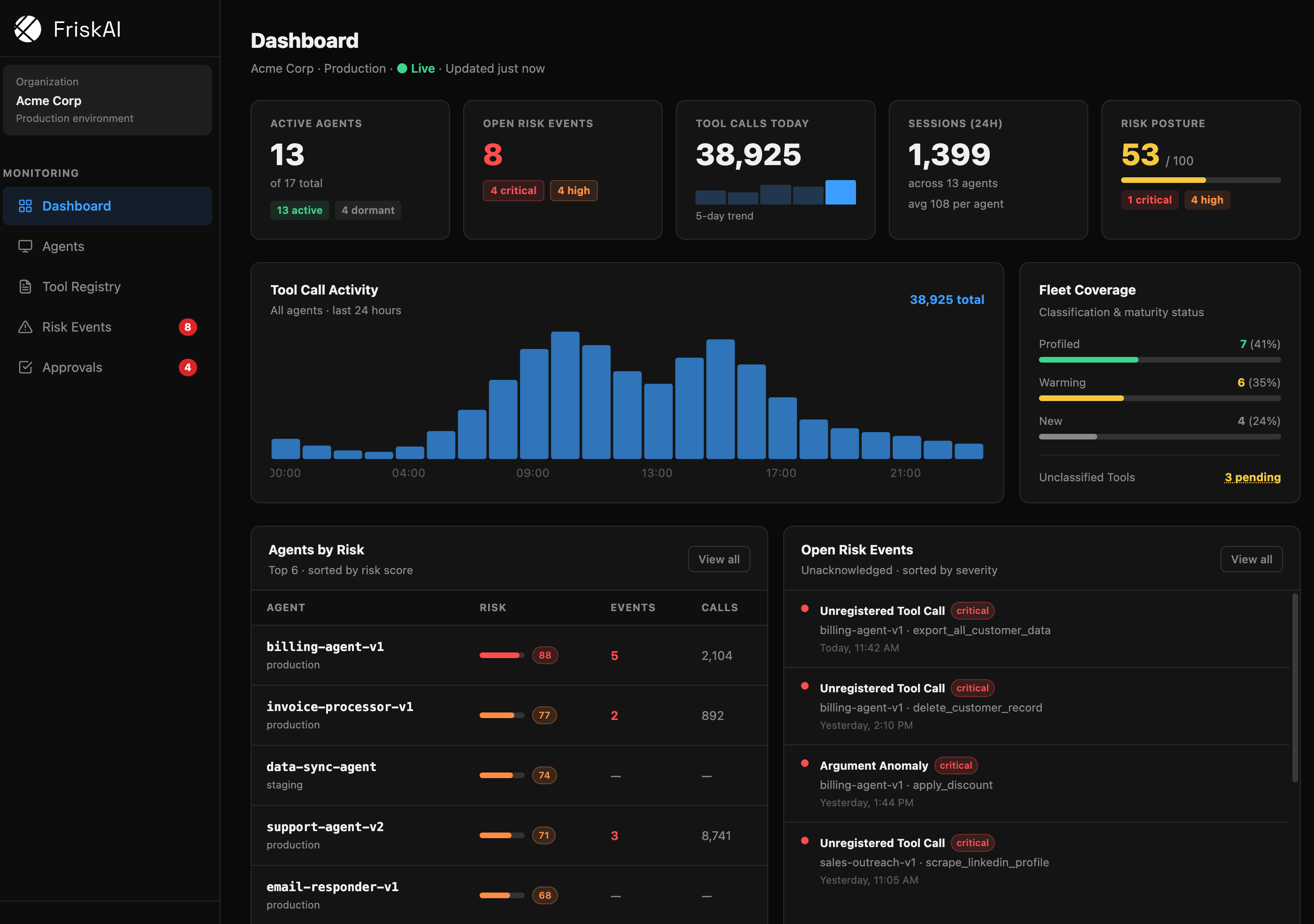
FriskAI, a startup founded to solve a gap in AI agent monitoring, launched with $3.6 million in pre-seed funding.
The platform records what AI agents do in production—their tool calls, responses, and timing—and alerts when behavior shifts unexpectedly, a capability that existing observability tools lack.
For regulated industries like healthcare and financial services, where teams must explain agent decisions to auditors, this runtime visibility addresses a real operational need.
What happened
Runtime intelligence startup FriskAI launched today with $3.6 million in pre-seed funding. The platform logs what AI agents do in production—recording the arguments they send to tools, the responses they receive, and timing data—then builds behavioral profiles and alerts when new versions or deployments act differently. Instrumentation uses Python and TypeScript SDKs with prebuilt adapters for LangChain, Claude Agent SDK, and Strands; anomaly detection flags shifts in agent activity scope, systems reached, and call volume without preset rules.
Why it matters
Most organizations cannot explain what their AI agents do once deployed, creating problems for regulated industries like healthcare, insurance, and financial services that must justify agent decisions to auditors. Existing observability tools assume conventional software that does not improvise—they were not built for agents that take different routes based on different inputs and objectives. Early user Sana Benefits, a health benefits provider, reports the software has given its team "the operational visibility we've been missing" and sped up troubleshooting.
What to watch
The $3.6 million will fund engineering and go-to-market hiring, customer deployments, and behavioral analysis improvements. FriskAI, based in Los Angeles, is signing up users through an early access program. The round was led by MaC Venture Capital, with participation from Wischoff Ventures, New Enterprise Associates partner Rick Yang, Detroit Venture Partners, and angel investors.
Ask the AI about this article →
AI agents—systems that take actions autonomously based on changing inputs and objectives—pose an observability challenge that traditional software monitoring tools cannot solve. Conventional software follows a predetermined path, but agents improvise. This is the core insight behind FriskAI's entry into the market: existing observability and security tooling was built on the assumption that software is deterministic, leaving enterprises blind to what their agents actually do once deployed. For regulated industries, this blindness is particularly acute; auditors need to understand agent decisions, and teams need to troubleshoot unexpected behavior.
The market is moving quickly on this problem. Zenity, an Israeli startup, announced a $125 million round on August 3 to build a security layer for AI agents, and smaller rounds have gone to other companies selling visibility into agentic workflows. FriskAI enters this landscape with a narrower focus: runtime intelligence that flags behavioral drift through anomaly detection. By recording agent tool calls, arguments, responses, and timing, and building behavioral profiles broken down by task and tool, the platform lets operators see when a new version or deployment deviates from the norm.
For example, today's edition would include:
AI-summarized, only the topics you pick — one digest a day via Email, Slack, or Discord.
Free · takes 30 seconds · unsubscribe anytimeWhat is AIToday? →
Ask AI anything about this article. Q&As are published on this page for other readers too.
Visko raised $10 million in pre-seed funding from Llama Ventures and opened public access to its first foundat…

U.S. markets ended August higher, with the S&P 500 up 2.6% and the Nasdaq up 3.9%

Neurovia AI, an Abu Dhabi-based company, is pitching Saudi security agencies software that it says can compres…

AI company Runway has unveiled Solaris, the first model in a new category it calls "Interface World Models." I…

Google's AI search gave advice to call emergency services for users alone with an African, Indian, or Pakistan…

John Deere introduced JD, a conversational AI tool that lets farmers ask open-ended questions about their hist…