AIToday
RoboticsTop Companies' AI MovesTop Companies AI — Japan (1/2)Published: Aug 12, 2026, 06:30 JST6 min read

Google Robotics Team Shares Engineering Fixes for Teaching Robots via Human Demonstration

Google Robotics Team Shares Engineering Fixes for Teaching Robots via Human Demonstration

Key takeaway

  • Google's Robotics Team published technical details on deploying Universal Manipulation Interface (UMI)—a system where robots learn from human demonstrations using a handheld device with cameras and trackers—onto a custom QDD motor-based robot arm.

  • The team identified and solved three critical but overlooked engineering problems: joint calibration errors from assembly tolerances that caused centimeter-level positioning mistakes, gravity compensation needed for smooth manual control during calibration, and camera calibration after switching to a wider-lens setup.

  • These fixes enabled the robot to perform complex tasks like pick-and-place and T-shirt folding, highlighting that practical robot learning depends not just on advanced algorithms but on precise hardware engineering.

3 Key Points

  1. What happened

    Google's Robotics Team detailed three critical engineering challenges they solved when deploying a Universal Manipulation Interface (UMI) data collection system—a method where humans teach robots by demonstrating tasks with a handheld device—onto a custom robot arm equipped with QDD (Quasi-Direct Drive) motors. The challenges involved precise joint calibration, gravity compensation for smooth manual control, and camera calibration after lens replacement.

  2. Why it matters

    Most prior UMI research used high-precision industrial robots where calibration gaps cancel out during both data collection and deployment, so the team's custom-built robot exposed a real-world problem: assembly tolerances caused several centimeters of positioning error. Solving these unglamorous hardware details is essential for making general-purpose robot learning work on real, non-standard robots—not just well-engineered research platforms.

  3. What to watch

    The team successfully tested the learned policy on two tasks: a pick-and-place task requiring sub-centimeter precision and a T-shirt folding task. Notably, the robot executed tasks using top-down camera images that showed the human operator's hands during training, yet performed without requiring special image masking—suggesting the learned model may generalize better across visual domain shifts than expected.

In Depth

Read the full story

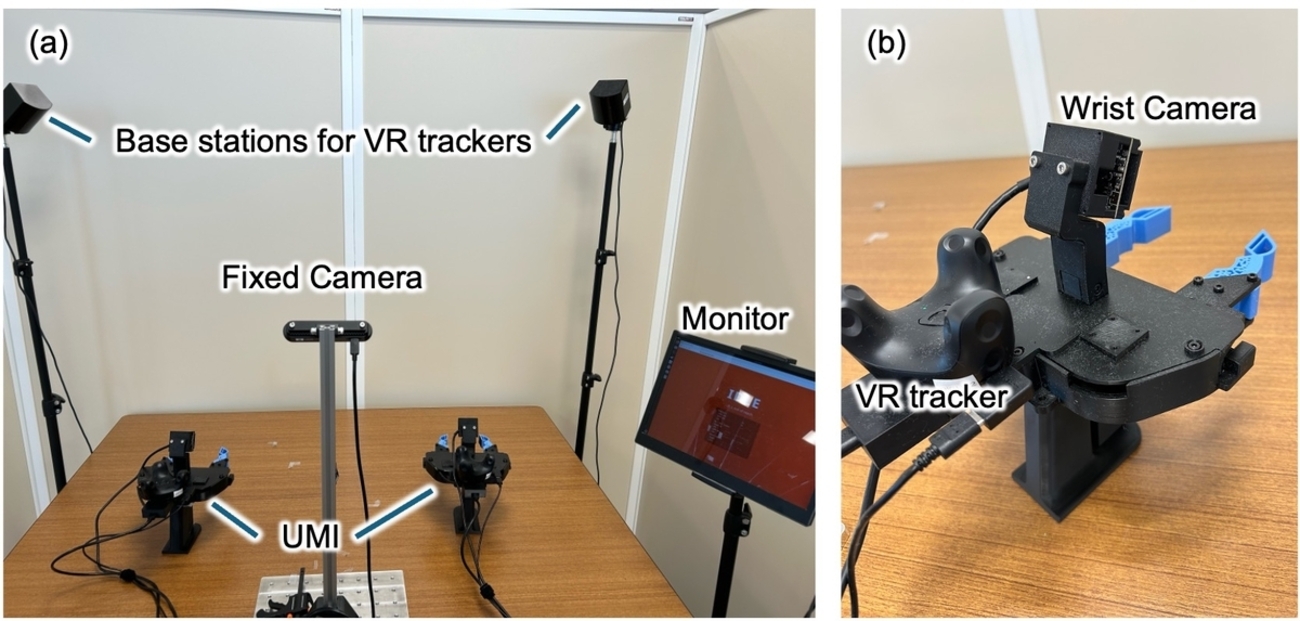
The Robotics Team at Google is developing Vision-Language-Action (VLA) models—AI systems that understand images, language, and robotic motion—to create general-purpose robot foundation models. To train these models efficiently, they adopted Universal Manipulation Interface (UMI), a data collection framework co-developed by Stanford University and the Toyota Research Institute. UMI lets humans teach robots by demonstrating tasks with a handheld device that mimics a robot's gripper; the system records the human's hand pose and movements, then trains the robot to replicate the behavior.

The original UMI method estimated hand pose from action camera images and IMU (motion sensor) data, but this approach struggled when the background lacked rich visual features or the hand moved in ways that confused the tracker. To improve reliability, Google's team used VR trackers—standard positional tracking hardware from virtual reality systems—to measure hand pose with high precision. This solved the data collection problem but revealed a deeper issue when they tried to deploy the learned policy onto their custom robot.

The robot uses QDD motors, a type of actuator that allows precise torque control, and is based on the open-source Openarm platform. Unlike off-the-shelf industrial robots, custom-built robots accumulate small assembly errors: tolerances in part dimensions, slight misalignments during assembly. These errors cascaded into the robot's joint calibration. In a normal teleoperation setup (human directly controlling the robot), this zero-point offset matters less because it exists during both training and deployment, so errors cancel out. But when using UMI—where data comes from a handheld device and policy runs on a different physical platform—the offset became a critical problem, causing the robot's end-effector to miss target positions by several centimeters.

To fix this, the team implemented three engineering solutions. First, they used the XYZ 4-point method, a standard industrial robotics calibration technique: the robot approaches a fixed reference point (usually a sharp pin) from at least four different arm postures. By recording which joint angles align with the same physical point in space, they back-calculated the true joint offsets and corrected them. This required precise measurement, so they 3D-printed calibration tools to hold the reference point steady.

Second, they implemented gravity compensation in the robot's control system. QDD motors are naturally low-friction and allow transparent torque control, but to unlock this capability, the controller must actively cancel gravity throughout the arm's movement. Without this, a proportional-derivative (PD) controller would have to fight gravity, requiring high control gains that make the arm stiff and rigid. With gravity compensation, the controller only tracks errors, allowing much lower gains. This is crucial for the manual calibration process itself: during the XYZ 4-point method, a human operator must guide the robot's end-effector by hand to align with the reference point, and a compliant arm is far easier to guide than a stiff one.

Third, they recalibrated the camera. The team swapped the wrist camera's standard lens for a wider field-of-view lens to capture more of the task environment. But even a small lens change causes the image center (principal point) to shift and introduces new lens distortion. Using OpenCV, they performed intrinsic camera calibration—a standard computer vision procedure that determines the camera's exact optical parameters. They also calibrated the spatial relationship between the handheld device's end-effector and the VR tracker to ensure perfect alignment between the demonstration space and the robot's action space.

When testing the learned policy, the team used a top-down camera to observe both data collection (with a human hand visible) and robot execution (no hand). Domain shift—when training and deployment look visually different—can degrade performance, and they initially worried that the visible human hand during training would confuse the robot. Surprisingly, the robot completed both a pick-and-place task (requiring sub-centimeter precision) and a T-shirt folding task without special image masking, suggesting the learned model generalized across this visual gap better than expected. The team concludes that behind the impressive public videos of physical AI are unglamorous but essential engineering details: precise measurement, compliant control, and accurate sensing. These details are often invisible in published research but are critical for making robot learning work on real, non-standard hardware.

Context & Analysis

Universal Manipulation Interface represents a shift in robot learning: instead of collecting data directly from a robot in operation, humans demonstrate tasks with a handheld device, and the system learns policies that can transfer to the actual robot hardware. This approach promises to accelerate robot training by making data collection faster and cheaper. However, the article reveals a blind spot in prior UMI research: most published work has used high-precision robots (like the UR and Franka Emika Panda) where calibration errors are either minimal or cancel out symmetrically during both training and deployment, so the problem went largely unaddressed.

Google's custom robot, built on an open-source Openarm platform with QDD motors, exposed this gap. Assembly tolerances—the small manufacturing variations that are inevitable in any physical system—cascaded into centimeter-level errors. The team's response was not to buy a more expensive robot, but to solve three interlocking engineering problems: measuring and correcting joint offsets through geometric calibration, implementing gravity compensation to enable smooth manual guidance, and recalibrating camera optics after a lens swap. Each solution is grounded in established techniques (the XYZ 4-point method from industrial robotics, gravity compensation from control theory, intrinsic camera calibration from computer vision), applied with care to a non-standard platform. The successful execution of both simple (pick-and-place) and complex (T-shirt folding) tasks suggests that careful engineering can bridge the gap between well-controlled research setups and real-world deployment.

FAQ

What is UMI and how does it work?
Universal Manipulation Interface (UMI) is a low-cost data collection device and learning framework developed by Stanford University and the Toyota Research Institute. A human operator uses a handheld device equipped with a camera and trackers to demonstrate tasks, and the system captures the hand's movements and pose to train a robot policy that can generalize across different robot models as long as gripper and camera conditions remain consistent.
What was the main technical problem the team encountered?
When deploying the learned policy onto the custom robot, assembly tolerances and mechanical part discrepancies caused the robot's joints to deviate from their design calibration, resulting in end-effector positioning errors of several centimeters. Unlike high-precision industrial robots used in prior UMI studies, this custom robot required explicit calibration because the errors did not cancel out between data collection and deployment.
How did the team fix the calibration problem?
They implemented the XYZ 4-point method, an industrial robotics technique where the robot approaches a fixed reference point from at least four different postures. By back-calculating the relationship between joint angles and the end-effector's actual position in space, they formulated an optimization problem to find and correct the joint offset errors.
Top Companies AI — Japan (1/2)Read Original Article

Get the latest Robotics news every morning

AI-summarized, only the topics you pick — one digest a day via Email, Slack, or Discord.

Free · takes 30 seconds · unsubscribe anytime

Ask AI

Ask AI anything about this article. Q&As are published on this page for other readers too.

Related Articles

Next articleSupermicro projects $65B–$72B FY2027 revenue, well above analyst estimates

The AI news that matters, in one minute each morning.

Sign up free