As AI models have become capable enough for production use, the limiting factor has shifted from intelligence to compute utilization.
Companies now spend billions on GPU clusters that must run continuously, but demand fluctuates—leaving expensive hardware idle outside peak hours and misallocated when different workload types (real-time inference, batch processing, training) compete for the same hardware.
Managing this utilization efficiently, rather than simply owning more GPUs, is becoming the decisive factor in AI economics.
What happened
An analysis compares GPU management to airline fleet utilization, arguing that as AI compute becomes abundant, the bottleneck has shifted from model capability to how efficiently hardware is kept busy. Companies now face a problem previously unseen: how to keep expensive GPUs productive every hour, since costs accrue by the calendar day regardless of output.
Why it matters
Enterprises acquiring their own GPU infrastructure—trading variable API costs for fixed capital—must now solve a new operational challenge. A cluster can report high occupancy while still wasting capacity if the wrong workload type runs on the wrong hardware. Unlike aircraft that can fly any route, GPUs can only absorb workloads matching their memory, latency, and duration profile, making the orchestration problem fundamentally harder than simple fleet scheduling.
What to watch
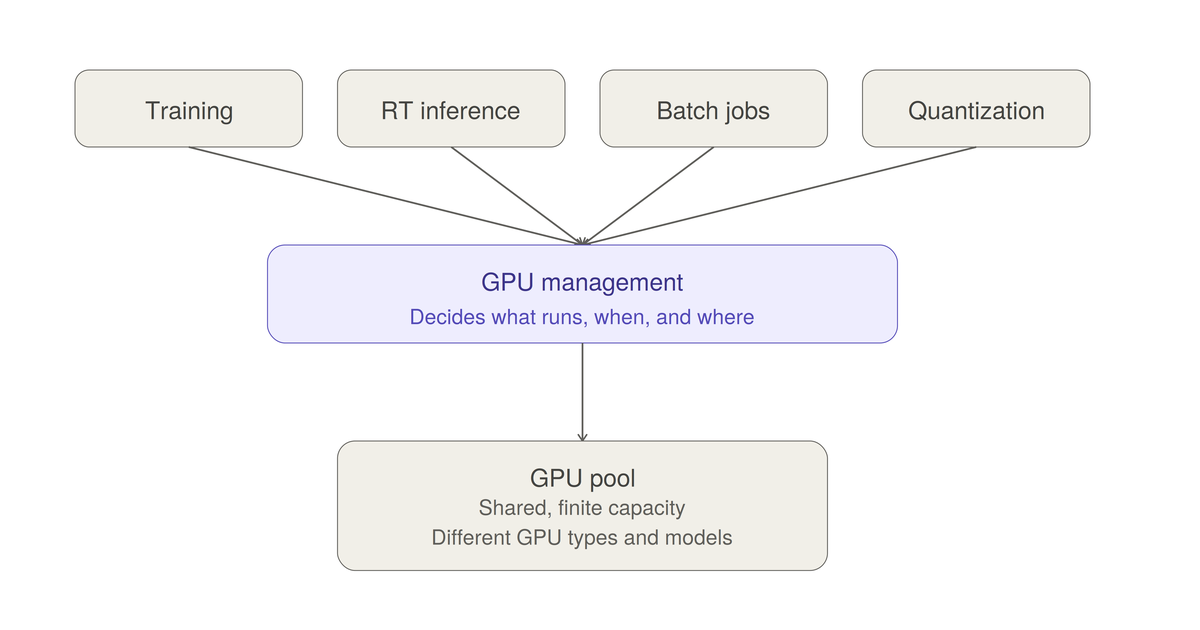
GPU Management is emerging as a distinct discipline—an orchestration layer that continuously decides which workload runs on which GPU, at what priority, and when. The field is still forming with no single mature playbook yet, but the underlying constraint is now clear: maximizing return per installed GPU, not just keeping it occupied, has become the measure that separates winners from losers.
The article opens with a structural analogy: airlines learned that aircraft utilization—the percentage of calendar hours spent in flight versus on the ground—is the single number that predicts survival, because costs accrue by the calendar hour (financing, depreciation, maintenance, crew contracts) while revenue accrues only during flight. An aircraft on the ground still costs money but generates no revenue. The same logic now applies to GPUs in enterprise AI. A GPU accrues cost by the calendar hour through financing, depreciation, power, and cooling, whether or not it is doing useful work, but generates output only during compute time. Two companies with comparable GPU budgets increasingly diverge based on utilization—how much of the hardware is doing something useful at any moment—rather than on total hardware owned.
The article traces how the constraint in AI shifted from model capability to compute. In the first wave of enterprise AI, the game was won on model quality: bigger parameters, more training compute, higher benchmark scores. But production AI runs on GPUs, which are expensive, supply-constrained, and in demand far beyond availability—even at the very top. Microsoft's 2020 supercomputer for OpenAI contained over 10,000 GPUs and 285,000 CPU cores, reported as one of the five largest systems in the world. Six years later, that reads as a starting point, not a ceiling. By 2026, Anthropic was running simultaneous multi-gigawatt commitments across four separate hardware platforms (Amazon, Google, Microsoft, and AMD) layered within months of one another, while Meta signed a comparable deal, because spreading commitments across four vendors is what compute scarcity looks like even with unlimited capital.
Downstream in enterprises, the shift manifests differently. API pricing scales linearly with tokens used, separating proof-of-concept economics from production economics almost completely. A PoC processing a few thousand requests a month looks affordable; the same workload at production scale can become prohibitive. Enterprises increasingly acquire their own GPUs, trading variable costs for fixed capital, but this purchase opens a new problem rather than closing the old one: keeping the cluster busy. The day hardware comes online, the question shifts from procurement (can we get accelerators?) to operations (can we keep them busy?).
The deeper challenge is that a busy cluster can still waste most of its potential. Clusters must be sized for peak demand—the moment when training runs, batch jobs, and real-time traffic all arrive at once—leaving spare capacity provisioned but unused outside that peak. More critically, different workloads demand different things from GPUs: real-time inference needs low latency (a slow response counts as failure), batch work cares about throughput and tolerates hours of delay, training can occupy a GPU continuously for hours or days, quantization needs large capacity but only briefly. A scheduler tuned for one workload will misallocate the others almost by default. A cluster can report high average occupancy while queued jobs wait for a GPU shape that happens to be busy running something else entirely. Unlike an idle aircraft that can redeploy to any route, an idle GPU can only absorb a workload whose memory, latency, and duration profile it can serve.
In response, GPU Management is emerging as a distinct orchestration discipline sitting between workloads, models, and hardware. Its job is to decide continuously which workload runs, when, how, and on which specific GPU. This moves decisions from one-time provisioning (made at purchase) to continuous allocation (made every time a job finishes, every new request arrives, or priorities shift). The goal shifts from keeping GPUs occupied (easy to fake with low-priority work) to maximizing return per installed GPU. The field is still forming with no single mature playbook yet, but the constraint has settled: utilization, not intelligence, is now the binding factor in enterprise AI economics.
The article traces a fundamental shift in AI economics: from a scarcity of model capability to a scarcity of compute utilization. In 2020, a 10,000-GPU supercomputer built for OpenAI looked like an unimaginable concentration of hardware. By 2026, companies like Anthropic were spreading multi-gigawatt commitments across four separate vendors—Amazon, Google, Microsoft, and AMD—within months of one another, and Meta signed a comparable deal, all because no single source could meet demand even for the best-capitalized labs. This shift has propagated downstream: enterprises facing linear API costs with usage are now acquiring their own GPU clusters, trading variable costs for fixed capital expenditure. The question has thus morphed from "Can we get accelerators?" to "Can we keep them busy?" but the operational discipline required to answer that second question—continuous, real-time allocation of workloads to hardware—sits orphaned between procurement (which has owners and deadlines) and operations (which owns the result but measures it far less rigorously). The root difficulty is that unlike an idle aircraft that can redeploy to any route with minimal penalty, an idle GPU can only absorb workloads matching its specific memory, latency, and duration profile, making the orchestration problem fundamentally harder than fleet scheduling and explaining why a cluster reporting high average occupancy can still be misallocating resources.
AI-summarized, only the topics you pick — one digest a day via Email, Slack, or Discord.
Free · takes 30 seconds · unsubscribe anytime
The AI news that matters, in one minute each morning.
Sign up free

