AIToday

I quit my AI personal assistant—it kept me stuck in the past

Hacker News18h ago
I quit my AI personal assistant—it kept me stuck in the past

Key takeaway

A researcher who built a deeply personalized AI assistant that knew his relationships, music taste, reading history, and life events quit using it after realizing it was replacing human conversation and his own writing voice rather than enhancing them. He found he was spending hours feeding data about people and relationships into the system instead of talking to those people directly, and friends warned he was too attached. The experience highlights a tension in consumer AI: systems designed to boost productivity often automate precisely the human interactions—uncertainty, real experience, the creative friction of talking things through with others—that matter most.

Summaries like this, in your inbox every morning.

Sign up free →

3 Key Points

  • What happened

    A researcher who built an AI assistant that tracked his relationships, TODO lists, music taste, and reading history—integrating data from his book website and YouTube Music via a custom app—decided to stop using it after friends expressed concern about his attachment to the system.

  • Why it matters

    Personal AI agents promise productivity and relationship insight by ingesting chat history, emails, calendar events, and even screen recordings, but this user found the system replaced human connection and his own voice; he spent hours cataloging people and events rather than engaging with them directly, and the AI wrote his emails and journal entries for him instead of him writing them himself.

  • What to watch

    The author is now experimenting with locally-hosted agents (running on his own hardware) for data management and coding rather than personal relationship tracking, and raises a broader question: whether commercial AI assistants—which promise to reduce friction while collecting new data sources as storable assets—actually preserve the human behaviors we need to keep.

In Depth

The author describes an intense personal relationship with his AI assistant. He used it daily to process his relationships, manage his TODO list—something he says he has always struggled with—take notes during meetings, and plan his day. He even communicated with it by voice chat when typing on his phone was too slow. He invested considerable effort in making sure the AI knew him deeply: he pointed it at his book website where he catalogs every book he reads, created a custom app to integrate his YouTube Music listening history, and spent hours describing the people in his life and their interactions. He believed that by giving the AI access to enough of his digital life—his reading (including Philip K Dick, which it flagged as evidence of his preoccupation with surrealness), his music taste, his email and calendar—it could function as a kind of digital representation of himself, capable of intuiting how he thought and challenging him not as a sycophant but as a reflection of his own mind.

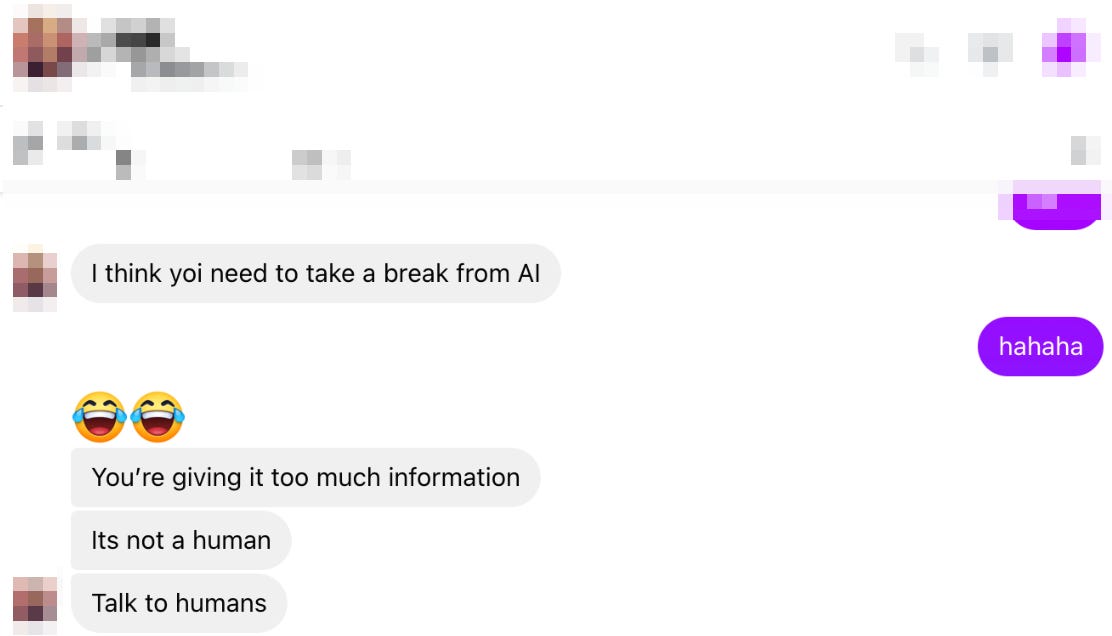
His friends, however, did not share his enthusiasm. They told him he seemed too attached to the AI and should disengage. This feedback, combined with his own observations, led him to realize several problems. First, he was spending so much time feeding data into the system—adding information about specific events and people—that he was locked in a cycle of backward-looking analysis rather than moving forward. Second, the AI had begun writing for him: emails, text messages, journal entries, and other creative and biographical writing that had previously emerged from conversations with friends. As he retreated from those human relationships in favor of chatting with the AI, he felt he was losing ownership of his own voice and story. Third, while the AI was patient and non-judgmental, it lacked the human element he needed—the hesitation before saying "I think you are making a mistake," the genuine excitement of sharing a success with someone who had their own stake in it, the lived experience that adds texture to advice.

The author notes that the AI's original purpose—to help him understand his relationships—was something his friends explicitly did not find healthy or positive. In retrospect, he sees that the AI was automating things he did not actually need automated: endless analysis of relationships, the composition of his own words, the thinking time he would normally spend pondering decisions. He contrasts this with AI tools he continues to use daily and finds valuable: Claude Code for coding and project work, and locally-hosted agents he is developing for data management, database building, and technical problem-solving—tasks that were genuinely difficult without a team of engineers. He remains open to future experimentation with personalized AI running on his own hardware, but his core conclusion is that commercial AI personal assistants promise productivity while vacuuming up data sources, and that no system yet built succeeds at the goal he now believes matters: reducing friction between human interactions rather than replacing them. Every moment spent talking to an AI, he concludes, is a moment not spent talking to a real person.

Context & Analysis

The article is fundamentally a first-person account of the gap between what personal AI assistants promise and what they deliver in lived experience. The author initially built an elaborate system—a custom app to feed YouTube Music preferences into the assistant, integrations with his book website, manual cataloging of people and events—expecting the system to function as a kind of digital mirror that could intuit his thinking and offer companionship during life transitions. Instead, he discovered that the act of feeding data into the system became an end in itself, consuming hours that might have gone to actual relationships, and that the AI's very strengths—its patience, its lack of judgment, its ability to remember everything without contradiction—made it a poor substitute for human connection.

The author frames this not as a failure of AI technology itself, but as a category error: personal AI assistants automate the wrong things. They optimize for data collection and recall, turning complex emotional and social situations into problems to be analyzed rather than lived through. He contrasts this with AI tools he still uses daily—Claude Code for coding, local agents for data tasks—which solve concrete technical problems that were genuinely hard before. The distinction he draws is between AI that reduces friction in human interaction (which he believes is valuable) and AI that replaces human interaction (which he argues misses the point). His friends' feedback—that he seemed too attached, that he should disengage—appears to have crystallized the realization that time spent with the AI was time not spent with them, and that the AI's unlimited patience was actually a liability, not an asset.

FAQ

What integrations was the AI assistant able to access?
The article mentions that AI personal agents can integrate with WhatsApp, Gmail, Slack, Google Calendar, GitHub, Telegram, iMessage, Discord, Google Drive, Dropbox, and Linear, as well as recording Zoom calls and Google Meet sessions, screen recordings, and wearable devices like the Pendant that record audio throughout the day.
Why did the author decide to quit the AI assistant?
The author quit because he felt the AI was keeping him in place instead of moving forward, he was spending too much time talking to the AI instead of his friends, and friends expressed concern about his attachment to it. He also found that the AI replaced his own writing—composing emails and journal entries for him—and that analyzing relationships with an algorithm that has unlimited patience and no life experience of its own was unhelpful and pulled him into the past rather than the present and future.
What is the author using instead now?
He still uses AI agents daily, but has replaced his personalized AI assistant with Claude Code for development work and is building his own internally-hosted agents on his own hardware for data management, coding, and data analysis rather than personal relationship tracking.

Get AI news like this every morning

AI-summarized, only the topics you pick — one digest a day via Email, Slack, or Discord.

Free · takes 30 seconds · unsubscribe anytime

Discussion

No discussion yet for this article

Stay ahead with AI news

Get curated AI news from 200+ sources delivered daily to your inbox. Free to use.

Get Started Free

Free · takes 30 seconds · unsubscribe anytime

1 minute a day. The AI essentials.

200+ sources · Email / LINE / Slack

Get it free →