What happened
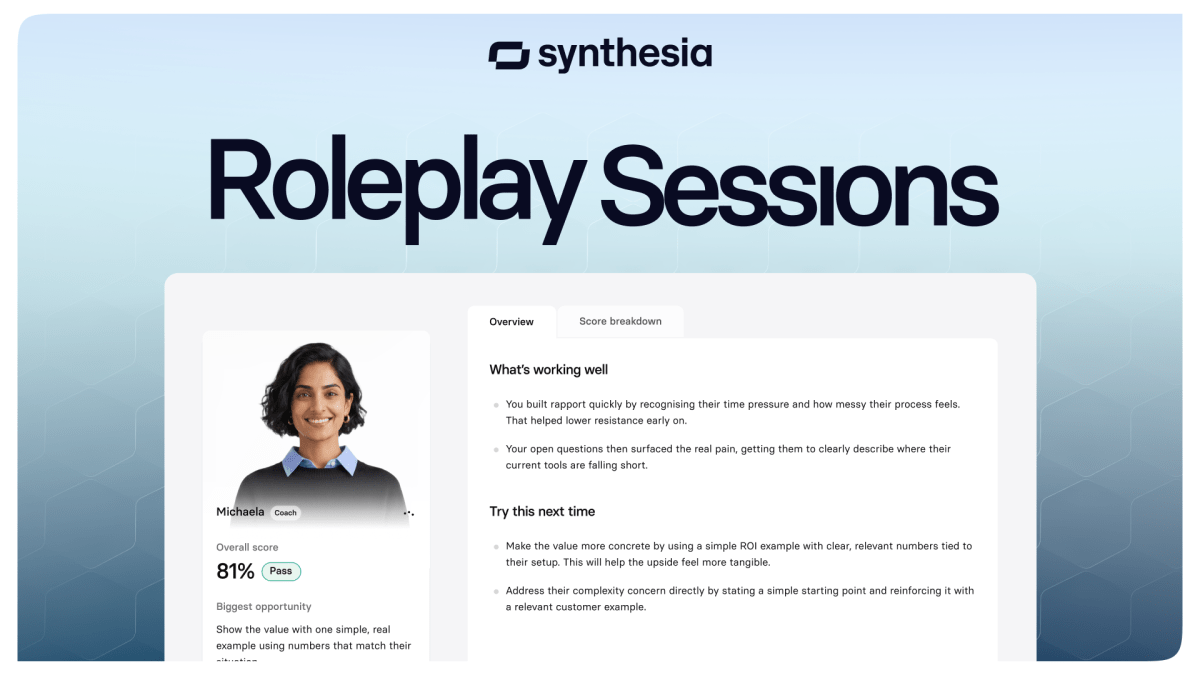
British AI startup Synthesia launched Roleplay Sessions on Wednesday, an interactive training product where employees practice high-stakes conversations—sales pitches, performance reviews, customer complaints—with an AI avatar that responds, challenges them, and scores their performance against a rubric. The company has already secured early customers including one of Europe's top three companies by market cap, one of the top five Fortune 100, and one of the world's biggest recruitment companies.
Why it matters
Synthesia is shifting from video generation to proving training actually changes behavior. Most corporate training informs and demonstrates but stops short of driving real learning; Synthesia argues the breakthrough comes from practice plus feedback. By layering rubrics, performance data, and analytics on top of its avatar technology, the company is positioning itself as a performance-management platform rather than just an AI avatar vendor—a more defensible business model. CEO Victor Riparbelli notes that when an entire sales team practices with an AI role player, managers can gather granular data on overall sales-force performance.
What to watch
Roleplay is currently an enterprise offering, but Synthesia plans to expand it to small businesses, prosumers, and potentially educational institutions in the next few months as inference costs continue to fall. The platform is also the first release under a broader "Sessions" framework the company plans to extend into job interviews and candidate screening.
Summaries like this, in your inbox every morning.
Synthesia's pivot from content generation to performance coaching reflects a maturing enterprise AI market. The startup built its reputation by allowing companies to create training videos in minutes at lower cost than traditional production. However, the company recognized a fundamental gap: video content alone rarely changes employee behavior. By citing learning research showing that practice and feedback are the drivers of actual learning, Synthesia is tackling what many enterprise customers have quietly struggled with—proving that training spend produces measurable results, not just knowledge transfer.
The move also addresses a competitive moat challenge. Synthesia's avatar and voice technology are proprietary, but the underlying AI reasoning comes from OpenAI, making the core technology less defensible in a crowded market. By wrapping its avatars in a layer of rubrics, performance data, and analytics, the company shifts identity from an AI avatar vendor to a talent-management platform. This layering is strategically important: it creates stickiness through data and insight that go beyond the avatar interaction itself. A manager gaining granular visibility into sales-team performance across hundreds of practice sessions has a harder reason to switch vendors.
The early customer set—including a top-three European company by market cap and a top-five Fortune 100 firm—validates that large enterprises see value in the approach. The concentration in sales and leadership training (soft skills) also signals where the company sees quickest ROI: these are areas where behavior change and measurable outcome (close rate, team morale, retention) are most directly linked.
For example, today's edition would include:
AI-summarized, only the topics you pick — one digest a day via Email, Slack, or Discord.
Free · 30 seconds with Google · unsubscribe anytimeWhat is AIToday? →
Ask AI anything about this article. Q&As are published on this page for other readers too.
Simply Wall St's most-followed KLA narrative sets fair value at $232.43 versus a $176.99 close, with the stock…
Nvidia founder and CEO Jensen Huang told CBS News that AI development should move 'as fast as we can irrespect…
Visa joined Mastercard and Ant International to design a shared Know Your Agent framework, aimed at standardis…

Broadcom projected roughly $58 billion in AI semiconductor revenue for fiscal 2026, about $115 billion in fisc…

Aehr Test Systems reported FY2026 revenue of $50.0 million, down 15.2% from the prior year, and a net loss of…
Citi said it expects a hawkish Fed to slow the non-AI economy