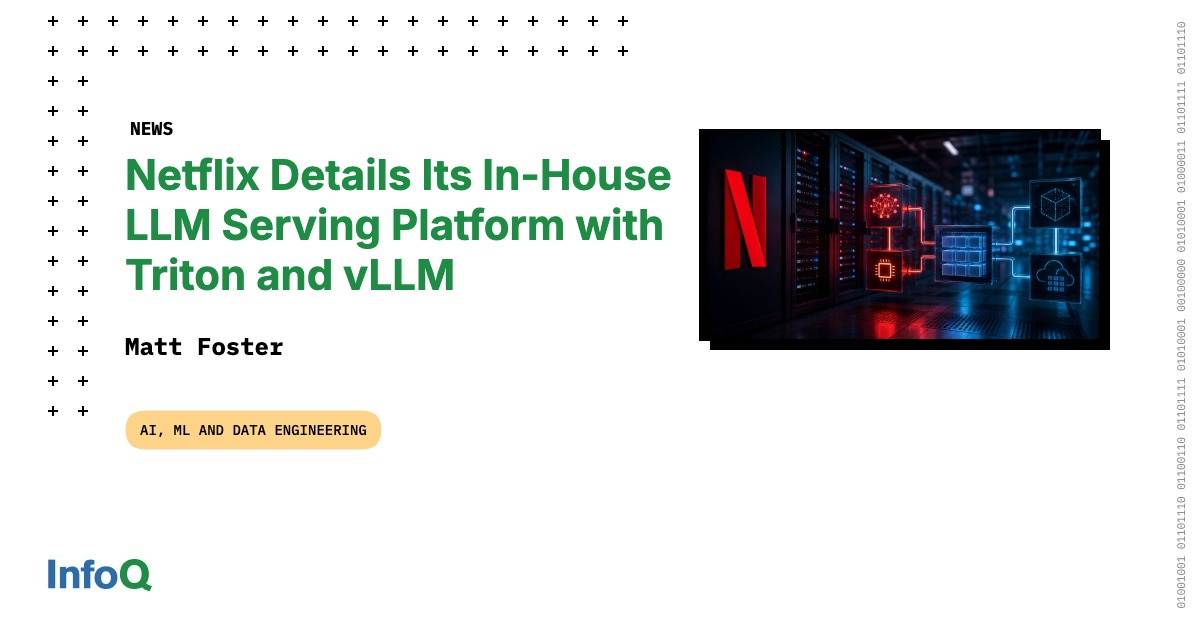
Netflix has detailed how it built a production system to run large language model inference by layering its existing serving platform with Triton and vLLM. The platform routes smaller models to CPUs and larger requests to GPUs, maintaining a unified interface while handling real-time and batch workloads. Netflix's account highlights the engineering effort required to manage version compatibility, custom model architectures, and state consistency across different inference engines—work that a standardized API alone cannot eliminate.
Summaries like this, in your inbox every morning.
Sign up free →What happened
Netflix published technical details on how it built an internal platform to serve large language model (LLM) inference—the step where an AI produces an answer—combining its existing JVM-based serving layer with Triton for model management and vLLM for inference execution. Smaller models run directly on CPUs, while larger requests route to a dedicated serving system where Triton handles scheduling and multi-framework support.
Why it matters
The platform reveals the operational complexity of running AI models at scale. Netflix encountered specific challenges—mismatched software versions preventing deployments, custom models exceeding standard compatibility, and state management during paused requests—that required engineering solutions at multiple layers. This shows that even with standardized APIs, production LLM serving demands careful integration work across different engines and hardware.
What to watch
Netflix opted for vLLM's backend over Triton's Python backend because it allows models and interfaces to evolve more independently. The company also pins tested versions of Triton and vLLM together to prevent failures, and uses Versioned deployment strategies to let teams migrate at their own pace when model schemas change.
Netflix has published a technical account of how it integrates large language model inference into its production serving platform, combining Triton and vLLM with its existing JVM-based serving layer. The architecture reflects a deliberate separation: Netflix's JVM layer continues to handle routing, feature retrieval, candidate generation, post-processing, and logging across all requests. For smaller models, inference runs in-process on CPUs, maintaining low latency. For larger models, requests delegate to a dedicated serving system called MSS, where Triton takes over model loading, batching, and GPU scheduling, while vLLM performs the actual inference.
The choice to use Triton alongside vLLM rather than replacing the entire pipeline reflects operational pragmatism. Triton controls the serving environment around the model—managing multi-framework support and scheduling—while vLLM provides inference execution and extension points for custom behavior. Netflix reports that this division of labor allows the surrounding production workflow to remain consistent even as inference moves between local and remote hardware. However, the separation introduces a new constraint: mismatched Triton and vLLM versions can prevent deployments from loading entirely, so Netflix pins tested releases together.
Custom models introduced further integration challenges. Netflix encountered cases where Hugging Face compatibility in vLLM proved insufficient for proprietary model architectures, forcing the company to use vLLM extension points for custom decoding behavior. Netflix also compared two Triton packaging strategies—Triton's native Python backend and its vLLM backend—and chose the vLLM backend because it allows models and frontends to evolve more independently, reducing tight coupling between model and serving environment. One concrete problem Netflix solved involved constrained decoding, a technique that forces model responses into specific formats such as valid JSON by filtering the tokens the model may generate at each step. When vLLM pauses a request to manage GPU resources and later resumes it, the decoder's internal state can fall out of sync with the token history. Netflix added logic to detect this misalignment and rebuild the state before generation continues.
Deployment strategy also reflects the complexity of version management. Netflix uses Red-Black and Versioned deployment strategies at the model level: Versioned deployments keep old and new model revisions available separately, allowing downstream teams to migrate after adapting to incompatible input or output schemas. This architectural approach—where a stable serving interface sits above distinct layers of models, runtimes, and hosting environments—mirrors similar efforts at other large organizations, such as Uber's generative AI gateway. Netflix's account demonstrates that while a common serving interface reduces integration burden, it does not eliminate the underlying engineering work: packaging, compatibility controls, constrained decoding state management, and deployment isolation still require attention at each layer.
Netflix's technical account reveals the hidden complexity of LLM serving in production. While the company maintains a unified interface—combining its JVM-based routing layer with Triton's scheduling and vLLM's inference—the underlying integration requires careful orchestration across multiple tools and frameworks. The decision to layer Triton (handling model loading, batching, and scheduling) above vLLM (performing inference) creates a separation of concerns: Triton manages the serving environment while vLLM executes the model. However, this architecture introduces new failure modes, particularly version compatibility issues that can block deployments entirely.
Netflix encountered several domain-specific challenges that standardized APIs did not solve. Custom model architectures exceeded Hugging Face compatibility in vLLM, forcing the company to use vLLM extension points. Constrained decoding—which forces responses into formats such as valid JSON by filtering tokens at each generation step—required additional logic to detect and rebuild state when vLLM pauses to manage GPU resources. These details show that abstraction layers reduce but do not eliminate the engineering work at lower levels: packaging, version management, and state coherence still demand attention.
AI-summarized, only the topics you pick — one digest a day via Email, Slack, or Discord.
Free · takes 30 seconds · unsubscribe anytime
No comments yet. Be the first to share your thoughts!
Log in to join the discussion




Get curated AI news from 200+ sources delivered daily to your inbox. Free to use.
Get Started FreeFree · takes 30 seconds · unsubscribe anytime
