What happened
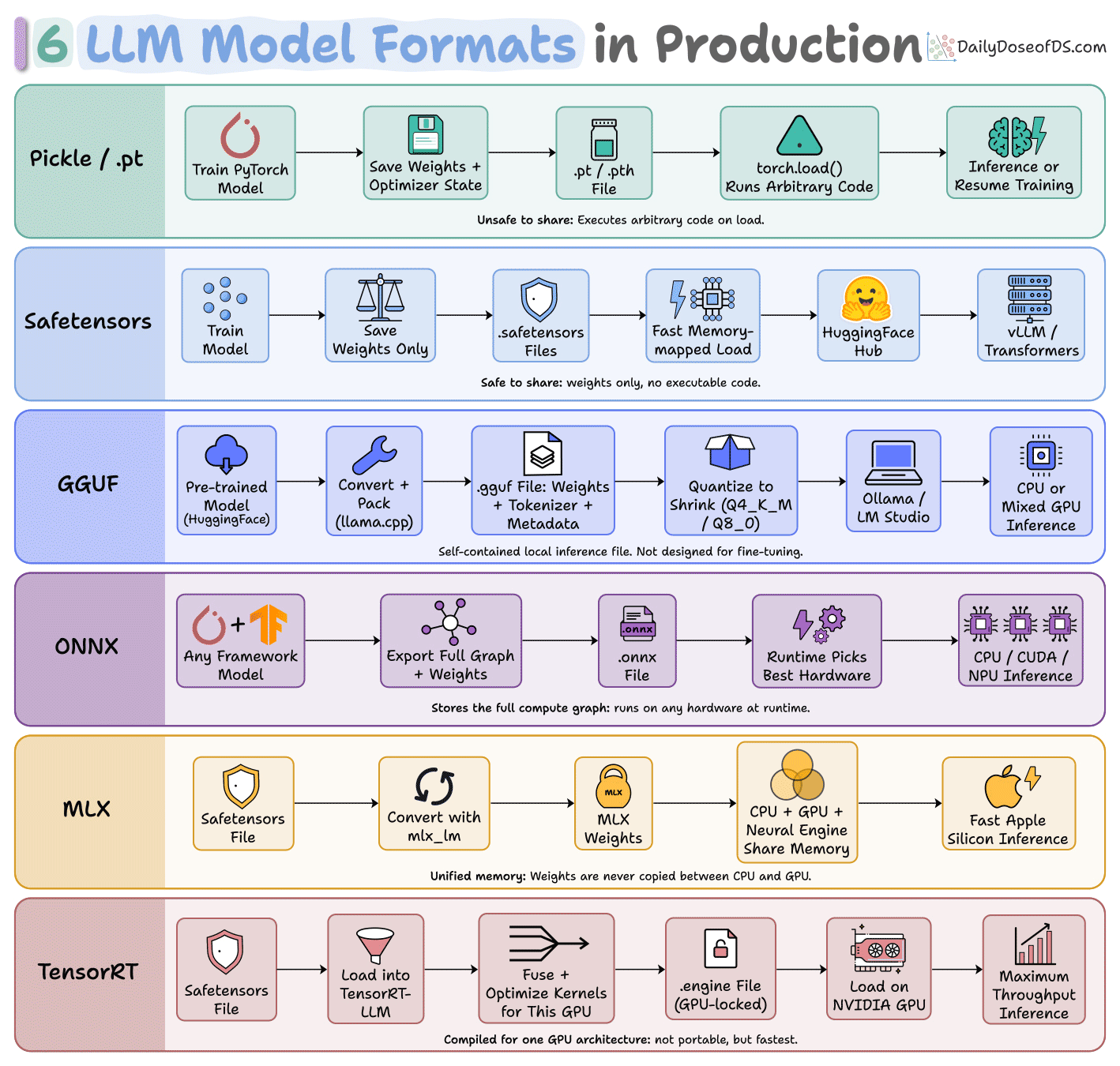
A technical breakdown of six production LLM deployment formats—Pickle, safetensors, GGUF, ONNX, MLX, and TensorRT—each with different tradeoffs between inference speed and hardware compatibility. Pickle and safetensors run anywhere Python runs; GGUF bundles weights and tokenizer for CPU-only machines; ONNX lets models switch frameworks; MLX optimizes for Apple silicon; TensorRT compiles to specific NVIDIA GPUs for maximum speed.
Why it matters
Faster models require hardware-specific choices baked into the file, so a single model must be rebuilt separately for each chip or runtime it needs to support. Teams must choose how far down the speed-versus-compatibility ladder to go—trading inference latency against the types of hardware that can actually run the model in production.
What to watch
The article emphasizes holding the deployment format as high on the speed-compatibility chart as the latency budget allows, because every step toward faster execution narrows the hardware it can run on. Teams deploying LLMs face a constant tradeoff between minimizing response time and maximizing portability.
Summaries like this, in your inbox every morning.
The article frames a fundamental constraint in LLM deployment: the speed-portability tradeoff. As models become faster through hardware-specific optimizations, they become less portable. This explains why major AI providers maintain multiple versions of the same model—a practical necessity, not a choice. The six formats form a spectrum, with the safest default sitting high on the chart (favoring compatibility) and dropping down only when latency budgets demand it.
The breakdown also reveals why different formats exist for different environments. GGUF and Ollama enable deployment where Python and ML frameworks are unavailable (edge devices, servers without ML infrastructure). ONNX acts as a bridge, letting models trained in one framework run in another. MLX and TensorRT represent the opposite end: maximum speed by committing fully to Apple's unified memory architecture and NVIDIA's specific GPU instruction sets, respectively. Teams choosing a format are essentially choosing which hardware constraints they are willing to accept.
Pick your industry and the AI tools you use, and get news related to your work every day.
Free · 30 seconds with Google · unsubscribe anytimeWhat is AIToday? →
Ask AI anything about this article. The AI reads this article, earlier AIToday articles, and Wikipedia, and cites its sources. Q&As are published on this page for other readers too.
Cammarata reinterprets InceptionV1's cat-car neuron as a V-shape detector, not two unrelated concepts

Google Deepmind's Gemini 4 Argon scored 97.5 percent on ARC-AGI-3 at a cost of $4,800, second only to GPT-6 As…
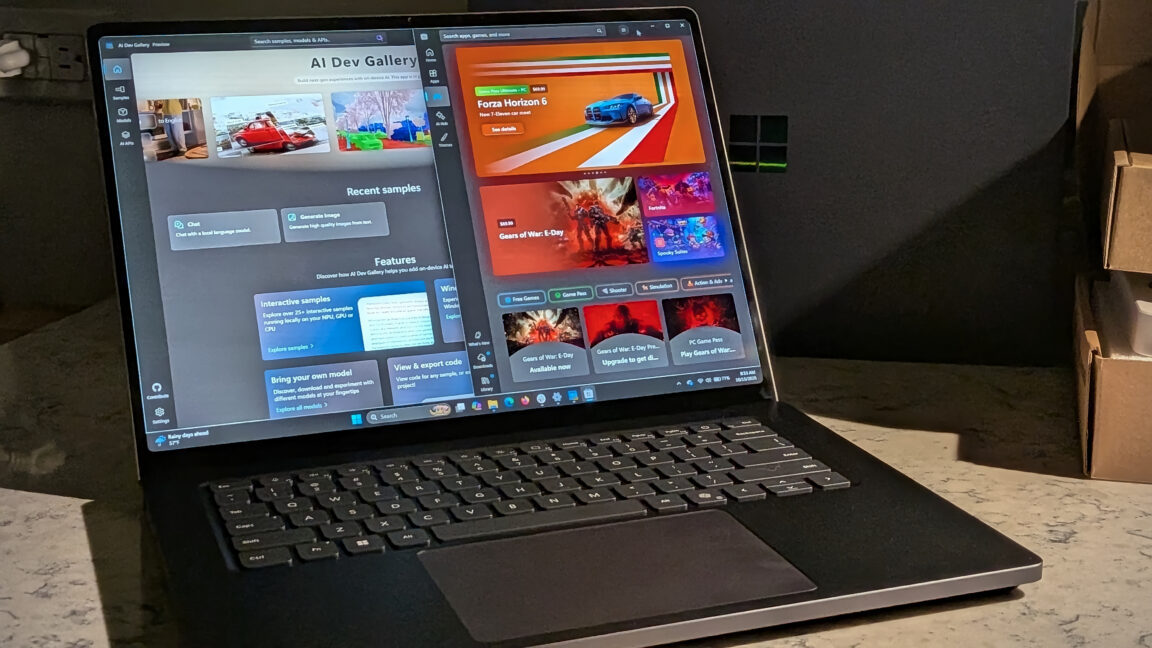
Microsoft's Surface Laptop Ultra, using Nvidia's RTX Spark platform, starts at $2,599 (up to $5,899)
Meta's new commercial terms, effective October 30th, appear to let it crawl and train AI on content from websi…
Vercel data published Thursday shows TypeSafe AI's Jev, a lightweight decision model for choosing among predet…
Reflection AI introduced Beam, an open-weight model for agentic coding and long-horizon tasks, with 501 billio…