What happened
A developer released memharness, a memory system for AI agents that stores facts with two time dimensions—when something became true in the world (valid_from/valid_to) and when the agent learned it (tx_at)—plus provenance tracking for each fact. The system runs as a library or MCP server (a standard interface for connecting tools to AI clients) and uses plain SQLite, with no LLM or network calls in the storage layer.
Why it matters
Agent memory often grows too large for context windows (the text limit in each conversation), and bag-of-string storage cannot answer audit questions like "what did you believe before I corrected you?" or "why do you believe that?". Memharness answers those by keeping old facts as history (never deleting) and tagging each fact with its source, making it possible to revert changes, time-travel queries, and selectively forget information by source—useful for compliance (GDPR-shaped deletion) and explainability.
What to watch
The system is positioned as a storage layer, not an automatic fact extractor; you decide what to remember. It is available now as a library (@memharness/core) and MCP server (@memharness/mcp), with optional semantic search via a local embedding model (BGE-small, ~130MB). The default database lives at ~/.memharness/memory.db with no signup or API key required.
Summaries like this, in your inbox every morning.
Pick your industry and the AI tools you use, and get news related to your work every day.
Free · 30 seconds with Google · unsubscribe anytimeWhat is AIToday? →
Ask AI anything about this article. The AI reads this article, earlier AIToday articles, and Wikipedia, and cites its sources. Q&As are published on this page for other readers too.
Aparna Nair, IBM's chief talent, leadership, and culture officer, said generalists alone "will cut it" in the…
Dell says its AI Data Platform uses a four-engine architecture and a Unified Semantic Layer to connect siloed…
Amazon introduced Bee Frontier, a wearable personal AI, for $74.99 in Onyx, Lavender and Sage, and Bee Eclipse…

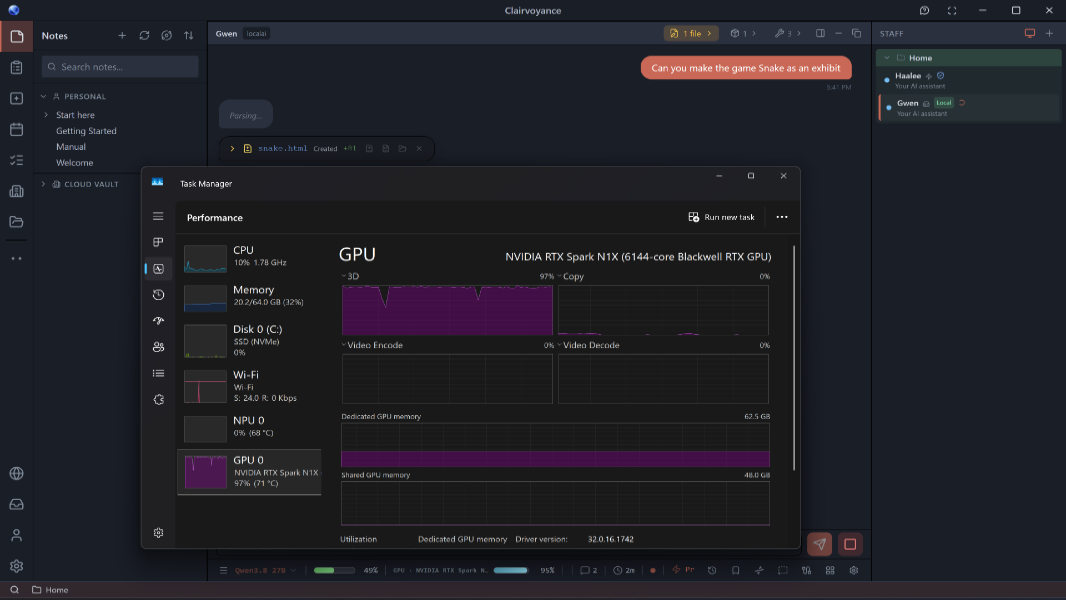
Microsoft and Nvidia are promoting RTX Spark, a new class of Windows PCs for local AI, with a top configuratio…
Microsoft AI CEO Mustafa Suleyman told employees that MAI-Base-2, announced Thursday, is a stronger pre-traine…
RapidCanvas raised a $29M Series B led by Vertex Ventures SEA & India, with Hitachi Ventures and existing inve…