AIToday

Kimi K3 open model matches GPT-5.6 Sol, Claude Fable 5 in benchmarks; China AI prices rise

THE DECODER1h ago
Kimi K3 open model matches GPT-5.6 Sol, Claude Fable 5 in benchmarks; China AI prices rise

Key takeaway

Kimi released K3, an open-source model with 2.8 trillion parameters that performs on par with leading proprietary models like GPT-5.6 Sol and Claude Fable 5 in independent benchmarks, scoring 57 on the Artificial Analysis Intelligence Index. The launch marks a shift away from ultra-cheap Chinese AI pricing: K3 costs $0.30 per million input tokens (with cache) and $15.00 for output, roughly 19 times higher than Kimi's previous K2.6 model, reflecting a broader move by Chinese providers to raise prices for frontier models rather than compete on cost alone.

Summaries like this, in your inbox every morning.

Sign up free →

3 Key Points

  • What happened

    Kimi launched K3, a 2.8 trillion parameter open model with a one million token context window. In Kimi's benchmarks, K3 trails only Claude Fable 5 and GPT-5.6 Sol but beats all other tested systems including Claude Opus and Chinese rival GLM-5.2. Independent testing by Artificial Analysis scores K3 at 57 on the Artificial Analysis Intelligence Index, placing it fourth behind Fable 5 (60), GPT-5.6 Sol (59), and Opus 4.8 (56). Full model weights are scheduled for release by July 27.

  • Why it matters

    K3 signals the end of ultra-cheap Chinese AI. Kimi's pricing—$0.30 per million input tokens (with cache hit) and $15.00 for output—is nearly 19 times higher than its predecessor K2.6 ($0.16 input, $4.00 output). Chinese providers overall are raising prices for frontier models. At $0.94 per task, K3 lands in the same range as GPT-5.6 Sol ($1.04) but costs roughly half of Claude Opus 4.8 ($1.80), positioning it as a competitive midrange option rather than a price-leader.

  • What to watch

    K3 shows higher hallucination (51 percent) than its accuracy improvement (46 percent, up from 33 percent on the AA-Omniscience Index), and it uses a mixture-of-experts architecture activating only 16 of 896 experts. The model is available now via Kimi.com, mobile apps, and Kimi Code; a planned Kimi Hosted Agent platform with isolated environments for long-running tasks is in waitlist signup.

In Depth

Kimi, a Chinese AI company, launched K3, its flagship open multimodal model featuring 2.8 trillion parameters, native image and video processing, and a one million token context window. The company claims K3 is the first open model in the roughly 3 trillion parameter range, with full weights scheduled for release by July 27.

In Kimi's own benchmarks, K3 performs behind only Claude Fable 5 and GPT-5.6 Sol but beats all other tested systems. Across 35 total tests spanning programming, general agents, and other domains, K3 took first place approximately seven times and landed second or third in most other tests. Fable 5 won the most individual tests. In programming benchmarks, K3 won two out of six tests; in general agent tests, it won three out of six, with Fable 5 taking both visual agent test wins. Notably, K3 substantially outperformed Claude Opus 4.8, GPT-5.5, and Chinese rival GLM-5.2 across most benchmarks. All results came from Kimi and were achieved at maximum or high thinking intensity.

Independent testing lab Artificial Analysis published its first evaluation and confirms K3's strength while flagging concerns. On the Artificial Analysis Intelligence Index, K3 scores 57, placing fourth overall behind Claude Fable 5 (60), GPT-5.6 Sol (59), and Claude Opus 4.8 (56). On agentic tasks using GDPval v2, K3 reaches an Elo of 1,668—a significant jump from K2.6's 1,190—and beats GLM-5.2 (1,514), GPT-5.5 (1,494), and Claude Opus 4.8 (1,600), though it falls short of Claude Fable 5 (1,760). K3 also takes the top spot on AutomationBench-AA with a score of 53 percent. On AA-Briefcase, a private long-horizon knowledge work evaluation, K3 reaches an Elo of 1,547, up 732 points from K2.6, with only Claude Fable 5 scoring higher. Artificial Analysis notes K3 is well-rounded, with rubric scoring and analytical quality close to Fable 5's level, though GPT-5.6 Sol leads on presentation quality. However, K3's hallucination rate climbed from 39 percent to 51 percent, meaning the model fabricates more answers even as accuracy improved from 33 percent to 46 percent on the AA-Omniscience Index.

Kimi positions K3 for long-running software development with minimal human oversight. The model analyzes large codebases, coordinates terminal tools, and maintains focus across multiple work steps. A key feature is "Vision in the Loop," a closed-loop system where K3 examines screen captures, modifies code, then checks visible output, designed to enable game development, UI design, and CAD work. Kimi showcased K3 building a procedurally generated 3D open-world game entirely in the browser using Three.js, WebGPU, and GPU Compute, along with an interactive black hole visualization, a Long March 10 rocket launch simulation, and a Game Boy Advance emulator.

Technically, K3 uses a mixture-of-experts architecture activating only 16 of 896 experts at a time. A new attention architecture called Kimi Delta Attention enables up to 6.3× faster decoding for million-token contexts. "Attention residuals" boost training efficiency by approximately 25 percent while adding less than 2 percent in extra compute overhead.

Pricing marks a dramatic shift. According to Kimi API docs, one million input tokens cost $0.30 with a cache hit and $3.00 without; one million output tokens cost $15.00. This represents a roughly 19-fold increase from K2.6, which cost $0.16 per million input tokens (with cache), $0.95 without, and $4.00 for output. The pricing aligns with Claude Sonnet 5 ($0.30 input cached, $3.00 uncached, $15.00 output) and sits between GPT-5.6 Sol ($0.50–$5.00 input, $30.00 output) and open-weight competitors like DeepSeek V4 Pro ($0.04 output) and GLM-5.2 ($0.32 per task). According to Artificial Analysis, K3 averages $0.94 per task on the Intelligence Index, close to GPT-5.6 Sol ($1.04) and roughly half the cost of Opus 4.8 ($1.80). K3 required about 132 million output tokens to complete nine evaluations, down 21 percent from K2.6's roughly 166 million tokens, meaning despite higher per-token prices, K3 will likely cost more per task than K2.6 in most cases due to the price increase.

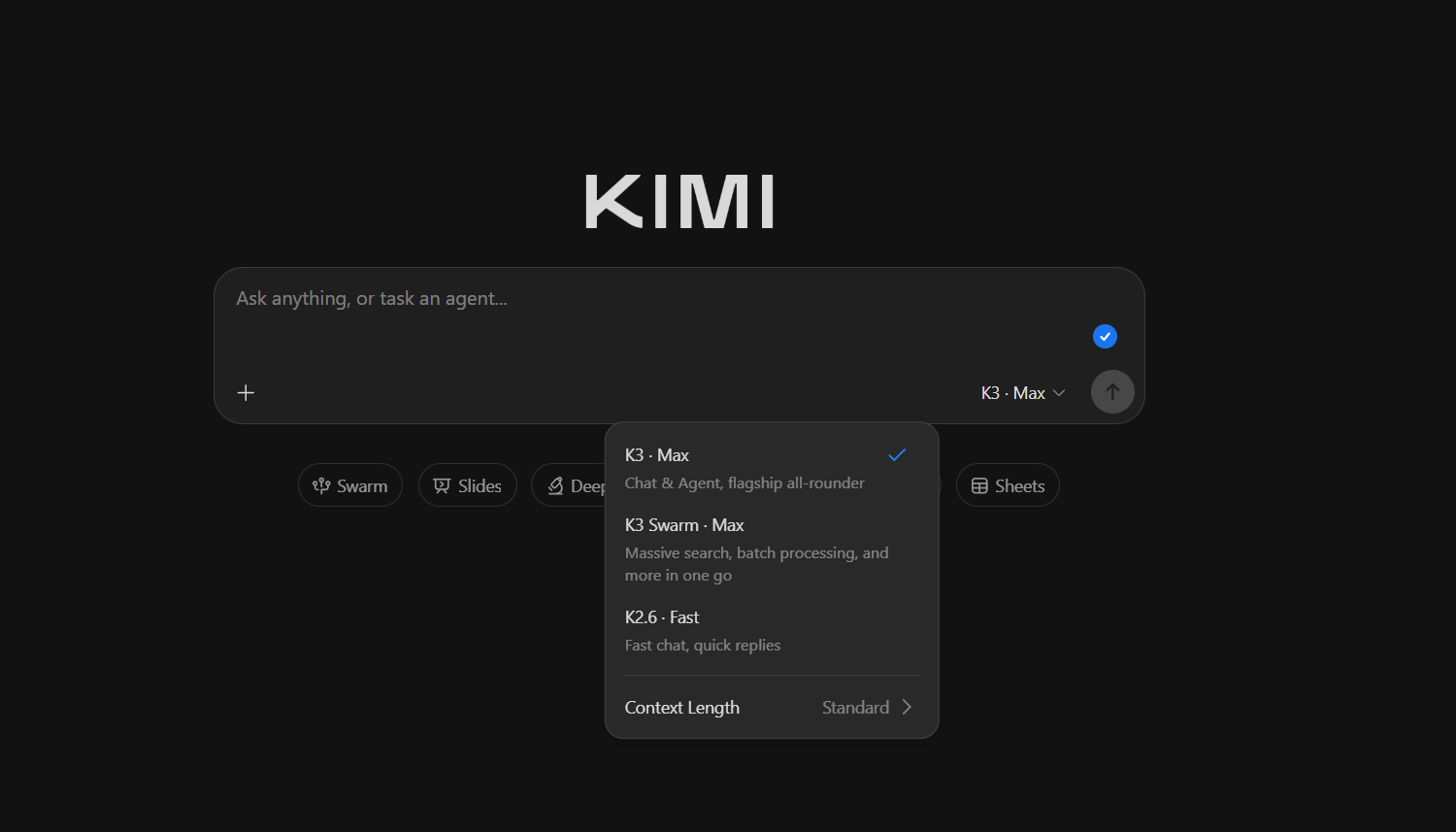
K3 is available now through Kimi.com, mobile apps for iOS, Android, and HarmonyOS, Kimi Work desktop client (version 3.1.0 and later), and Kimi Code. On OpenRouter, it is listed as "moonshotai/kimi-k3" but currently served only by Moonshot itself. For businesses, Kimi offers a separate version with member management and account splitting. A planned Kimi Hosted Agent platform will provide isolated environments and runtimes for long-running tasks, with interested users able to sign up for the waitlist now.

Context & Analysis

Kimi K3 represents a significant shift in Chinese AI economics. While the model delivers performance competitive with top-tier Western proprietary systems, its pricing strategy breaks sharply with the race-to-the-bottom dynamic that characterized Chinese AI for the past year. At $0.30–$3.00 per million input tokens and $15.00 per output, K3 is priced to compete with Claude Sonnet 5 (identical pricing) and sit between GPT-5.6 Sol ($0.50–$5.00) and open-weight competitors like DeepSeek V4 Pro ($0.04). This pricing reflects both the computational cost of training and serving a 2.8 trillion parameter model and a broader market signal: frontier AI models—whether proprietary or open-weight—are no longer treated as loss-leader commodities.

The performance data underscore K3's position in the upper midrange. Artificial Analysis's independent testing places K3 at 57 on the Intelligence Index, a clear fourth place, but the margin matters: it trails Opus 4.8 by only one point, and on agentic tasks (Elo 1,668), it substantially beats both Opus 4.8 and GPT-5.5. Kimi's own benchmarks show K3 winning roughly one-sixth of tests across a 35-test suite and placing second or third in most others. However, Artificial Analysis flags a troubling trade-off: K3's hallucination rate climbed to 51 percent even as accuracy improved to 46 percent, a 12-point jump from K2.6, suggesting the model generates more plausible-sounding but false outputs.

The open-weights release by July 27 will test whether market demand supports non-cheap open models. K3's efficiency gains—a mixture-of-experts design activating only 16 of 896 experts, and a new Kimi Delta Attention architecture enabling 6.3× faster decoding on million-token contexts—suggest the model was engineered for cost-effective inference at scale, not merely raw capability. For businesses running agentic workloads, the positioning as a platform for "Vision in the Loop" code generation and long-horizon task completion signals Kimi's intent to compete on developer utility rather than price, a marked departure from the commodity positioning of earlier Chinese models.

FAQ

How does K3 perform compared to other models?
On Artificial Analysis's Intelligence Index, K3 scores 57, placing fourth overall behind Claude Fable 5 (60), GPT-5.6 Sol (59), and Claude Opus 4.8 (56). On agentic tasks, K3 reaches an Elo rating of 1,668, beating GLM-5.2 (1,514), GPT-5.5 (1,494), and Claude Opus 4.8 (1,600), though falling short of Claude Fable 5 (1,760).
When will the open weights be available?
Full model weights are scheduled for release by July 27. K3 is already available now through Kimi.com, mobile apps (iOS, Android, HarmonyOS), Kimi Work desktop client, and OpenRouter.
How much does K3 cost?
One million input tokens cost $0.30 with a cache hit and $3.00 without; one million output tokens (including reasoning) cost $15.00. This is roughly 19 times higher than K2.6, which cost $0.16 per million input tokens (with cache hit) and $4.00 for output.
What is K3 designed to do?
K3 targets long-running software development with minimal human oversight, analyzing large codebases, coordinating terminal tools, and staying focused across many work steps. It uses a 'Vision in the Loop' system that examines screen captures, modifies code, and checks visible output.

Get the latest Large Language Models news every morning

AI-summarized, only the topics you pick — one digest a day via Email, Slack, or Discord.

Free · takes 30 seconds · unsubscribe anytime

Discussion

No comments yet. Be the first to share your thoughts!

Log in to join the discussion

Related Articles

Stay ahead with AI news

Get curated AI news from 200+ sources delivered daily to your inbox. Free to use.

Get Started Free

Free · takes 30 seconds · unsubscribe anytime

1 minute a day. The AI essentials.

200+ sources · Email / LINE / Slack

Get it free →