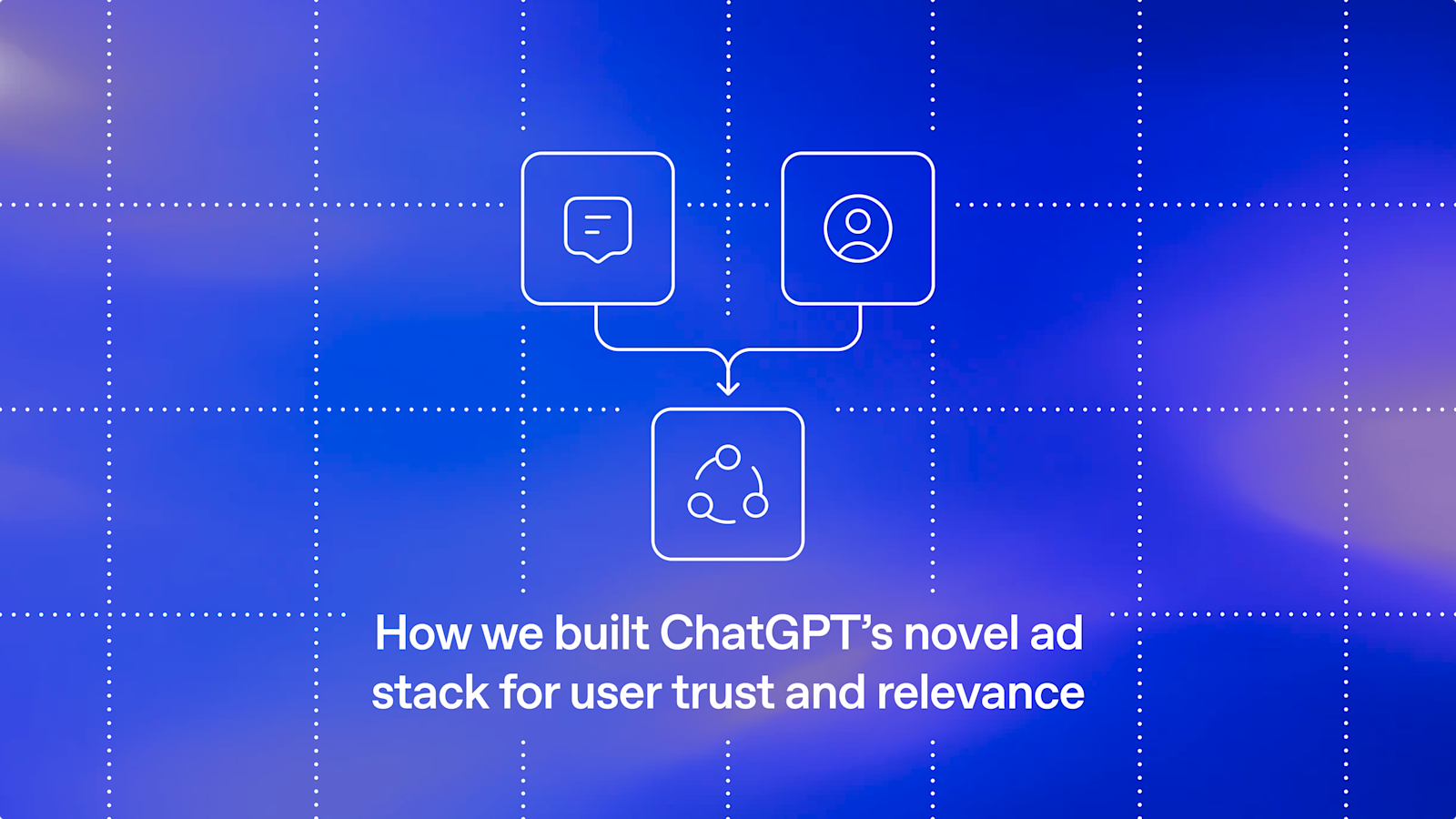
What happened
OpenAI detailed a custom ads stack built on a post-trained LLM it calls the orchestrator, which reads conversation intent and calls tools for retrieval, ranking, relevance and auctions. ChatGPT Ads reached $1 billion in annualized revenue run rate less than 200 days after launch, and more than 100,000 advertisers have run ads since launch.
Why it matters
Because ads run in a separate service from answer generation, OpenAI says ads cannot influence ChatGPT's answers or take the product down if ad serving slows. Returning no ad is treated as a normal outcome, which OpenAI positions as a trust safeguard for users and a high bar for advertisers.
WHO IT HITSAdvertisers and media buyers now have a fast-scaling conversational channel to plan around, while product and trust teams at chat-based services get a concrete architecture for keeping sponsored content from shaping AI answers.
Summaries like this, in your inbox every morning.
OpenAI frames the core problem as one of timing rather than targeting. Traditional ad systems respond to a discrete event such as a search query or page view, but a ChatGPT conversation may carry commercial intent that only becomes clear after several turns, as in its running example of a user who asks about race training and only later asks about shoes. Building around single messages, OpenAI says, risked misreading the goal, starting the ad flow too soon, or rerunning the flow on every change.
Its answer is a stateful ads session plus an orchestrator LLM that summarizes conversations, retrieves candidates, filters for eligibility and relevance, and nominates candidates for an auction without itself setting the price. OpenAI draws a hard architectural line between this flow and answer generation, and it notes the practical upside: ad serving issues cannot take down or delay ChatGPT, and delivering no ad counts as a successful outcome.
The build itself leaned on Codex, which OpenAI describes as a force multiplier for bootstrapping the system and its guardrails at speed. OpenAI credits human feedback, including clicks, hides, surveys and advertiser input through Ads Manager, with shaping taste more than the model's own observations. The next stated step is more dynamic formats, including letting users talk directly to businesses through ads.
Pick your industry and the AI tools you use, and get news related to your work every day.
Free · 30 seconds with Google · unsubscribe anytimeWhat is AIToday? →
Ask AI anything about this article. The AI reads this article, earlier AIToday articles, and Wikipedia, and cites its sources. Q&As are published on this page for other readers too.
Red Hat and Nvidia expanded their partnership around Red Hat AI Factory with Nvidia, adding agent runtime cont…

Pichai said on the Big Technology Podcast that Google Cloud forgoes short-term revenue for compute trade-offs…
The Department of Homeland Security ordered civilian federal agencies to remove Deepseek products, including s…

Writing as a non-engineer, the author says a service built with AI slipped three months past its planned relea…

One developer runs multiple Grok Bots, each with a single responsibility — a master bot for shared rules, sepa…
In Claude Code 2.1.283, a PermissionRequest hook receives the AskUserQuestion tool_input, adds an answers map…

