What happened
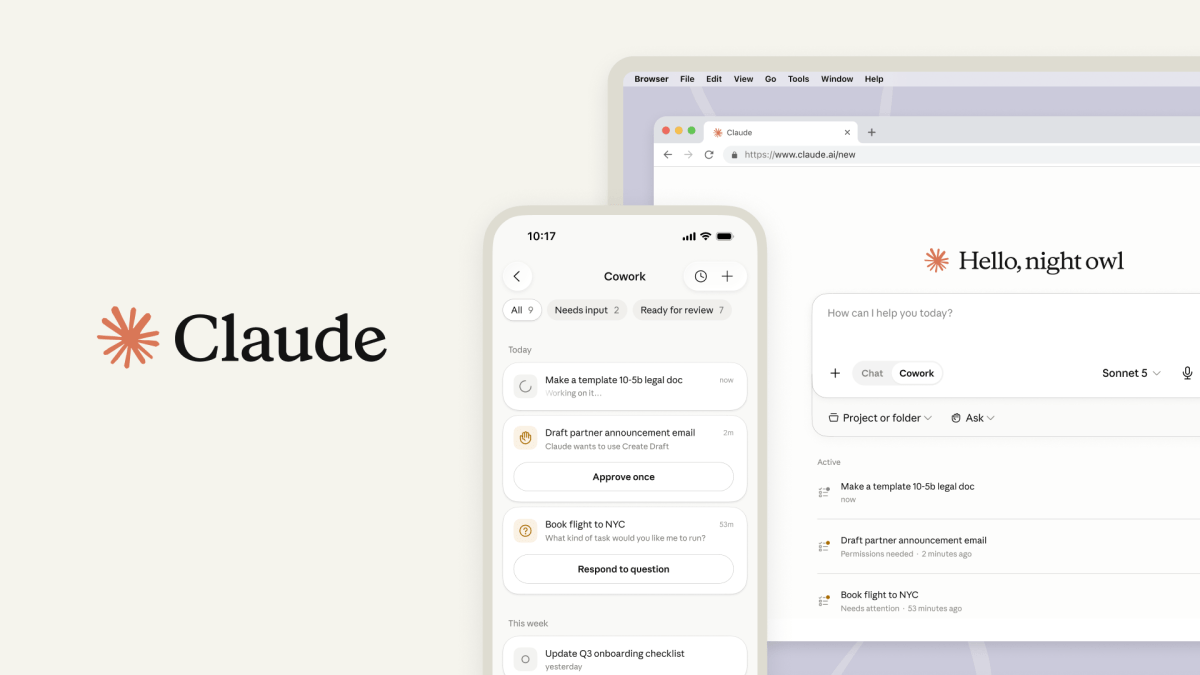
Claude Cowork, Anthropic's AI agent for knowledge work, launched on web and mobile for Max subscribers starting Tuesday, after debuting as a desktop app in January. Users can now start tasks on their desk, check status on their phone, and retrieve finished work even when their laptop is closed.
Why it matters
The expansion signals that AI firms are moving beyond chatbots into the everyday surfaces where work actually happens. Anthropic's own usage data shows that business process work (33.4% of sessions) and content creation (16.4%) dominate Cowork use—not coding (8.7%)—suggesting the real value for companies may lie in automating administrative and communications tasks across finance, HR, marketing, and management roles.
What to watch
Anthropic studied 1.2 million anonymized and aggregated Cowork sessions from more than 600,000 organizations over the last two weeks of May. The desktop app will remain the primary interface for deep work with local file and browser access, while web and mobile expand reach to users who did not install the app.
Summaries like this, in your inbox every morning.
Claude Cowork's expansion to mobile and web represents Anthropic's bet that the future of AI value lies not in replacing specialized tools but in automating the recurring administrative and coordination work that occupies a "broad swath of jobs" across organizations. Anthropic calls this the "work around the work"—the tasks that keep companies functioning but are rarely anyone's core responsibility. This positioning directly mirrors OpenAI's strategy with Codex, which began as a software development tool but is increasingly used by non-developers for reports, spreadsheets, and research, suggesting both labs see ownership of everyday work surfaces as more strategically important than dominance in any single category.
The usage data Anthropic released—drawn from 1.2 million sessions across more than 600,000 organizations in late May—provides a window into where AI agents are actually creating value right now. Finance, HR, and administrative roles generate the largest slice of Cowork work, handling the scattered email threads, transcripts, and checklists that manually consume hours each week. The modest share of coding (8.7%) undercuts the narrative that AI's primary business impact will come from software development; instead, the numbers suggest that broad-based automation of business process work and communication tasks may unlock faster and wider organizational adoption.
AnthropThreopic's move to unify chat and Cowork across web and desktop, with projects and artifacts living together, also signals a strategy to make the agent feel less like a specialized coding tool and more like a persistent administrative coworker—one that can work in the background across devices and escalate decisions to humans only when required. This reflects the broader industry shift away from chatbots as the primary user interface for AI and toward embedding agents directly into the workflows and surfaces where work already happens.
Pick your industry and the AI tools you use, and get news related to your work every day.
Free · 30 seconds with Google · unsubscribe anytimeWhat is AIToday? →
Ask AI anything about this article. The AI reads this article, earlier AIToday articles, and Wikipedia, and cites its sources. Q&As are published on this page for other readers too.
Cammarata reinterprets InceptionV1's cat-car neuron as a V-shape detector, not two unrelated concepts

Google Deepmind's Gemini 4 Argon scored 97.5 percent on ARC-AGI-3 at a cost of $4,800, second only to GPT-6 As…

Microsoft's Surface Laptop Ultra, using Nvidia's RTX Spark platform, starts at $2,599 (up to $5,899)

Meta's new commercial terms, effective October 30th, appear to let it crawl and train AI on content from websi…

Vercel data published Thursday shows TypeSafe AI's Jev, a lightweight decision model for choosing among predet…

Reflection AI introduced Beam, an open-weight model for agentic coding and long-horizon tasks, with 501 billio…


