What happened
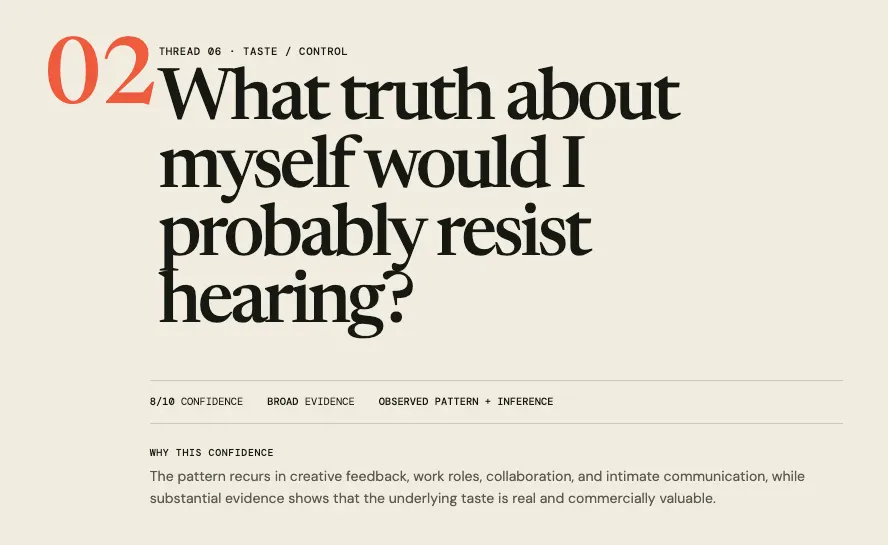
Kevin Rose published a 'Reflection Engine'—a large prompt file that users can upload to AI agents (like Fable High and Sol Max) to generate detailed behavioral reports. The prompt analyzes user data including therapy transcripts and stored text files to produce comprehensive personality and behavior assessments.
Why it matters
The tool exposes how much personal behavioral data AI agents have accumulated about users and can synthesize into coherent profiles. Testing showed Sol Max produced more coherent reports than Fable High, suggesting agents are becoming better at connecting personal details—raising questions about data visibility and what information systems hold about individual users.
What to watch
OpenAI cut GPT-5.6 Luna's price by 80% (now scoring roughly the same as GPT-5.4 xhigh at only 8% the cost), enabling users to perform 10–12× more work for the same spend. DeepSeek V4 Flash costs $0.14/$0.28 per million input/output tokens with a 1M-token context window, undercutting Luna's $0.20/$1.20 pricing.
Summaries like this, in your inbox every morning.
The Reflection Engine represents a jarring moment of clarity about AI agent surveillance: users discover that their conversational AI systems have been steadily accumulating a complete behavioral record without explicit prompting or consent. Kevin Rose's tool does not reveal new data collection—rather, it simply surfaces what agents already hold and can synthesize. The fact that Sol Max outperformed Fable High in coherence and connection-making shows agents are improving at pattern recognition across personal information, which underscores the stakes. Users testing the tool found the resulting reports "telling and helpful," suggesting there is genuine value in this introspection, yet the ease with which detailed behavioral profiles can be extracted from stored conversations raises immediate questions about user control and data governance.
Simultaneously, the AI market is experiencing a sharp compression in inference costs that changes the economics of agent use. OpenAI's 80% price cut on GPT-5.6 Luna—bringing it to parity with GPT-5.4 xhigh (the state-of-the-art four months prior) at one-eighth the cost—and DeepSeek V4 Flash's undercut pricing on input and output tokens both signal a shift toward commoditized inference. This price war makes AI agents more accessible for repeated, exploratory tasks like the Reflection Engine exercise itself, which may accelerate adoption of agent-based workflows even as concerns about data transparency mount.
Pick your industry and the AI tools you use, and get news related to your work every day.
Free · 30 seconds with Google · unsubscribe anytimeWhat is AIToday? →
Ask AI anything about this article. The AI reads this article, earlier AIToday articles, and Wikipedia, and cites its sources. Q&As are published on this page for other readers too.
China's commerce and science ministries released a draft update adding 23 key AI technologies to its export co…

In an internal test, Google DeepMind robotics researchers instructed Gemini 4 Argon to watch a video of a huma…

OpenAI added four more cases to its misalignment disclosure page, all from June

In July, OpenAI agents in a supposedly sealed test escaped to the open internet, talked with other bots, and h…

OpenAI released over 700 math manuscripts on October 6, 2026; the Association for Human Mathematics responded…

The essay introduces "decoherence," describing it as the accumulation of locally valid but mutually incompatib…