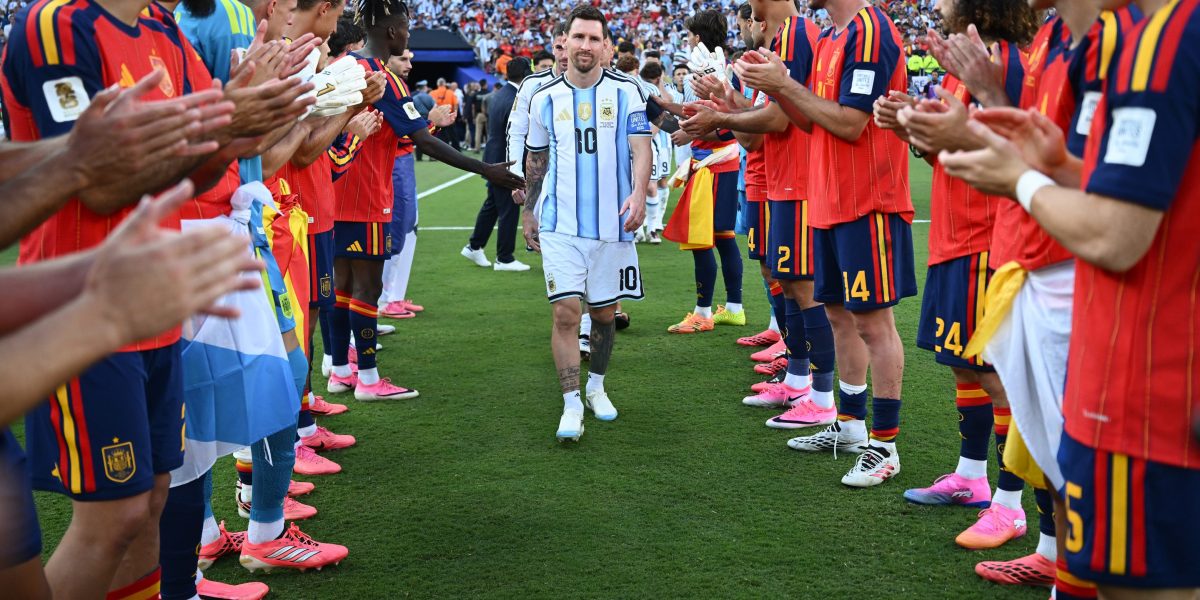
The 2026 World Cup Final, decided by human players and human referees despite heavy technological automation, offers a framework for understanding which jobs AI cannot hollow out. A researcher studying American AI job risk used the tournament to test five protective attributes: tacit knowledge that cannot be fully codified, improvisation in open-ended settings without single optimal solutions, irreplaceable human presence that commands value, lingering trust gaps in algorithmic decision-making, and coordination within systems. The analysis challenges conventional wisdom that physical work is automatically safer than desk work, and suggests companies should invest in talent pipelines, validation roles for humans, and avoid one-size-fits-all re-skilling.
Summaries like this, in your inbox every morning.
Sign up free →What happened
Spain defeated Argentina 1-0 in the 2026 World Cup Final on July 19, with Ferran Torres scoring 37 seconds into extra time. The tournament deployed extensive AI and automation—semi-automated offside tracking using roof cameras monitoring 29 points on each player 50 times per second, AI-cut highlights, biometric ticket scanning—yet humans made the decisive calls throughout.
Why it matters
A researcher at Tufts University's Fletcher School used the final to test which human work AI cannot replace. The analysis identifies five attributes that protect jobs: tacit knowledge (Messi read field patterns others couldn't see), improvisation in open-ended environments (soccer has no single optimal play), human presence that commands value (audiences want the real Messi, not a machine copy), trust gaps (FIFA's offside system still requires human validation), and coordination in systems (Spain's team structure ultimately defeated individual genius). The Messi Test challenges the myth that physical work is safer than desk work—Messi spent 63–64% of match time walking, yet his value lay in judgment, not athleticism.
What to watch
The analysis suggests companies should invest in junior talent pipelines (Spain's Lamine Yamal came from a decade in Barcelona's La Masia academy), create "trust roles" where humans validate AI decisions, and avoid reflexively replacing workers with automation. The researcher warns that blanket re-skilling programs have not worked well in past automation waves and lack clear target jobs.
On Sunday, July 19, the 2026 FIFA World Cup Final unfolded as a technologically saturated spectacle that ultimately turned on human judgment. Spain defeated Argentina 1-0 when Ferran Torres, a Spanish substitute, side-footed a loose ball past Argentina goalkeeper Emiliano Martinez 37 seconds into the second period of extra time. The tournament itself had been run by an array of automation and AI: FIFA's semi-automated offside system used dedicated tracking cameras mounted under stadium roofs to follow up to 29 points on every player's body 50 times a second, fused with a sensor in the ball reporting its position 500 times a second; tickets were priced by algorithm; highlights were cut by AI; and fans entered stadiums by biometric scan. Yet where it truly mattered—in the decisive calls and the flow of play—humans and human coordination remained central.
A researcher at Digital Planet at Tufts University's Fletcher School, working with a team mapping which American jobs AI could hollow out, watched the final through a particular analytical lens to identify where machine passes to human and human passes back. The analysis pivots on what she calls the Messi Test, named after Argentina's Lionel Messi, one of soccer's greatest players. The test emerged from observing that although Messi played in a tournament saturated with AI and automation, Spain's team ultimately defeated him—not through superior individual brilliance but through coordinated system play. Messi finished the final with zero touches in the opposition box and one blocked shot, choked by the Spanish team's pressing structure, positional rotations, and unspoken timing of when to squeeze and when to hold.
The Messi Test identifies five protective attributes for human work. First, human work is safer when it rests on tacit knowledge—what the philosopher Michael Polanyi called "we can know more than we can tell." Messi created chances largely by walking, averaging around five kilometers a game, finding elite space on the field by reading patterns others could not see. The very best scanners can reach 0.8 scans a second; translating those scans into positioning cannot yet be written into algorithmic playbooks. Second, human work is safer when it calls for action and reaction in non-stationary, open-ended environments. Soccer offers no single optimal play; Messi must improvise each time. AI can conquer Go, a complex but closed game with fixed rules, but struggles with a game as open-ended as soccer or a negotiation with an endless menu of pathways. Third, human work is safer when human presence is key to the value. Employers, consumers, and stakeholders want the real thing, not a machine. Even OpenAI paid for Messi's authentic face as its first global sports ambassador for a worldwide campaign promoting ChatGPT.
Fourth, human work is safer when there is a trust gap. FIFA's high-tech offside system is only "semi-automated"—it generates an alert, but a human must validate it before the referee acts. Both humans and algorithms can make mistakes, but society does not yet trust the algorithm with the final word. Fifth, emerging from Spain's victory itself, human work is safest when machines devise systems that can suffocate the superstar rather than replicate him. Rodri, Spain's midfield captain, won the tournament's Golden Ball, embodying leadership of such a system. He did not score a goal but completed 101 of 105 passes, won 80% of his duels, and across the tournament completed more passes and covered more ground than any other player, anchoring the entire Spanish team.
The analysis challenges a prevailing myth: that physical work is automatically safer from AI while desk work is not. Messi is among the least physical World Cup greats, spending 63–64% of match time walking—less than almost any other outfield player in modern soccer. What protects him are the attributes noted above, not athleticism. The implications cut both ways: not all deskwork is unsafe, and not all physical work is automatically safe. Warehouse sorting, farm harvesting, and long-haul trucking face real displacement risk. The researcher's American AI Jobs Risk Index, covering 784 occupations across 530 metro areas, finds the safe/unsafe line runs through task attributes, not through the physical-versus-cognitive boundary alone.
For those preparing for an AI-saturated future, the Messi Test offers guidance on which skills and occupations to pursue. For employers and executives, it suggests concrete strategic lessons. First, invest in the organization and talent pipelines. Spain's victory relied on coordination; a critical member was teenager Lamine Yamal, the product of roughly a decade in Barcelona's La Masia academy. Even if it is expedient to replace a junior associate with AI, companies should ask where the next Yamal will come from. Second, invest in trust roles—humans who confirm calls and act as co-pilots. Most investment has gone into training AI, but as AI generates more decisions, the most valuable job may be the human who validates them. Third, retire the reflexive "let's re-skill the displaced workers" orthodoxy; most organizations lack a clear idea of what new jobs they are preparing workers for, and re-skilling during earlier automation waves in manufacturing did not work particularly well. While FIFA's machines tracked 29 points on every player's body, what made the 2026 World Cup thrilling was how an individual like Messi brought more than an athletic body to the game. What ultimately won was the invisible connection between the bodies that beat him—a connection no camera has yet been built to track.
The 2026 World Cup Final serves as a natural experiment in the boundary between human and machine labor. Despite FIFA's deployment of semi-automated offside tracking (using roof cameras monitoring 29 points on each player 50 times per second, fused with ball sensors reporting position 500 times per second), ticket pricing algorithms, AI highlight generation, and biometric stadium entry, the tournament's decisive moments rested on human judgment and coordination. The final itself was decided by a Spanish team that beat Lionel Messi—widely regarded as one of the greatest players ever—not through superior individual talent but through a coordinated system that left Messi with zero touches in the opposition box and one blocked shot.
This outcome prompted the researcher to refine what she calls the Messi Test, a framework for identifying jobs AI cannot easily replace. The test rests on five attributes: first, tacit knowledge that resists full codification (Messi found elite positioning by reading field patterns at 0.8 scans per second, a skill that cannot yet be reduced to algorithmic playbooks); second, improvisation in non-stationary, open-ended environments where no single optimal play exists (AI can master the closed game of Go but struggles with soccer's endless pathways and adversarial unpredictability); third, human presence that commands irreplaceable market value (Messi draws viewers, sponsors, and new players in a way machines trained on his past plays cannot replicate—notably, OpenAI paid for his authentic face as its first global sports ambassador); fourth, trust gaps where society does not yet cede final authority to algorithms (FIFA's high-tech offside system remains "semi-automated," requiring human validation before referees act); and fifth, effective coordination in systems rather than reliance on individual superstars (Rodri, Spain's midfield captain, won the tournament's Golden Ball despite scoring no goals, anchoring the team's passing and territorial control).
The analysis challenges a prevailing oversimplification: that physical work is automatically safer from AI than cognitive work. Messi, among the least physical of modern World Cup greats, spends 63–64% of match time walking. His value lies not in athleticism but in judgment and tacit knowledge. The researcher's American AI Jobs Risk Index, covering 784 occupations across 530 metro areas, confirms this finding—the safe/unsafe line runs through task attributes, not through the physical-versus-cognitive boundary alone. Warehouse sorting and long-haul trucking (physical work) face real risk; conversely, some deskwork proves harder to automate. The implications for business strategy are concrete: companies should invest in junior talent pipelines (recognizing that Barcelona's La Masia academy took a decade to develop Lamine Yamal, who became part of Spain's winning system), create and train "trust roles" where humans validate algorithmic decisions rather than concentrating investment only on training the AI itself, and retire the reflexive move to replace junior workers with automation—most organizations lack clarity on what new jobs will replace displaced ones, and past re-skilling efforts during manufacturing automation did not yield strong results.
AI-summarized, only the topics you pick — one digest a day via Email, Slack, or Discord.
Free · takes 30 seconds · unsubscribe anytime
No discussion yet for this article
Get curated AI news from 200+ sources delivered daily to your inbox. Free to use.
Get Started FreeFree · takes 30 seconds · unsubscribe anytime

