What happened
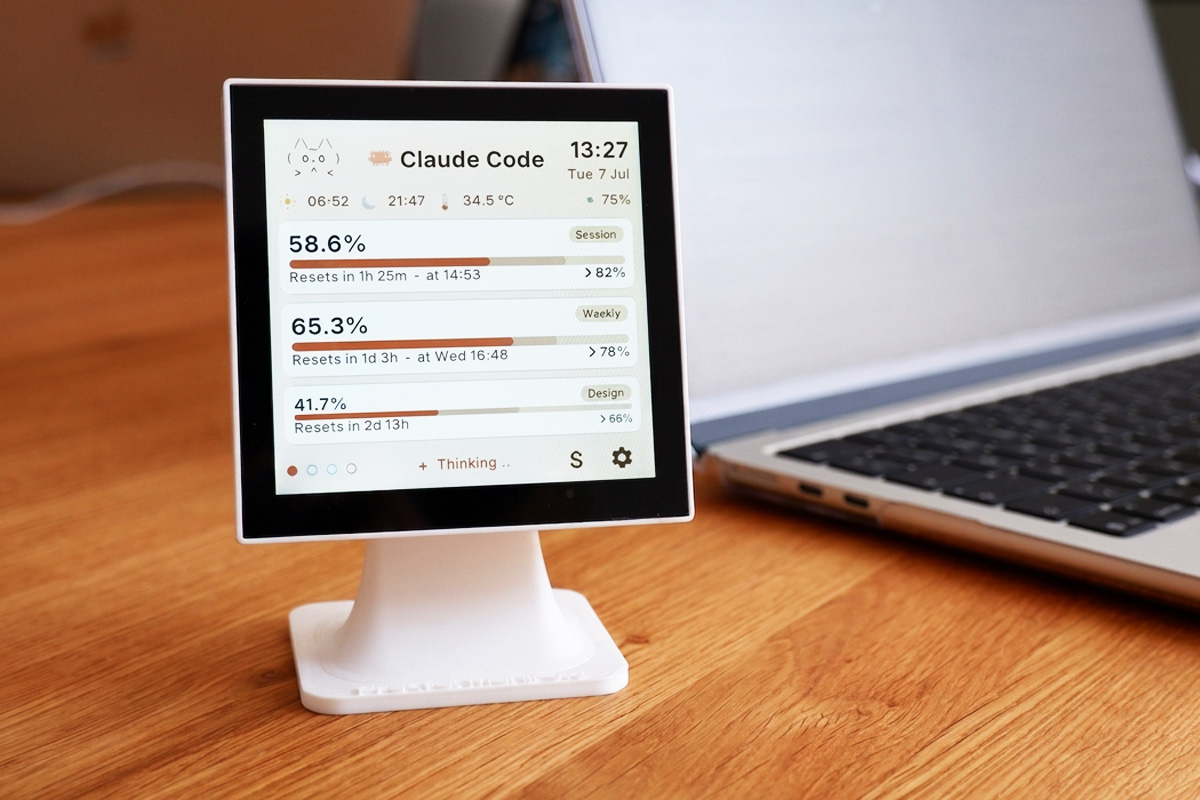
Fractal Manifold has introduced the Token Monitor, a 4-inch ESP32-S3-based desktop display that shows real-time AI coding assistant usage data including quota consumption, session limits, token counts, reset timers, and estimated token costs. The device launched on Kickstarter with a Super Early Bird reward priced at €99 (about $115) and standard Early Bird tier at €120, with first units expected to ship in November 2026.
Why it matters
The device runs a local open-source broker (tokenmonitor-mcp) that fetches usage data directly from provider APIs without transmitting raw code or telemetry externally, keeping user credentials on their own machine. It integrates with the Model Context Protocol to expose 17 hardware management tools to AI assistants like Claude Code, allowing provisioning, diagnostics, and firmware updates directly from the CLI.
What to watch
The Kickstarter campaign has a funding goal of €25,000. Delivery is currently available to the US, Canada, the EU, and the UK. The Token Monitor supports Claude Code, Codex CLI, and Antigravity CLI out of the box, and features customizable panels that display user-defined JSON data as line graphs, pie charts, tables, and text.
Summaries like this, in your inbox every morning.
The Token Monitor addresses a specific niche in the growing ecosystem of AI coding assistant monitoring tools. By running a local broker service, the device shifts data processing away from cloud services, giving users direct control over where their usage information flows. This design choice aligns with privacy concerns common among developers who use AI assistants for production work. The integration with the Model Context Protocol is particularly significant because it allows AI assistants themselves to manage the device's configuration and updates—provisioning the ESP32-S3, retrieving diagnostics, and installing firmware—all without leaving the CLI. This closes a loop between monitoring and control that most existing tools do not offer.
The hardware specifications reflect a pragmatic balance between capability and cost. The ESP32-S3 dual-core processor, 512KB SRAM, and 8MB PSRAM are sufficient for running LVGL-based UI rendering and maintaining a local WebSocket connection; the optional 1-cell Li-ion battery (which supports over 5 hours of session time) allows desk placement away from a power outlet. The 4-inch 480×480 touchscreen is large enough to display meaningful data without consuming significant desk space. Fractal Manifold positions the Token Monitor within an existing category of ESP32-based AI assistant displays—including the Claude Desktop Buddy, Clawdmeter, CtrlVibe AI Console, and ZecTrix Note 4—each targeting similar developer workflows but with different feature sets and form factors.
Pick your industry and the AI tools you use, and get news related to your work every day.
Free · 30 seconds with Google · unsubscribe anytimeWhat is AIToday? →
Ask AI anything about this article. The AI reads this article, earlier AIToday articles, and Wikipedia, and cites its sources. Q&As are published on this page for other readers too.
Apple and Meta said they would jointly release a new open-weight AI model designed to run on high-end Macs, ai…
A non-engineer operator says one person ships four smartphone apps on Google Play, three on the App Store, wit…

The walkthrough points the CLI at a local mock via the ANTHROPIC_BASE_URL environment variable
A Zenn guide explains systems to install before letting AI agents, bots or scheduled jobs post, send, publish…
A developer released agent-guardrails, a one-script Python standard-library plugin that guards Bash, Write, Ed…
Liquid AI released d1-ultra on October 15, 2026, an upgraded open-weights decision model that averaged 76.7 ac…