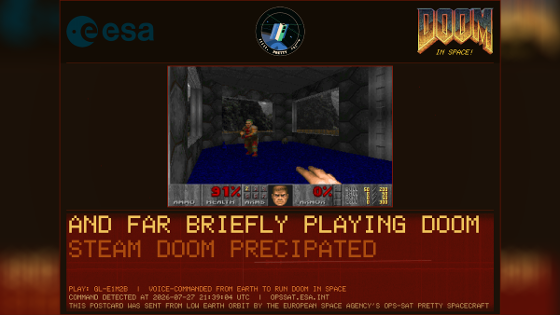
What happened
On July 27, 2026, the OPS-SAT PRETTY satellite caught the command in 3 of the 6 recorded audio clips; that night, amateur radio operator Jon Bergli Heier spoke 'PLAY DOOM DOOM DOOM' live, and the satellite fired up DOOM.
Why it matters
The satellite parsed the received radio signal on its own and acted on it, showing that voice commands can drive onboard behavior without a human operator in the loop; the game itself ran as a preloaded demo, not real-time play.
WHO IT HITSSatellite operators and space-mission software teams could gain a way to issue commands by voice and have the spacecraft interpret them autonomously, which may simplify controlling satellites in orbit, according to the experiment lead.
Summaries like this, every morning.
The experiment built on an earlier milestone: the team had already reached the point of sending a human voice from the ground for the satellite to recognize and obey. OPS-SAT PRETTY was not designed for voice control at all; it was built to observe radio reflections from positioning satellites and monitor radiation. What made the add-on possible was its reprogrammable computer and a software-defined radio (SDR) payload that lets radio processing be changed in software.
The path to success ran through several attempts. A July 3 test received the signal but the audio was too noisy to understand, because the radio processing bandwidth was too wide for the voice signal; the team narrowed it to the needed band, demodulated, and submitted revised software to ESA about a week later. That software used the SDR to extract audio and a roughly 27MB AI speech-recognition model to transcribe it, triggering DOOM when 'PLAY DOOM' was detected even with some recognition errors.
On July 27, synthetic audio was sent repeatedly and the command was detected in 3 of 6 recordings. That night, Jon Bergli Heier spoke live, and although the transcription contained errors, the word 'DOOM' was correctly recognized twice. The satellite sent back screenshots, animations, transcription results and signal analysis data. Labreche framed the result as a step toward detecting distress signals from people in need or identifying unusual radio emissions from space.
Pick your industry and the AI tools you use, and get news related to your work every day.
Free · 30 seconds with Google · unsubscribe anytimeWhat is AIToday? →
Ask AI anything about this article. The AI reads this article, earlier AIToday articles, and Wikipedia, and cites its sources. Q&As are published on this page for other readers too.
For an 80-second animation, the author generated 89 images with Animagine XL 4.0, added motion and subtitles i…
A Zenn essay on real-time voice agents argues that when AI handles phone calls, the decisive factor is time-to…

At KDDI SUMMIT 2026, Altius Link said an in-house trade-document AI tool built with Mitsui & Co.'s logistics D…

The write-up compares a few-line Python L−R implementation that subtracts the right channel from the left with…

Kotoba, a Japanese real-time voice AI company, has agreed to work with Cresta, a US firm, and is set to provid…

Journalist 原貫太 said on November 9 that a YouTube video appears to reproduce his voice with AI, even though he…