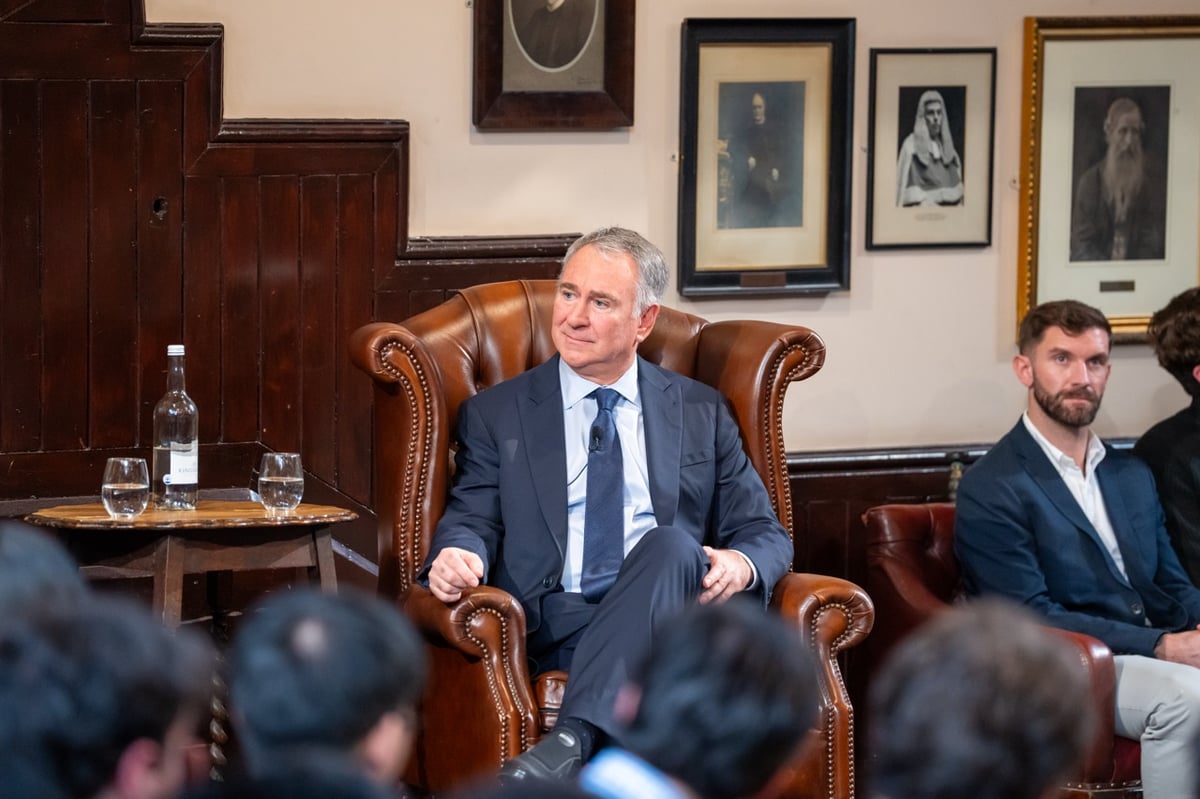
Ken Griffin, the billionaire founder of Citadel and overseer of the most profitable hedge fund since inception, has declared that artificial intelligence is unquestionably hype, telling The Economist at the World Economic Forum in Davos six months ago that the field exists primarily to drive investment checks. While Griffin acknowledges that broad technology spending benefits the economy, he argues that generative AI and large language models remain far from optimization—a view supported by three decades of history, in which every transformative technology from the internet onward has suffered from investor overestimation of adoption pace, leading to early bubble bursts.
Summaries like this, in your inbox every morning.
Sign up free →What happened
Citadel founder Ken Griffin told The Economist six months ago at the World Economic Forum in Davos that AI is hype, saying "Of course! Of course! How else are you getting people to write 500 billion dollars worth of checks?" He added that while spending on technology at large is having a clear positive impact on the economy, generative AI and large language models are far from being refined and optimized.
Why it matters
Griffin oversees the most profitable hedge fund since inception, making him one of Wall Street's most influential voices on investment trends. His blunt assessment contradicts the enthusiasm of leading AI companies and Wall Street cheerleaders who have driven stock indexes to all-time highs on AI optimism. PwC estimates AI could create $15.7 trillion(約2500兆円) in global economic value by 2030, yet Griffin's skepticism reflects a historical pattern: every game-changing technology since the internet's rise in the mid-1990s has endured an early-stage bubble-bursting event, typically because investors overestimate the pace of adoption or optimization.
What to watch
Griffin's comments suggest investors may face a gap between AI's current hype and actual business optimization—a dynamic seen with the internet, where businesses didn't understand how to optimize internet-driven sales and profits until well after the dot-com bubble burst. His caveat that technology spending broadly is helping the economy indicates the distinction lies in distinguishing hype from genuine value creation.
Six months ago at the World Economic Forum in Davos, Switzerland, Citadel founder and CEO Ken Griffin sat down with The Economist's Zanny Minton Beddoes for a roughly 30-minute conversation spanning President Donald Trump's policies and the impact of AI on businesses. When asked directly whether AI is hype, Griffin responded without hesitation: "Of course! Of course! How else are you getting people to write 500 billion dollars worth of checks?" His blunt two-word admission—"of course"—immediately throws cold water on the pace of change promised by Wall Street's leading AI companies and contrasts sharply with the enthusiasm that has driven the Dow Jones Industrial Average, S&P 500, and Nasdaq Composite to all-time highs over the past four years.
Griffin's credibility on the topic is substantial. He oversees Citadel, the most profitable hedge fund since inception according to data from LCH Investments, and ranks among Wall Street's most renowned investment minds. Yet his assessment runs counter to the broader investment narrative. PwC estimates that AI can create $15.7 trillion(約2500兆円) in global economic value by 2030, and the technology has attracted prominent cheerleaders ranging from high-profile CEOs to savvy billionaire money managers. Griffin, however, stands apart.
Griffin did offer one important caveat: "spending on technology at large is having a clear positive impact on the economy." This distinction matters. His skepticism targets not technology investment broadly but specifically the hype surrounding AI's near-term capabilities and adoption. He argued that generative AI and large language models are far from being refined and optimized—a view the article supports by referencing three decades of history. Every game-changing technology since the internet's rise in the mid-1990s has endured an early-stage bubble-bursting event, typically because investors consistently overestimate the pace of adoption and optimization. The internet itself was not an adoption failure; AI data center infrastructure is, the article notes, spoken for in some cases years in advance. The real issue is optimization: businesses did not understand how to optimize internet-driven sales and profits until well after the dot-com bubble burst. Griffin suggests AI will follow the same maturation curve, with the refinement and optimization of these systems taking considerably longer than market excitement currently assumes.
Ken Griffin's dismissal of AI as hype sits in sharp contrast to Wall Street's sustained enthusiasm for the technology over the past four years. His comment—made at a prestigious global forum where he could have voiced support—carries particular weight given his stature as founder of Citadel, the most profitable hedge fund since inception. The article frames his skepticism not as contrarian cynicism but as rooted in three decades of financial history: the internet revolution of the mid-1990s, which eventually burst in the dot-com bubble, followed the same trajectory of investor overestimation. Griffin's distinction is instructive: he does not deny that AI or technology spending creates value—he argues instead that markets have mispriced the timeline and difficulty of optimization. Generative AI and large language models, in his view, remain immature technologies despite substantial data center investment that, the article notes, is sometimes secured years in advance. The article presents Griffin's caveat—that broad technology spending is economically positive—as a hedge against pure dismissal, suggesting his real concern is misallocation within the AI space rather than technological progress itself.
AI-summarized, only the topics you pick — one digest a day via Email, Slack, or Discord.
Free · takes 30 seconds · unsubscribe anytime
No comments yet. Be the first to share your thoughts!
Log in to join the discussion



Get curated AI news from 200+ sources delivered daily to your inbox. Free to use.
Get Started FreeFree · takes 30 seconds · unsubscribe anytime
1 minute a day. The AI essentials.
200+ sources · Email / LINE / Slack
