What happened
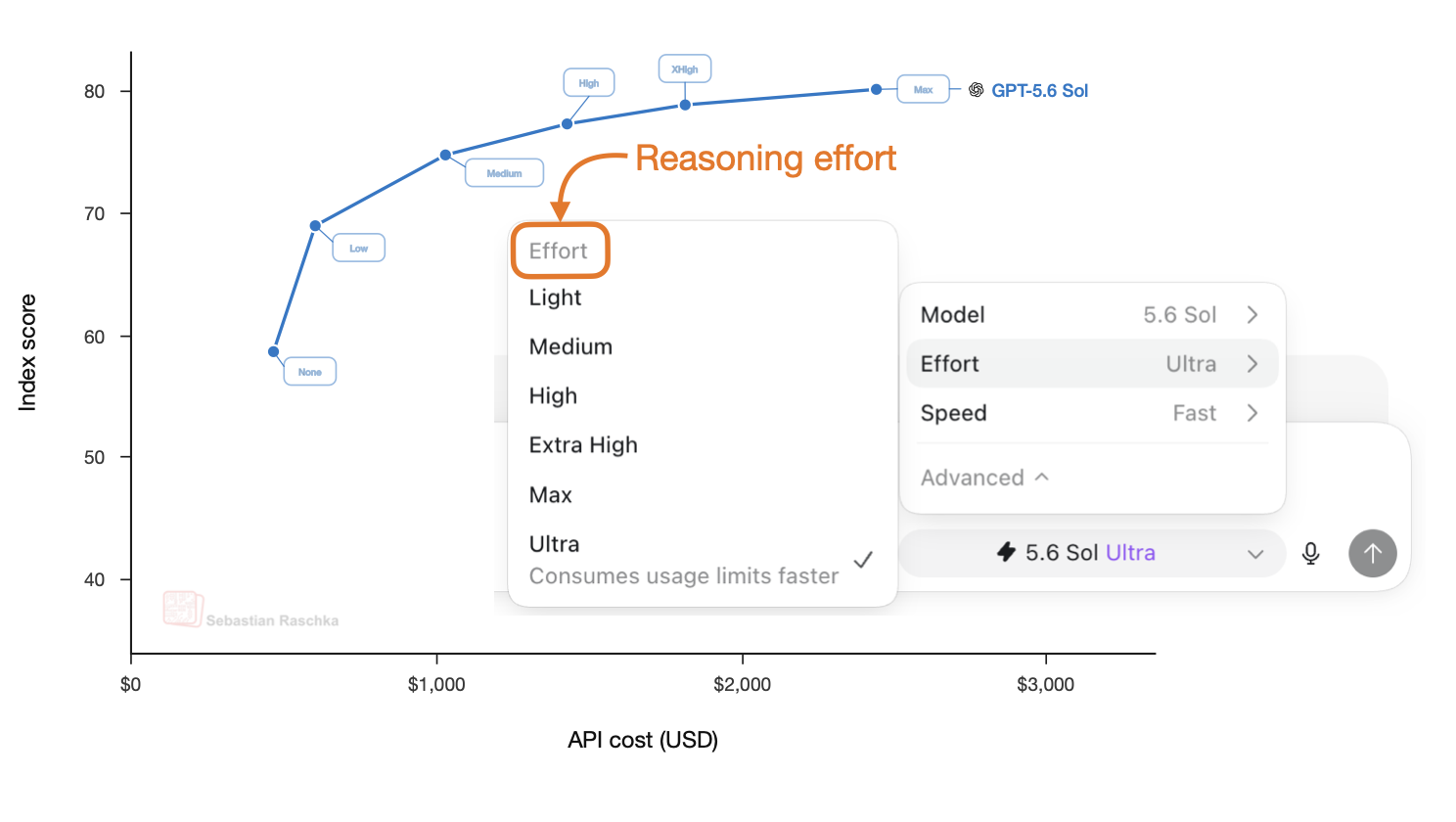
OpenAI released the GPT-5.6 model family last week, which comes in three sizes, each with roughly five or six reasoning-effort settings that allow users to adjust how much computational work the model applies to a problem.
Why it matters
Reasoning models—which output intermediate step-by-step explanations rather than jumping straight to answers—have become standard in modern model releases since OpenAI's o1 two years ago. The ability to dial reasoning effort up or down means developers and users can now trade off answer quality against latency and cost, rather than being locked into a single reasoning intensity.
What to watch
The article frames this as an evolution beyond early dedicated reasoning models (which were always verbose) toward hybrid approaches where the same model can toggle reasoning on and off or scale it to different effort levels, similar to what Qwen3 has already demonstrated.
Ask the AI about this article →
Summaries like this, in your inbox every morning.
Reasoning models have become a standard feature of modern LLM releases following OpenAI's introduction of o1 nearly two years ago. DeepSeek-R1, released about four months after o1, advanced the field by publishing a detailed recipe for training such models using reinforcement learning with verifiable rewards (RLVR)—a technique that provides reward signals (correct or incorrect) for verifiable domains like mathematics and code. The key insight from DeepSeek-R1's work is that models trained this way learn to generate reasoning traces, backtrack, and self-correct without explicitly training on the intermediate reasoning steps themselves; the final-answer reward signal alone is sufficient.
OpenAI's GPT-5.6 release reflects a maturation of this approach by introducing multiple reasoning-effort levels within the same model family. Earlier dedicated reasoning models like DeepSeek-R1 were monolithic—they always generated verbose outputs with no option to disable reasoning mode. Newer models like Qwen3 demonstrated that a single model can support both reasoning and non-reasoning modes via supervised fine-tuning and reinforcement learning stages, with a toggle flag to switch between them at inference time. GPT-5.6 extends this pattern further by allowing fine-grained control over reasoning intensity, giving users and developers the ability to optimize for their specific latency and cost constraints rather than accepting a one-size-fits-all reasoning depth.
For example, today's edition would include:
AI-summarized, only the topics you pick — one digest a day via Email, Slack, or Discord.
Free · 30 seconds with Google · unsubscribe anytimeWhat is AIToday? →
Ask AI anything about this article. Q&As are published on this page for other readers too.
OpenAI announced GPT-6 Astra on September 3, 2026

Nvidia CEO Jensen Huang declared on X that AGI has arrived, citing OpenAI's GPT-6 Astra, trained on roughly 10…

OpenAI said Saturday its AI agents posted messages on external wiki sites earlier this year, following a repor…

Former Chinese trade negotiator Quan Zhao argues that AI is becoming an autonomous actor, not a tool, and that…

NVIDIA's DGX Spark, priced at about ¥1.13 million, ranked first on price comparison site Kakaku.com's desktop…
OpenAI Chief Scientist Jakub Pachocki warned that smarter-than-human intelligence is coming in our lifetime, b…