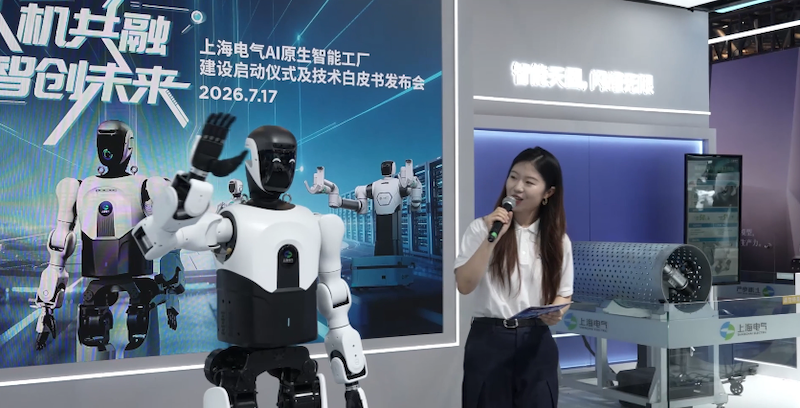
What happened
At WAIC 2026, Shanghai Electric unveiled a suite of embodied AI robots (including the SUYUAN bipedal humanoid with 41 degrees of freedom, the TUOYUAN wheeled humanoid, and the Mermaid bionic robot), core components like a planetary roller screw with more than three times the load capacity of traditional ball screws, and 51 AI models and agents under its "StarCloud Intelligent Manufacturing" series spanning R&D, production, and maintenance.
Why it matters
The robots and AI agents are designed to handle precision tasks in confined spaces—like connector insertion, assembly, and pipe processing—where human judgment combined with machine stability and strength is critical. The company framed this as "machine-assisted, human-machine collaboration," transforming manufacturing from experience-driven to data-driven operations through automated production-line scheduling, quality inspection, and predictive maintenance.
What to watch
Shanghai Electric released an "AI-Native Smart Factory Technology White Paper" proposing a vertically integrated architecture with three layers: an AI factory brain as control center, industrial agents and embodied robots as execution network, and a physical twin as digital mirror. The company aims to accelerate large-scale deployment of these AI-native smart factories across diverse manufacturing environments.
Summaries like this, in your inbox every morning.
Shanghai Electric's announcement at WAIC 2026 reflects a strategic push to embed AI and robotics into the core manufacturing workflow. The company is positioning embodied intelligence—robots that combine physical precision with AI decision-making—as the bridge between automation and the nuanced judgment humans bring to complex tasks. By emphasizing "machine-assisted, human-machine collaboration" rather than full replacement, Shanghai Electric is articulating a vision where robots handle the strength and precision demands while human expertise guides the operations.
The breadth of the portfolio—from specialized robots for connector insertion and pipe processing to dexterous hands and core mechanical components like the planetary roller screw—suggests Shanghai Electric is building a vertically integrated stack. This integration is reinforced by the release of the "AI-Native Smart Factory Technology White Paper," which proposes a three-layer architecture designed to eliminate traditional hierarchies and data silos. The white paper's emphasis on "self-perception, self-decision, and self-execution" capabilities indicates Shanghai Electric views the factory of the future as an autonomous, closed-loop system where production data flows continuously and informs real-time optimization.
The 51 AI agents launched across R&D, production, and maintenance domains are not isolated tools but embedded into robotic decision-making and the operational logic of these AI-native smart factories. This suggests Shanghai Electric is attempting to make industrial expertise reusable and scalable across different manufacturing environments, moving manufacturing from intuition and experience to data-driven operations supported by predictive maintenance and quality inspection agents.
Pick your industry and the AI tools you use, and get news related to your work every day.
Free · 30 seconds with Google · unsubscribe anytimeWhat is AIToday? →
Ask AI anything about this article. The AI reads this article, earlier AIToday articles, and Wikipedia, and cites its sources. Q&As are published on this page for other readers too.
Chunghwa Telecom president Rong-shy Lin said the shift from conversational AI to autonomous AI agents is resha…

CoreWeave fell 5% in premarket trading Friday and was on track to finish the week down 15%, after rebounding f…

Apple and Meta said they would jointly release a new open-weight AI model designed to run on high-end Macs, ai…

Investors put $38.5 billion into Asian startups in Q3, per Crunchbase data

A longtime Anthropic investor told Fortune he expects shares priced around $1.8 trillion, below the company's…

In Q2, billionaires or their funds sold six 'Magnificent Seven' AI stocks


