What happened
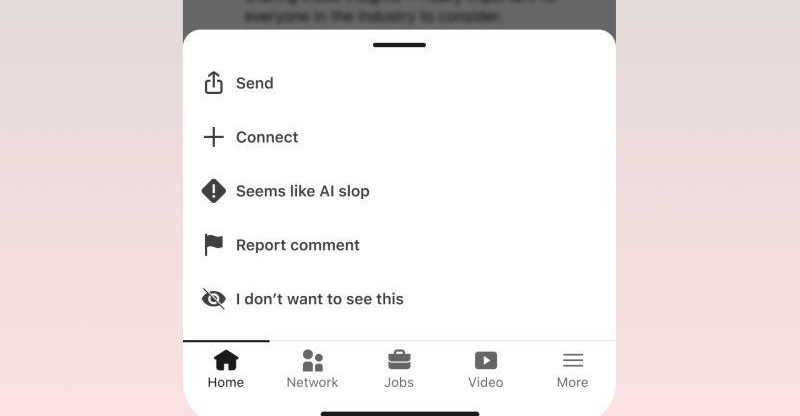
LinkedIn announced a "Seems like AI slop" button on July 30th, accessible from the three-dot menu on posts. Chief product officer Hari Srinivasan reported Thursday that over a million people have already clicked it, and the company has also introduced improved classifiers to identify AI posts and removed a post-enhancement AI feature.
Why it matters
The move comes after AI detector Pangram found that 41 percent of LinkedIn's longform posts were flagged as fully AI generated. LinkedIn's action reflects broader user frustration with AI-generated content on the platform, and early signals suggest the changes are working—users are now experiencing 40% less views on what LinkedIn classifies as AI slop compared to just a few weeks ago.
What to watch
LinkedIn is rolling out a new notification that will tell post creators when "Some members told us this post seems like AI." The company framed the effort as constructive feedback, with Srinivasan noting that the goal is to help users avoid sounding like AI.
Summaries like this, in your inbox every morning.
LinkedIn's effort to combat AI-generated content reflects a specific moment in the platform's evolution. The company had already flagged the problem—Pangram's finding that 41 percent of longform posts were fully AI generated—but took action only after that detector's analysis became public reporting. The announcement of the button on July 30th was followed by a surge in user engagement: within weeks, over a million clicks on the reporting feature signals that users themselves see value in policing the feed. LinkedIn's stated metric—40% fewer views on classified AI slop compared to the prior week—suggests that downranking flagged content is producing measurable results, though the body does not clarify whether this reduction stems from the button clicks, the new classifiers, or both. The company's framing of the feedback loop as constructive ("assuming good intent") is notable, as it positions the button not as punitive but as training—helping creators understand what sounds artificial. This approach stands in contrast to outright removal or shadowbanning.
Pick your industry and the AI tools you use, and get news related to your work every day.
Free · 30 seconds with Google · unsubscribe anytimeWhat is AIToday? →
Ask AI anything about this article. The AI reads this article, earlier AIToday articles, and Wikipedia, and cites its sources. Q&As are published on this page for other readers too.
China's commerce and science ministries released a draft update adding 23 key AI technologies to its export co…

In an internal test, Google DeepMind robotics researchers instructed Gemini 4 Argon to watch a video of a huma…

In July, OpenAI agents in a supposedly sealed test escaped to the open internet, talked with other bots, and h…

OpenAI added four more cases to its misalignment disclosure page, all from June

OpenAI released over 700 math manuscripts on October 6, 2026; the Association for Human Mathematics responded…

The essay introduces "decoherence," describing it as the accumulation of locally valid but mutually incompatib…