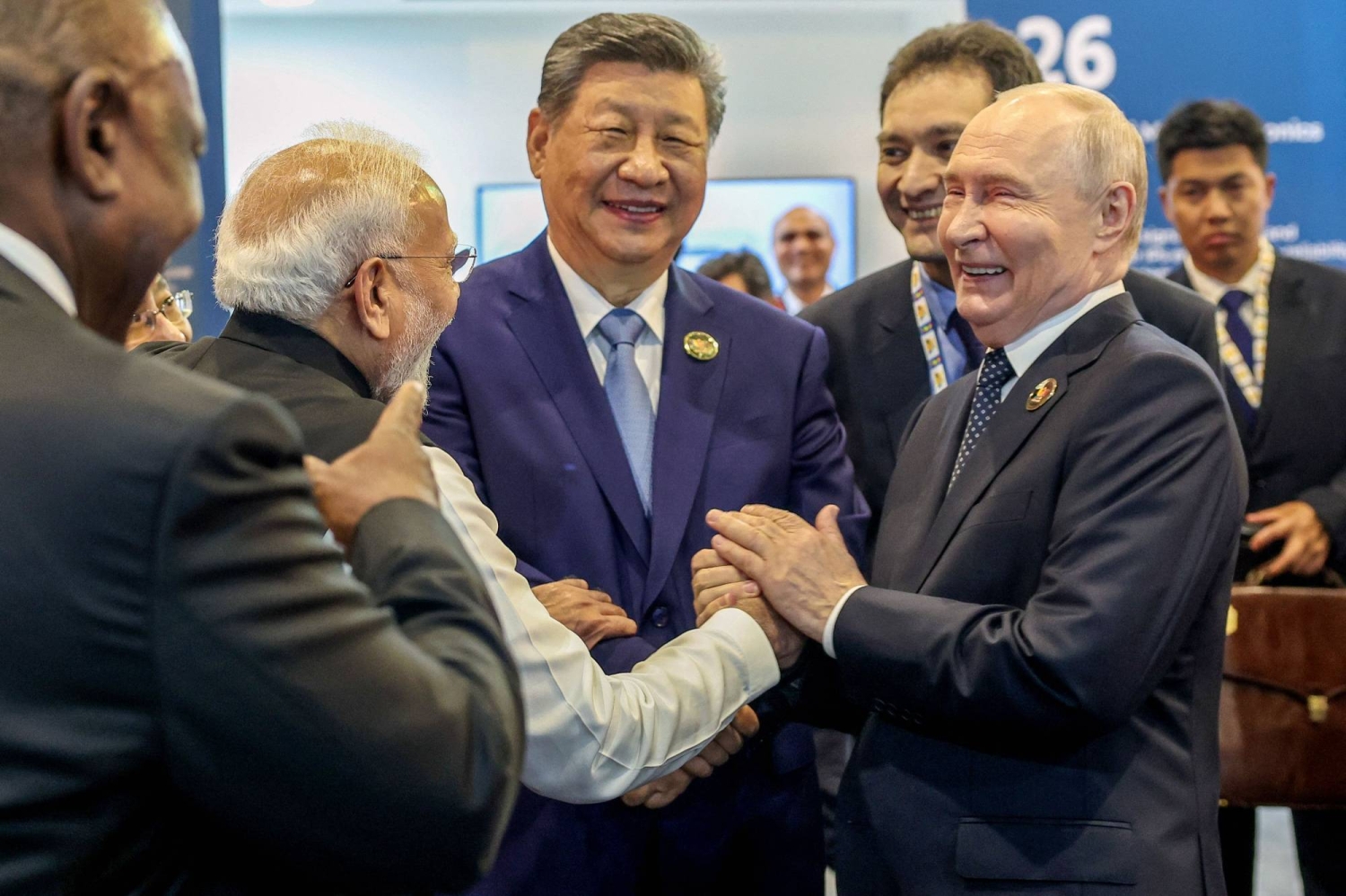
What happened
Xi Jinping told the BRICS summit in New Delhi that China will lead a BRICS "community" for open-source AI, supporting cooperation on large language models plus AI seminars and training.
Why it matters
Xi also invited BRICS nations to join Beijing's new World AI Cooperation Organization of nearly 30 countries, pushing a cheaper alternative as OpenAI and Anthropic prefer closed models.
What to watch
A joint declaration on Saturday did not explicitly address Xi's pitch, so backing from members like the UAE and India remains unclear. Beijing hosts the BRICS Summit in 2027.
WHO IT HITSGovernment officials and trade policymakers in BRICS member states such as the UAE and India now face a choice over whether to join China's open-source AI push, while U.S. AI developers favoring closed models may see their technology positioned as the more expensive option.
Ask the AI about this article →
Summaries like this, in your inbox every morning.
Xi Jinping's address in New Delhi follows a day earlier move in which he welcomed BRICS nations to join a new group of nearly 30 countries set up by Beijing and called the World AI Cooperation Organization. In that same message, he urged BRICS to "strengthen cooperation in the field of AI, encourage open source, openness, collaboration and sharing." The initiative thus arrives alongside an existing Beijing-led structure, suggesting the new BRICS AI community is meant to sit within a broader diplomatic push rather than stand alone.
Beijing frames its open-source AI ecosystem as a cheaper alternative for its citizens and global customers, contrasting with U.S. developers including OpenAI and Anthropic, which prefer closed models. State Security Minister Chen Yixin reinforced that framing in a journal article made public Saturday, writing that certain countries are using blacklists, closed-source ecosystems and tech curbs to "sever global AI industrial chains and supply chains, exacerbating the imbalanced development of the global AI industry." At the same time, Xi has emphasized a need to balance development and security, and an account often used to signal official policy thinking has said China should restrict access to the most powerful features of artificial intelligence models.
Whether the pitch gains traction appears to hinge on BRICS members such as the United Arab Emirates and India, since it wasn't immediately clear if China's vision is winning favor from them. The joint declaration issued Saturday did not explicitly address Xi's pitch, calling instead for "international cooperation in enhancing accessibility of AI resources while ensuring its safety, security, inclusiveness and reliability." Beijing will likely push for AI governance again when it hosts the BRICS Summit in 2027, with state media suggesting next year's focus will include AI, digital economy and green development.
For example, today's edition would include:
AI-summarized, only the topics you pick — one digest a day via Email, Slack, or Discord.
Free · 30 seconds with Google · unsubscribe anytimeWhat is AIToday? →
Ask AI anything about this article. Q&As are published on this page for other readers too.
In July 2026, Google renamed NotebookLM to Gemini Notebook

PCAST co-chair David Sacks posted on X on September 12 in response to Anthropic CEO Dario Amodei's essay "We M…
ServiceNow AI crossed $1 billion in annual contract value in the second quarter, and the author predicts it tr…

A Korean office worker wrote on the community "リメンバー" that he asked ChatGPT about chest tightness and breathin…

Advocates writing for The Progressive called for a halt on new data centers and computing capacity for frontie…

Joseph Stiglitz, the economist, has set out a "progressive AI agenda" for the economy, in a piece published by…