What happened
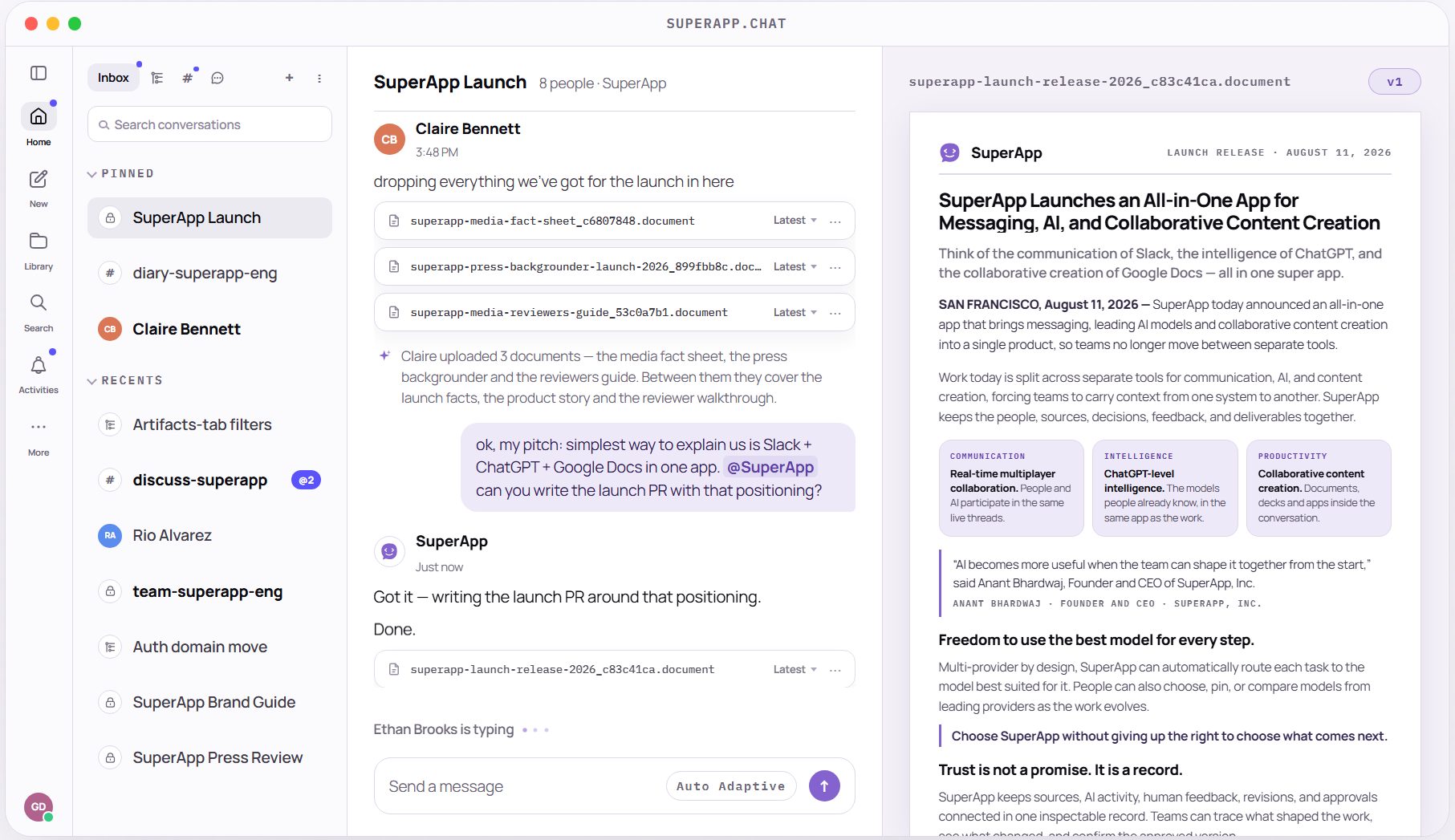
SuperApp Inc., formerly Instabase Inc., launched its flagship SuperApp platform today—a web, iOS, Android, and Windows application that combines Slack-like messaging, a Google Docs-style document library, and integrated access to AI models from OpenAI, Anthropic, and Google. The platform automatically routes tasks to the appropriate AI model based on efficiency, reasoning, knowledge, and cost, while allowing users to select or compare models within the same context.
Why it matters
The platform addresses a workflow problem the company identifies: teams currently split work between communication tools and separate AI chat interfaces, losing context and work history in the process. By embedding AI directly into team collaboration space, SuperApp aims to create a durable record of research and thinking that persists beyond individual chats—meaningful for organizations that want to preserve institutional knowledge and avoid vendor lock-in as AI models evolve.
What to watch
SuperApp's founding parent, Instabase, raised more than $250 million to date, including a $100 million Series D round in early 2025 led by the Qatar Investment Authority. The company is positioning this as a new product direction centered on AI collaboration rather than a rebrand; Instabase AI Hub will continue operating on SuperApp's technology.
Summaries like this, in your inbox every morning.
SuperApp emerges from Instabase, a company founded in 2015 that has raised more than $250 million, including a $100 million Series D round in early 2025 from the Qatar Investment Authority. The shift from Instabase's original focus on unstructured data processing to SuperApp's AI-centered collaboration platform signals a strategic pivot toward the current market priority: embedding AI into team workflows rather than treating it as a separate tool.
The core insight driving SuperApp is a friction point many knowledge workers face: the need to context-switch between communication platforms (like Slack) and dedicated AI chat interfaces (like ChatGPT). This split, the company argues, causes teams to lose the thinking and reasoning behind work once conversations end. By placing AI directly within a shared team space—alongside persistent messaging and document storage—SuperApp aims to create what founder Anant Bhardwaj calls a "durable record of the entire work." This design choice reflects a broader industry shift from single-user AI tools toward collaborative ones.
The multi-model routing strategy addresses another emerging concern: vendor lock-in and the pace of AI model evolution. Rather than forcing organizations to commit to one model, SuperApp's automatic routing allows teams to benefit from model improvements as they emerge without architectural disruption. Users retain the option to manually select or compare models, preserving agency while reducing friction for routine tasks.
Pick your industry and the AI tools you use, and get news related to your work every day.
Free · 30 seconds with Google · unsubscribe anytimeWhat is AIToday? →
Ask AI anything about this article. The AI reads this article, earlier AIToday articles, and Wikipedia, and cites its sources. Q&As are published on this page for other readers too.
Chunghwa Telecom president Rong-shy Lin said the shift from conversational AI to autonomous AI agents is resha…

CoreWeave fell 5% in premarket trading Friday and was on track to finish the week down 15%, after rebounding f…

Apple and Meta said they would jointly release a new open-weight AI model designed to run on high-end Macs, ai…

Investors put $38.5 billion into Asian startups in Q3, per Crunchbase data

A writer and entrepreneur opened his daily to-do list and found 156 items, and concluded that an AI assistant…

A longtime Anthropic investor told Fortune he expects shares priced around $1.8 trillion, below the company's…


