
Legacy technology still matters in the AI era.
Data professionals should keep their human judgment.
They must not lose their humanity when using AI.
What happened
The article discusses how legacy technology remains relevant in the age of AI, emphasizing that data professionals must not lose their 'humanity' when interacting with AI.
Why it matters
As AI becomes more central to business operations, the article suggests that older, established technical approaches still hold value, and that data experts need to balance technological efficiency with human judgment and ethics.
What to watch
The piece indicates that companies should consider how to integrate AI tools without completely discarding traditional methods, ensuring that data personnel maintain a human-centric approach in their work.
Ask the AI about this article →
Summaries like this, in your inbox every morning.
The article addresses a tension emerging within the business use of AI: as tools become more advanced, there is a temptation to rely on them entirely. It cautions against this, arguing that older, established technical foundations still provide stability and context that modern AI lacks. The piece suggests that data professionals have a specific responsibility—to use AI as a complement rather than a replacement for their own reasoning.
The framing around 'humanity' points to softer factors such as ethics, contextual understanding, and value judgment, which are not yet fully replicable by AI. The article appears to advocate for a hybrid approach: deploying AI for efficiency while keeping human oversight for decisions that carry broader implications. This perspective aligns with broader discussions in the industry about responsible AI deployment, although the article itself does not reference any external reports or examples.
Overall, the message is a reminder that technological advancement does not automatically make prior expertise obsolete. For business readers, the implication is that workforce training and process design should reinforce human capabilities alongside AI integration, rather than assuming AI can operate in isolation.
For example, today's edition would include:
AI-summarized, only the topics you pick — one digest a day via Email, Slack, or Discord.
Free · 30 seconds with Google · unsubscribe anytimeWhat is AIToday? →
Ask AI anything about this article. Q&As are published on this page for other readers too.
JM-Applied, a Taiwanese semiconductor gas equipment maker and supply chain member for Micron and TSMC, said on…

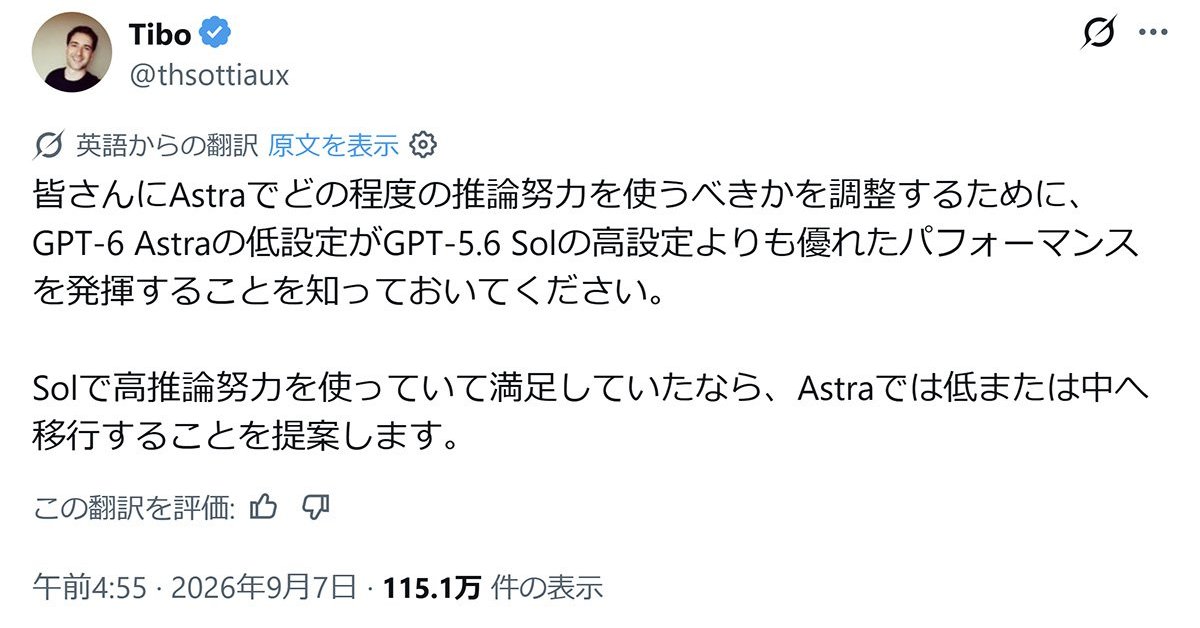
OpenAI's product lead Tibo Sotiou posted on X on September 6 that GPT-6 Astra's 'low' setting outperforms GPT-…
Nvidia disclosed roughly $99 billion of public and private equity investments as of July 26, plus about $25 bi…
In January, Ukraine's defense ministry said it would share millions of data points from tens of thousands of d…

OpenAI Group PBC acknowledged it did not publicly disclose an episode where its AI agents wrote to outside web…

Eaton is expanding beyond traditional power management into modular power deployment, next-generation DC conve…