What happened
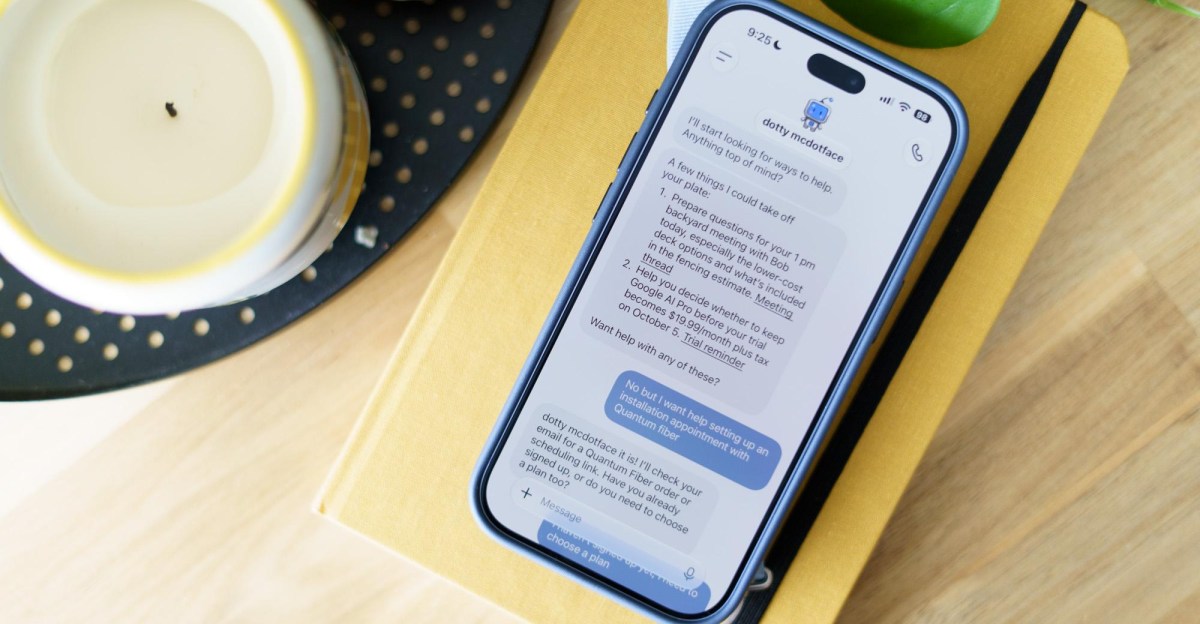
The Verge's Allison Johnson tested OpenAI's newly announced Dots agent on its $100-per-month Pro account and found it redesigned her personal website and cut desktop video clips, but got stuck on human and security checks booking an internet installation, an Ikea login, and a teriyaki order.
Why it matters
Dots is gated to OpenAI's highest-tier accounts, so the product reads as business software rather than a personal shopping helper — a positioning that may indicate the company is targeting workplace users first.
What to watch
Dots required more manual input and browser takeovers than other AI agents Johnson tested, so its usefulness hinges on whether OpenAI can reduce those security-check failures; the $100-per-month Pro account is the price to watch.
WHO IT HITSThe gated rollout to OpenAI's highest-tier accounts points the product at knowledge workers and small-business operators who already pay for premium AI tools. IT and operations teams evaluating workplace agents will likely weigh Dots' frequent security-check stalls against its success on tasks inside their own systems.
Summaries like this, in your inbox every morning.
OpenAI announced Dots earlier this week as an agent platform with blobby, anthropomorphic avatars and customizable names — closer in look to Meta's Muse than to conventional business software, but positioned squarely as work tooling. The Verge's Allison Johnson named hers Dotty McDotface and tested it on the $100-per-month Pro account she expensed, noting that Dots can access apps like Blender and GIMP right off the bat and can also be given access to a user's own computer through the desktop ChatGPT app.
The test exposed a split personality. When Johnson handed Dot tasks fully within her control — a personal website redesign and consolidating desktop video files — it delivered, even recreating a prototype block by block and pinging her on the ChatGPT phone app when the video clip was ready. Outside services were another matter: an internet installation booking stalled at a "human check" requiring a sustained mouse hold, an Ikea login looped in a security check, and the neighborhood teriyaki spot wouldn't let Dot onto its ordering page. A coworking space search also missed a free-tour option that Instinct found within minutes. Dot itself attributed the stalls to websites blocking its cloud browser traffic, and Johnson observed it required more manual takeovers than competing agents — possibly because it wasn't purpose-built for such errands.
The larger question is who Dots is for. The gated rollout to OpenAI's top-tier accounts, and the fact that users pay upfront rather than through eventual ad monetization, suggests an enterprise-first bet — a reading the product's mixed results on consumer errands only reinforce. Whether Dots becomes genuinely useful for a given worker may hinge on how much of their work lives inside systems they control, and on OpenAI closing the security-check gap that repeatedly forced Johnson to step in.
Pick your industry and the AI tools you use, and get news related to your work every day.
Free · 30 seconds with Google · unsubscribe anytimeWhat is AIToday? →
Ask AI anything about this article. The AI reads this article, earlier AIToday articles, and Wikipedia, and cites its sources. Q&As are published on this page for other readers too.
Talkdesk's survey of 252 director-level-and-above leaders found 98% use some form of AI in customer experience…

The Allen Institute for AI announced Olmo-core 3 on Thursday, a training framework it says scaled mixture-of-e…

Ben Thompson wrote that Meta's new Meta Enterprise Platform "won't work" and is "a distraction from the bigges…
Broadcom is reportedly raising $60 billion to fund chips for Anthropic, on top of a loan of up to $42 billion…

Meta is letting go of employees it hired from AI safety startup Virtue AI, four months after they joined in Ju…

Bain & Company found the industry's compute demand will require $6 trillion in annual revenue by 2031, includi…