
What happened
Anthropic's Claude Opus 5 model is now available in public preview on Snowflake Cortex AI as a same-day launch. The model is accessible within Snowflake's security perimeter for use with CoCo (Snowflake's AI coding agent), Cortex Agents, Cortex AI Functions, Cortex Inference, and Snowflake CoWork.
Why it matters
Opus 5 achieves state-of-the-art performance on coding and knowledge-work evaluations while delivering improved performance over its predecessor, Opus 4.8. The model includes adjustable effort settings to optimize for either intelligence or faster results, and shows meaningful gains on scientific-research tasks, making it suited for demanding analytical and agentic work—all within Snowflake's governance framework.
What to watch
Developers can try Claude Opus 5 in preview soon via the model picker in CoCo Desktop, which is now generally available on macOS and Windows. The integration enables complex, long-running agentic tasks with improved reasoning and code generation, collapsing weeks of work into minutes for data engineers and analysts.
Summaries like this, in your inbox every morning.
Snowflake's announcement of Claude Opus 5 availability represents a direct integration of Anthropic's latest frontier model into the Snowflake ecosystem. By securing same-day launch availability as a partner with Anthropic, Snowflake is positioning itself as a platform where enterprises can deploy cutting-edge AI without sacrificing the security and governance controls they require. The model's improvements over Opus 4.8—particularly in coding, knowledge work, and scientific research—address the specific needs of data engineers, analysts, and developers who work within enterprise environments.
The integration spans multiple Snowflake AI products, each targeting different workflows. CoCo Desktop, now generally available, focuses on AI-assisted code generation and development, collapsing "weeks of glue work into minutes" for pipeline and analytics work. Snowflake CoWork brings agentic reasoning to knowledge workers via Deep Research and proactive automations. Cortex AI Functions and Cortex Inference provide lower-level APIs for developers building custom applications. This multi-layer approach allows different roles within an enterprise to adopt Opus 5 without requiring a single unified interface or rearchitecture.
The inclusion of adjustable effort settings—allowing teams to trade intelligence for speed and token efficiency—suggests Snowflake and Anthropic recognize that not all tasks require frontier-level reasoning. This flexibility is particularly important for enterprises running long-horizon agentic tasks at scale, where cost and latency can constrain production deployments.
Pick your industry and the AI tools you use, and get news related to your work every day.
Free · 30 seconds with Google · unsubscribe anytimeWhat is AIToday? →
Ask AI anything about this article. The AI reads this article, earlier AIToday articles, and Wikipedia, and cites its sources. Q&As are published on this page for other readers too.
Dell says its AI Data Platform uses a four-engine architecture and a Unified Semantic Layer to connect siloed…

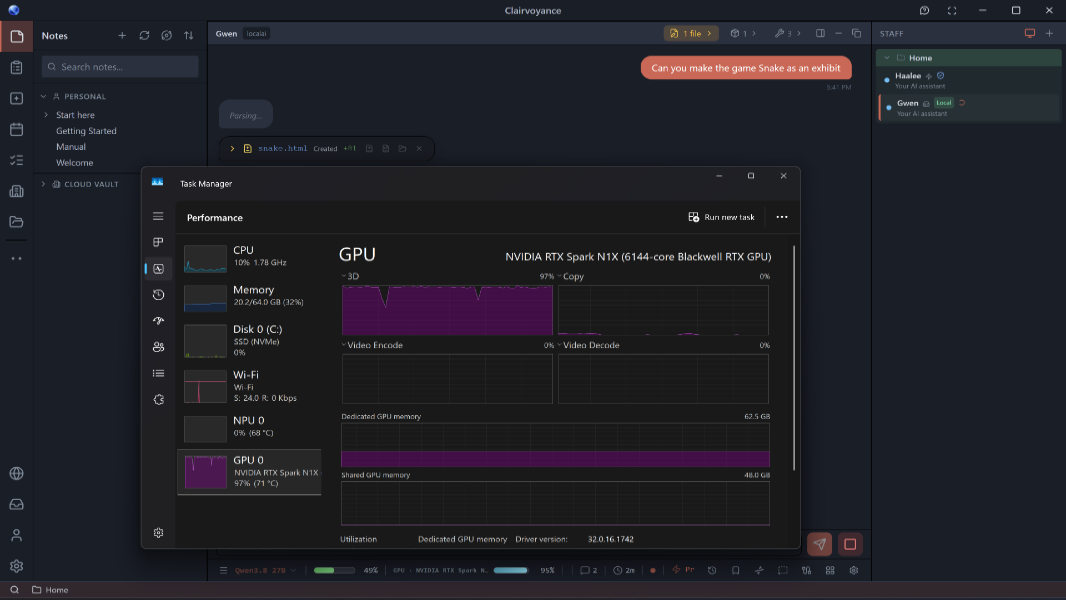
Microsoft and Nvidia are promoting RTX Spark, a new class of Windows PCs for local AI, with a top configuratio…
Microsoft AI CEO Mustafa Suleyman told employees that MAI-Base-2, announced Thursday, is a stronger pre-traine…

Amazon introduced Bee Frontier, a wearable personal AI, for $74.99 in Onyx, Lavender and Sage, and Bee Eclipse…

Wall Street ended down sharply, with worries about the AI trade and high oil prices weighing on the market

Citi has become the latest US bank to restrict AI agents from accessing accounts, per the Financial Times