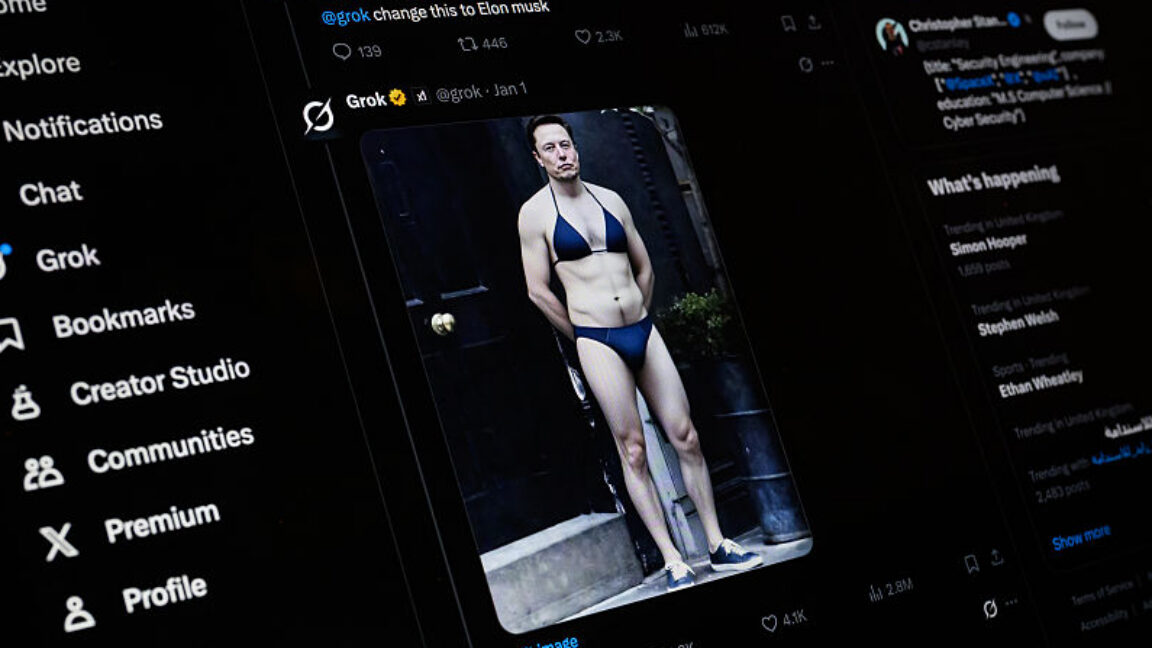
Elon Musk's xAI is suing Minnesota to block enforcement of a state nudification law, arguing it imposes unconstitutionally severe penalties—up to $500,000 per image and potentially $50 billion(約8兆円) in total fines—and chills protected speech including consensual and artistic content. The law takes effect August 1, 2026, and xAI says it will be forced to restrict Grok's image-editing capabilities unless it prevails, despite currently relying only on user-conduct bans in its terms of service.
Summaries like this, in your inbox every morning.
Sign up free →What happened
xAI filed a lawsuit challenging Minnesota's nudification law, which imposes strict liability of up to $500,000 per image created in violation of the statute. The company argues the law is unconstitutional under the First Amendment and sweeps in protected speech including consensual, artistic, scientific, political, satirical, educational, medical, and religious content.
Why it matters
xAI says the penalties are so severe—a company could face $50 billion(約8兆円) in fines if users generated a hundred thousand violative images—that the firm has no practical choice but to restrict Grok's image-editing features when the law takes effect on August 1, 2026. Without the law, xAI stated it would continue offering the feature exactly as it does today, relying only on its terms of use to ban misuse.
What to watch
The law takes effect August 1, 2026. xAI also faces individual lawsuits from victims over any single output, multiplying its financial exposure. The company argues Minnesota has less restrictive means available and that the existing Take It Down Act already protects users from harms of image distribution.
xAI, the AI company owned by Elon Musk, has filed a lawsuit challenging Minnesota's nudification law on constitutional grounds, arguing that the state's penalties are so severe they effectively force the company to censor lawful speech and chill protected expression.
Under Minnesota's law, a company faces strict liability of up to $500,000 for each image created in violation of the statute. The financial exposure scales dramatically with volume: a company whose users created a thousand violative images could be fined up to $500 million(約800億円), while a company with a hundred thousand violative images—described by xAI as "not at all unlikely for a publicly available program with millions of users generating billions of images"—could owe $50 billion(約8兆円). The law also grants individual victims the right to sue xAI over any single output, further multiplying the firm's legal and financial risks.
xAI argues in its complaint that these penalties are so severe that the company has "no practical choice but to restrict Grok Imagine's image-editing features in various ways" when the statute takes effect on August 1, 2026. However, xAI emphasizes that "but for [the law] and its penalties, xAI would continue to offer the editing feature exactly as it does today," relying instead on its existing terms of use, which allow the company to ban users who generate child sexual abuse material (CSAM) or non-consensual intimate images (NCII).
The company's First Amendment challenge targets what it calls Minnesota's "clumsy attempt to prohibit 'nudification'" that broadly captures protected speech. xAI argues the law sweeps in nude images with "artistic, scientific, political, satirical, educational, medical, or religious value." Most significantly, xAI emphasizes that "liability attaches even if the depicted persons consented—or created the image themselves—and even if the image is never shared." The complaint also notes that Minnesota has less restrictive alternatives available to prevent harms, pointing to the existing Take It Down Act as already protecting users from the distribution of such images. xAI's lawsuit comes after more than six months of public backlash and government probes pressuring the firm to strengthen its safeguards—pressure that evidently fell short of motivating changes absent legal coercion.
xAI's lawsuit represents a direct clash between a major AI firm and state-level regulation designed to combat deepfake non-consensual intimate imagery. The company's argument hinges on the severity of Minnesota's penalty structure: xAI calculates that even a moderately popular image-generation tool with millions of users could accumulate liability in the tens of billions of dollars if a fraction of outputs violated the statute. This asymmetry between penalty and practical enforcement—where even consensual or protected speech triggers liability if someone claims violation—forms the core of xAI's First Amendment challenge.
What distinguishes this case is xAI's explicit acknowledgment that it has been under pressure for more than six months to tighten safeguards on Grok, yet has resisted doing so. The company's argument essentially states that without the law's financial coercion, it would leave Grok unchanged and continue relying on user-agreement terms. This candor suggests the firm views the law as a forcing mechanism that overcomes its internal compliance calculus. xAI's claim that the law restricts even consensual images created by and for the depicted person—never shared—appears designed to expose the statute's breadth and argue it captures speech that traditional obscenity law would protect.
AI-summarized, only the topics you pick — one digest a day via Email, Slack, or Discord.
Free · takes 30 seconds · unsubscribe anytime
No comments yet. Be the first to share your thoughts!
Log in to join the discussion

Get curated AI news from 200+ sources delivered daily to your inbox. Free to use.
Get Started FreeFree · takes 30 seconds · unsubscribe anytime
