What happened
KDDI and Michinori Holdings announced on August 28, 2026, that they will run a demonstration from September 1 using AI to autonomously optimize communication quality for autonomous buses. The trial is part of a project adopted by Japan's Ministry of Internal Affairs and Communications and is conducted with cooperation from Hitachi City, Ibaraki Prefecture.
Why it matters
The demonstration compares network performance before and after AI-based RAN (radio access network) parameter optimization under remote monitoring. It aims to verify how much AI can cut the labor involved in network design and adjustment, and to measure improvements in 5G connectivity and signal quality for autonomous driving.
What to watch
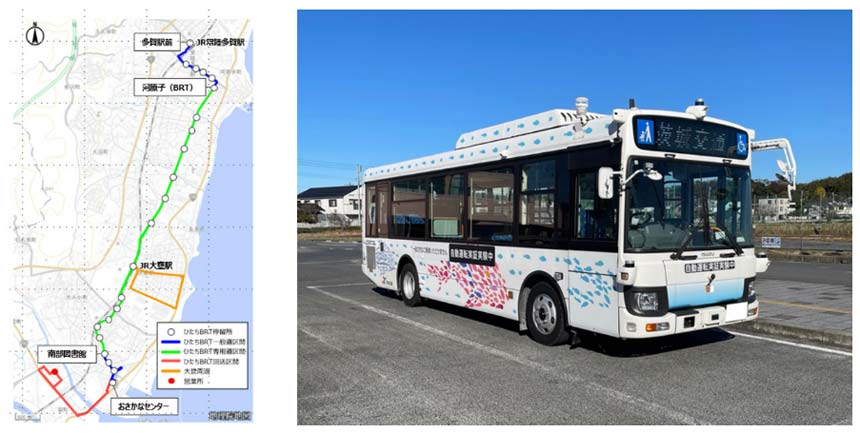
The test will run on two routes: the Hitachi BRT route, which has operated level 4 autonomous driving over a 6.1 km section since February 2025, and the Omika Station loop route, about 3.0 km, which has run level 2 autonomous driving since January 2025. The BRT route includes 14 bus stops, 11 crossings with general roads, and 15 pedestrian crossing points.
Summaries like this, in your inbox every morning.
This trial is part of a broader Japanese government push to deploy level 4 autonomous driving in regional areas, as seen by its adoption under the ministry's project. The Hitachi BRT route already operates in revenue service at level 4, making it a realistic testing ground for network optimization. By comparing AI-adjusted RAN parameters against the status quo, the demonstration could show whether network tuning can be automated enough to cut manual labor—a key cost in running autonomous services. If successful, this could make it easier for other rural operators to adopt similar systems, though the results are not yet known. The inclusion of both a long BRT route and a shorter loop provides data from different operational scales and vehicle types, which may help generalize the findings.
Pick your industry and the AI tools you use, and get news related to your work every day.
Free · 30 seconds with Google · unsubscribe anytimeWhat is AIToday? →
Ask AI anything about this article. The AI reads this article, earlier AIToday articles, and Wikipedia, and cites its sources. Q&As are published on this page for other readers too.
ElevenLabs completed a $300 million employee tender at a $22 billion valuation, and co-founder Mati Staniszews…

On October 15, OpenAI announced the Rosalind Academic Plan, giving approved US university labs free access to…
JR Central announced the S0系 on October 16, its first full model change since the N700S, with commercial servi…
A Qiita article compared automated red-teaming methods for LLM apps — GCG, PAIR, and TAP — using mock implemen…

Liquid AI released d1-ultra on October 15, 2026, an upgraded open-weights decision model that averaged 76.7 ac…
Circlia started a proof-of-concept for TASTE SIGNAL: visitors to Holland Village Cafe FUKUOKA taste cookies an…