What happened
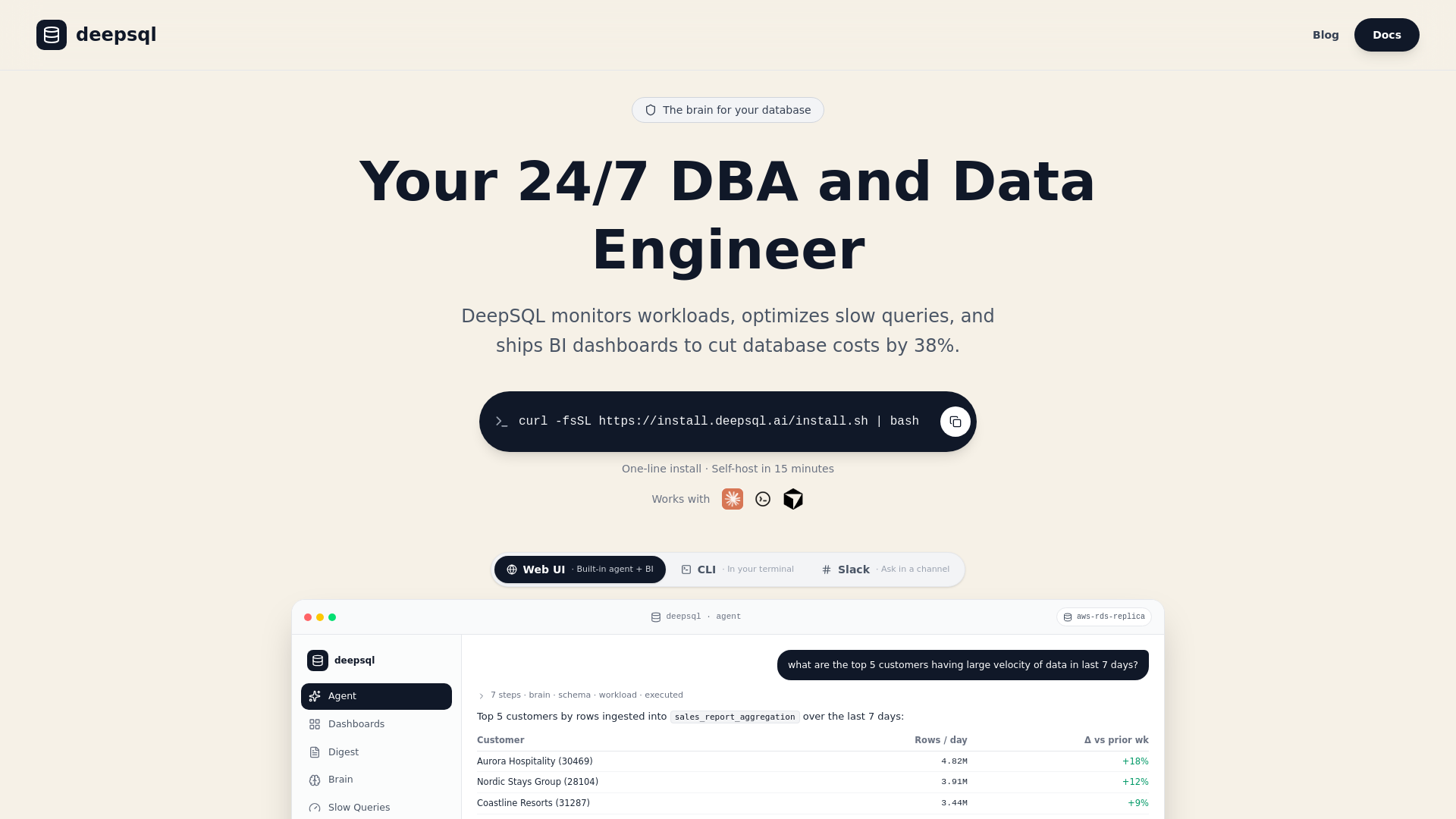
DeepSQL, a self-hosted AI database agent for Postgres and MySQL, monitors workloads, optimizes slow queries, and generates business intelligence dashboards. The tool installs in 15 minutes on any Linux machine, EC2 instance, or container and learns from slow query logs to make optimization recommendations.
Why it matters
Organizations running their own databases can reduce infrastructure costs by 38% while keeping all data and credentials within their own VPC—no data leaves the infrastructure. The tool accepts business rules in plain English (e.g., revenue definitions) and connects to existing AI tools like Claude and Cursor, making database optimization accessible to teams without deep SQL expertise.
What to watch
DeepSQL clusters slow queries into fingerprints (reducing 1,284 queries to 96 patterns in the example shown) and offers role-based access controls, query policies, and audit logs. The agent runs entirely self-hosted, requiring only read-replica credentials to a Postgres or MySQL database.
Summaries like this, in your inbox every morning.
DeepSQL addresses a common pain point for organizations running their own databases: the cost and complexity of query optimization and database observability. Rather than relying on external SaaS platforms that require data to be shipped elsewhere, the tool runs entirely within a company's infrastructure, appealing to teams with strict data residency requirements or security concerns. The 15-minute setup time and read-only database access (via read replica) lower the barrier to adoption—there is no need for invasive schema changes or broad write permissions.
The product combines three traditionally separate workflows: slow-query monitoring (traditionally handled by tools like pg_stat_statements), optimization recommendations (often manual or custom-built), and business intelligence dashboarding. By learning from slow query logs and clustering them into fingerprints (reducing 1,284 queries to 96 patterns in the described example), DeepSQL aims to help teams identify the highest-impact optimization targets. The claim of 38% cost reduction is grounded in workload optimization, though the body does not detail the mechanism or typical scenario behind that figure.
Pick your industry and the AI tools you use, and get news related to your work every day.
Free · 30 seconds with Google · unsubscribe anytimeWhat is AIToday? →
Ask AI anything about this article. The AI reads this article, earlier AIToday articles, and Wikipedia, and cites its sources. Q&As are published on this page for other readers too.
Cammarata reinterprets InceptionV1's cat-car neuron as a V-shape detector, not two unrelated concepts

Google Deepmind's Gemini 4 Argon scored 97.5 percent on ARC-AGI-3 at a cost of $4,800, second only to GPT-6 As…

Microsoft's Surface Laptop Ultra, using Nvidia's RTX Spark platform, starts at $2,599 (up to $5,899)

Meta's new commercial terms, effective October 30th, appear to let it crawl and train AI on content from websi…
Vercel data published Thursday shows TypeSafe AI's Jev, a lightweight decision model for choosing among predet…
Reflection AI introduced Beam, an open-weight model for agentic coding and long-horizon tasks, with 501 billio…