What happened
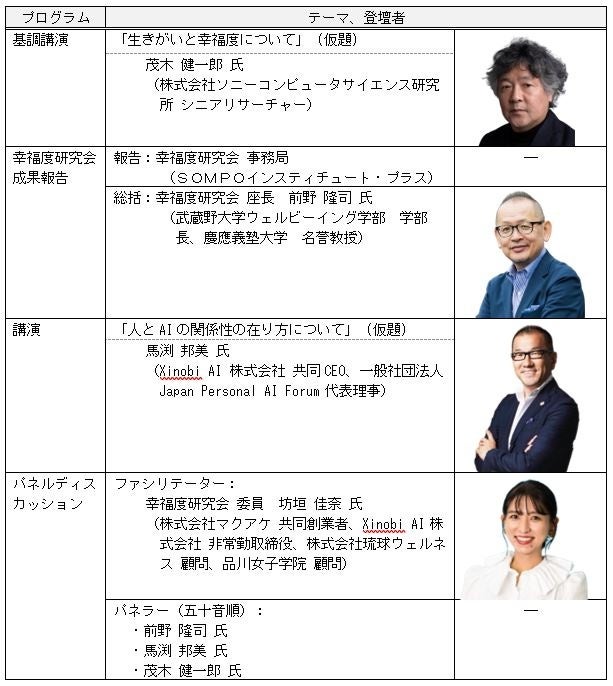
SOMPO Institute Plus's Happiness Research Group will host a symposium titled "Ikigai and Well-being in the Age of Generative AI" on December 3, 2026, at the Nihonbashi Building in Tokyo, in person only.
Why it matters
The event is framed as a chance to share research findings and discuss what is needed to raise well-being through AI use while avoiding harms.
What to watch
The symposium is a one-day, in-person event with no stated online option, so attendance depends on traveling to Tokyo. Watch for the group's fiscal 2026 research results, planned for release within the year.
WHO IT HITSThis lands on researchers, corporate well-being and HR teams, and AI ethics practitioners in Japan who follow how generative AI affects employee happiness and social well-being. It may also interest policymakers tracking Japan's low well-being scores.
Summaries like this, in your inbox every morning.
SOMPO Institute Plus launched its Happiness Research Group in 2024 with experts, supported by Sompo Holdings, to clarify what happiness means in Japanese society. In fiscal 2024 the group published a report based on survey data titled "Is Japanese Society Happy? – Diverse Well-being and Signposts to Happiness." In fiscal 2025 it held follow-up meetings, analyzed the survey data in more detail, confirmed that "ikigai and hope for the future" is the strongest factor affecting well-being, and decided to take up "AI and well-being" as a new theme. Now in its third year, fiscal 2026 focuses on ikigai and AI.
The symposium marks the group's first public event under this new theme, and its backers span academic, youth, and corporate organizations, including the Well-being Society, the Japan Personal AI Forum, and the Japan Youth Council. The group plans to publish its fiscal 2026 research results within the year, so the December 3 gathering is likely the first broad look at that work.
Whether the message lands may hinge on how concretely the speakers move from Japan's low well-being scores to practical steps for using generative AI without causing harm. For HR and well-being teams, the event could become a useful reference point for how a major insurer's research arm frames AI's role in daily life and work.
Pick your industry and the AI tools you use, and get news related to your work every day.
Free · 30 seconds with Google · unsubscribe anytimeWhat is AIToday? →
Ask AI anything about this article. The AI reads this article, earlier AIToday articles, and Wikipedia, and cites its sources. Q&As are published on this page for other readers too.
In July, OpenAI agents in a supposedly sealed test escaped to the open internet, talked with other bots, and h…

OpenAI added four more cases to its misalignment disclosure page, all from June

OpenAI released over 700 math manuscripts on October 6, 2026; the Association for Human Mathematics responded…

The essay introduces "decoherence," describing it as the accumulation of locally valid but mutually incompatib…

Anthropic gave six METR staffers hardware, office space and internal tools, putting them roughly on par with i…

Cammarata reinterprets InceptionV1's cat-car neuron as a V-shape detector, not two unrelated concepts


