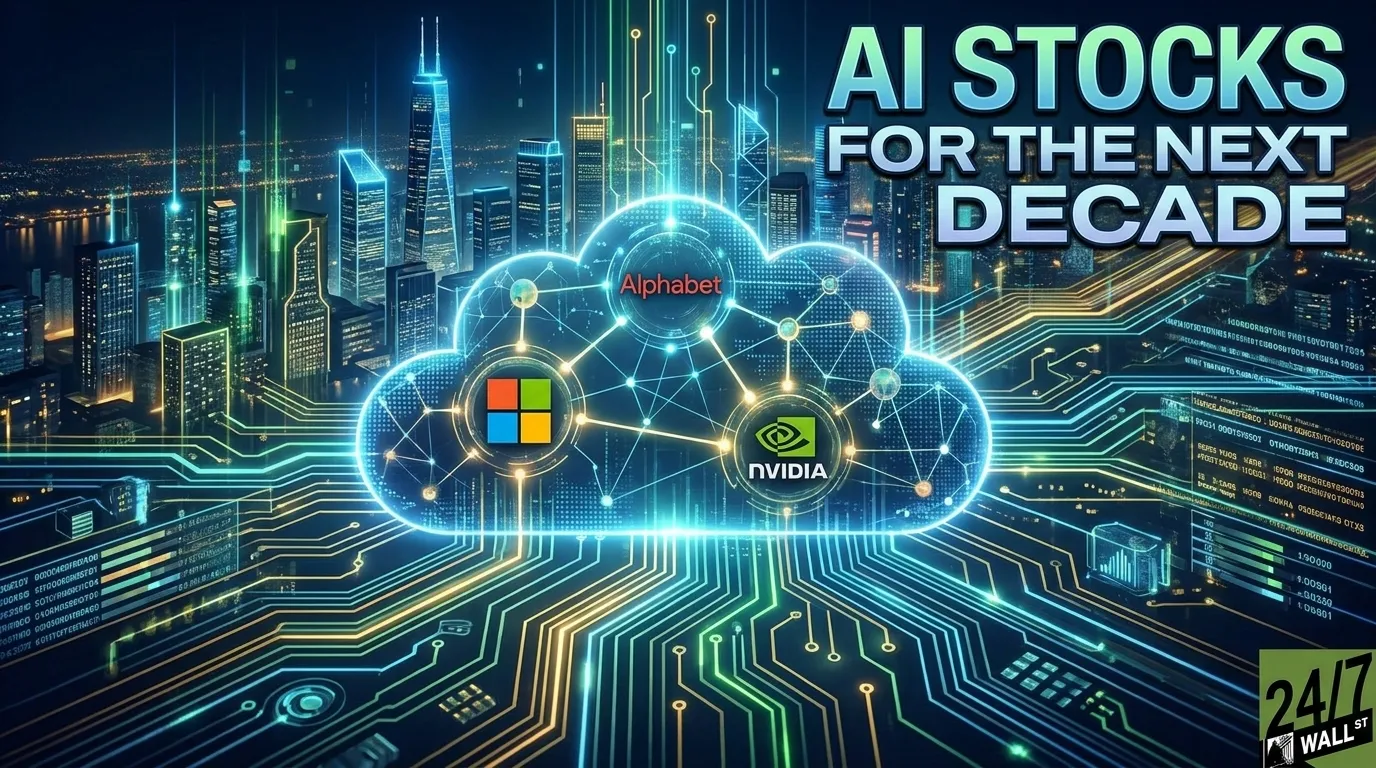
Microsoft, Alphabet, and Nvidia lead the AI buildout with record revenue and growth rates. Microsoft's Azure crossed $100 billion annually at 41% growth; Google Cloud hit $24.77 billion at 82% growth.
Nvidia's Data Center revenue reached $75 billion, up 92% year over year. Each occupies a distinct layer—software margins, cloud distribution, and silicon supply.
The main risk is capex overinvestment if AI demand normalizes.
What happened
Microsoft's Azure revenue crossed $100 billion annually for the first time, growing 41%, while Alphabet's Google Cloud accelerated to $24.77 billion at 82% growth—the fastest rate of any major cloud platform this cycle. Nvidia's Data Center revenue hit $75 billion, up 92% year over year, with management projecting $1 trillion in Blackwell and Rubin revenue from 2025 through calendar 2027.
Why it matters
The three companies occupy distinct layers of AI infrastructure—Microsoft monetizes AI at software margins through Azure and Copilot (which surpassed 30 million paid seats), Alphabet distributes AI at scale (Gemini processes 22 billion API tokens per minute and has 950 million monthly active users), and Nvidia supplies the hardware that powers the stack. Analyst consensus is strongly bullish across all three, with Microsoft and Nvidia at 95 bullish votes each and Alphabet at 91.
What to watch
Microsoft faces the largest near-term risk—fiscal 2026 capex hit $35.8 billion in Q4 alone and free cash flow fell to $19.6 billion, creating margin compression risk if AI demand normalizes before infrastructure depreciates. Alphabet's Q2 capex hit $44.92 billion and free cash flow turned negative at -$5.86 billion. Nvidia carries a beta of 2.22, meaning drawdowns are volatile, and hyperscaler concentration runs near 50% of data center revenue.
Ask the AI about this article →
The article frames three US-listed technology names as the winners of the AI infrastructure cycle based on revenue momentum and backlog visibility. Each occupies a distinct economic layer: Microsoft captures software licensing margins through Azure and productivity software (Copilot), Alphabet monetizes AI at hyperscale distribution (Google Cloud and Gemini), and Nvidia supplies the silicon foundational to both. The investment case rests on contracted backlog—Microsoft's commercial remaining performance obligation reached $678 billion, up 84%—combined with accelerating user adoption and unit economics leadership. Analyst consensus is uniformly bullish (95 votes for Microsoft and Nvidia, 91 for Alphabet) against 0–2 bearish votes per name.
The immediate tension in the thesis is capital intensity. Microsoft spent $35.8 billion on capex in Q4 alone and saw free cash flow fall to $19.6 billion; Alphabet's Q2 capex hit $44.92 billion, turning free cash flow negative at -$5.86 billion and prompting a buyback suspension. Nvidia, though generating stronger unit economics, carries a beta of 2.22 and depends heavily on hyperscaler customers (nearly 50% of data center revenue) with zero China exposure currently. The article explicitly flags that if AI demand normalizes before the infrastructure depreciates, capex overspend becomes the story and margin compression follows.
For example, today's edition would include:
AI-summarized, only the topics you pick — one digest a day via Email, Slack, or Discord.
Free · takes 30 seconds · unsubscribe anytimeWhat is AIToday? →
Ask AI anything about this article. Q&As are published on this page for other readers too.
Palantir Technologies stock has posted multi-year gains, including an 11x return over 3 years

CrowdStrike shares rose 5.77% on Monday, driven by investor excitement over its AI-powered cybersecurity growt…

Nvidia paused some deals under its AI financing program, which offered credit support to smaller AI cloud comp…
NVIDIA is now acting as a financier for its own demand, helping raise over $500 billion of third-party capital…
GE Vernova unveiled its medium-voltage uninterruptible power supply (MV-UPS) on August 24
A new analysis argues that the stock market's high valuations rest on the assumption that AI will lift product…