What happened
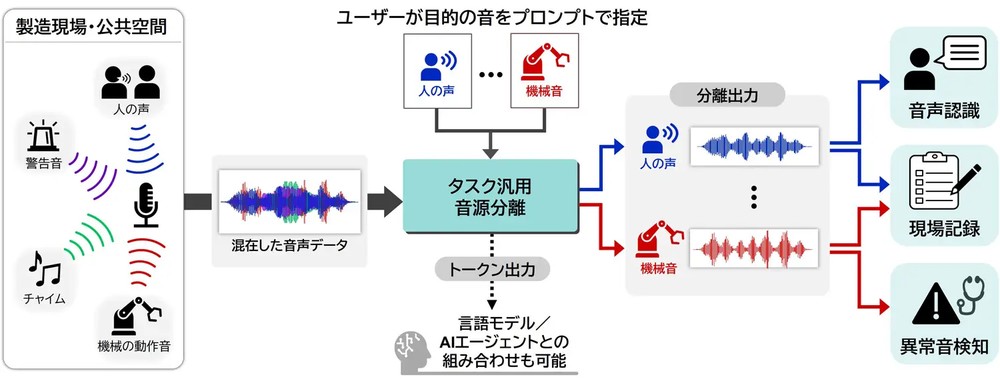
Mitsubishi Electric said it developed a single AI model, Task-Specific Sound Source Separation Technology, that separates mixed sound by specifying sound types such as speech, machine noise, and music through a prompt.
Why it matters
It moves from one model per task to one prompt-driven model that separates multiple sound sources and runs on edge devices and robots, not just high-compute machines.
What to watch
Commercial deployment into physical AI is targeted for around fiscal 2027, and the test is whether deployment on Serendie links to anomaly detection and voice recognition systems.
WHO IT HITSDevelopers building physical AI, robotics, and voice-enabled systems are the intended users, along with edge device and robot makers that need lower compute costs. Teams working on anomaly detection and voice recognition linked to Serendie would also be affected, though production use is targeted around fiscal 2027.
Ask the AI about this article →
Summaries like this, in your inbox every morning.
The announcement is part of Mitsubishi Electric's broader effort to position AI models closer to the point of data capture. The company says it developed the technology with Mitsubishi Electric Research Laboratories in the United States, and that the model can be input directly into a large-scale language model by encoding the separated sound.
The technology fits with Serendie, Mitsubishi Electric's digital platform, where linking separated audio to AI systems for anomaly detection or voice recognition could turn everyday sound into data for diagnosis and monitoring. Because it separates sound without training a separate model for each sound type, the company says it can run on edge devices and robots where computing power is limited, and it can work on various input devices without relying on specific microphones.
Whether the technology reaches those settings will depend on how well it performs when deployed through Serendie and at the physical AI stage targeted for around fiscal 2027. The practical test is likely to be whether linked anomaly detection and voice recognition systems can use the separated audio reliably enough in real environments.
For example, today's edition would include:
AI-summarized, only the topics you pick — one digest a day via Email, Slack, or Discord.
Free · 30 seconds with Google · unsubscribe anytimeWhat is AIToday? →
Ask AI anything about this article. Q&As are published on this page for other readers too.
Anthropic launched a new Claude tool aimed at financial advisors, and the offering includes integrations with…

Vertiv agreed to buy UtilityInnovation Group for about $1.45 billion, and Broadcom's fiscal Q3 2026 AI semicon…

CrowdStrike rose 12% to $232.08, Zscaler 12% to $183.97, and Palo Alto Networks 11% to $366.40 in midday Monda…

Seagate posted Q4 revenue of $3.63B, up 48.5% YoY, and is shipping Mozaic 4 HAMR drives up to 44 terabytes to…

Charles Schwab and Anthropic announced a joint effort to bring Anthropic's Claude to independent registered in…
Crowdstrike stock hit an all-time high, with shares booming 14% amid AI concerns