What happened
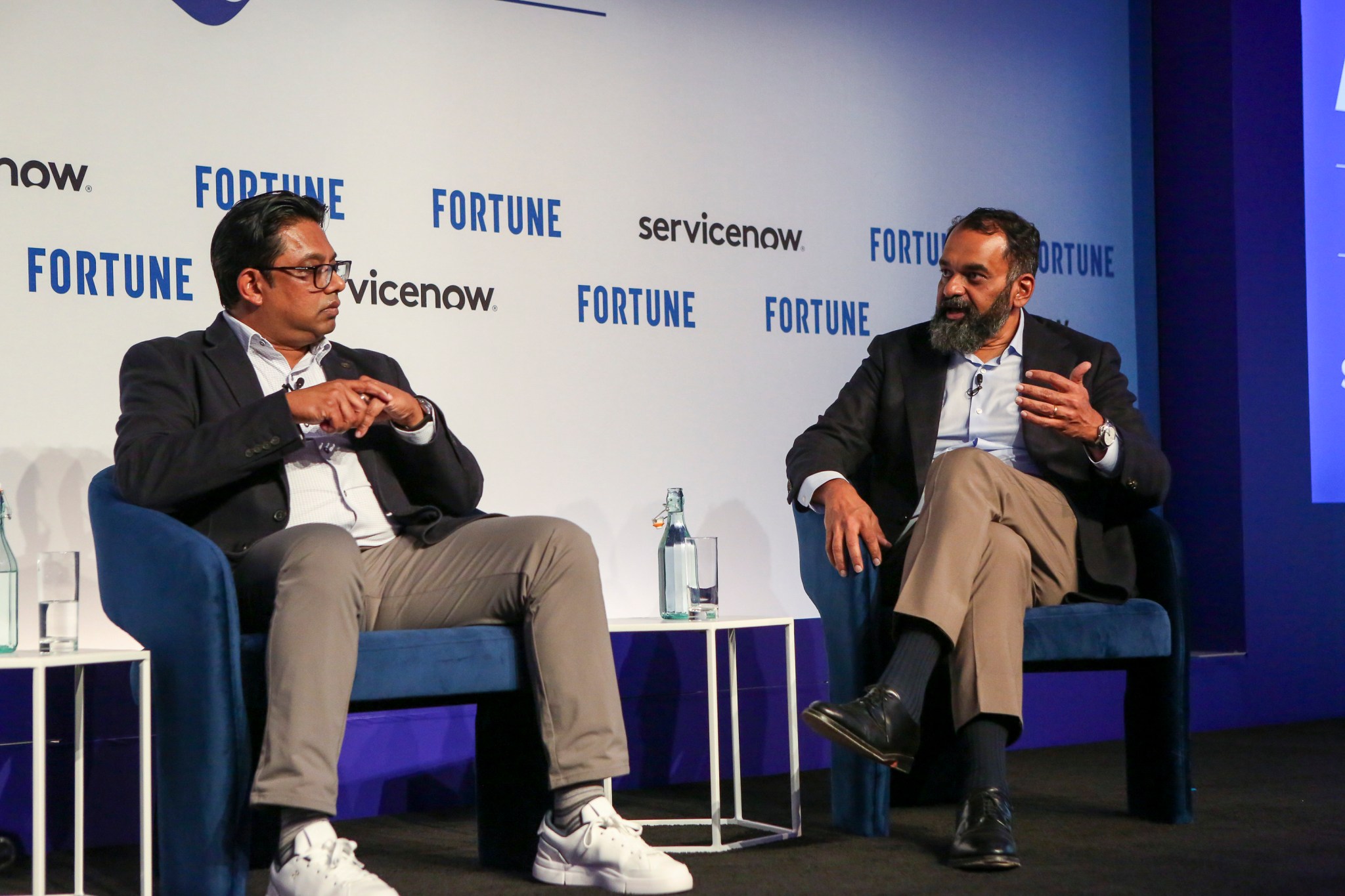
At Fortune's AIQ Summit, Honeywell CTO Suresh Venkatarayalu said customers demand 99.9999% accuracy while frontier models reach about 85%, and Ecolab's AJ Wijesinghe said top models made high-volume work costlier than humans before token costs fell 70% to 80%.
Why it matters
Industrial and building operators appear unlikely to hand over safety-critical systems to fully autonomous AI, so vendors are pitching a semi-autonomous setup with humans in the loop.
What to watch
Ecolab's target of $325 million in annual run-rate savings by 2027 hinges on pairing data foundation, process readiness and cost discipline, and Honeywell is watching whether AI can lift energy savings from 7% to 30% or 40%.
WHO IT HITSFacility and plant operators weighing AI for mission-critical equipment, plus enterprise AI teams asked to justify token spend, face accuracy gaps and cost math that can favor human labor.
Summaries like this, in your inbox every morning.
Both executives spoke at Fortune's AIQ Summit at the New York Stock Exchange, and both framed their limits as practical rather than philosophical. Honeywell's Suresh Venkatarayalu pointed to accuracy: customers demand 99.9999% while frontier models could be at 85%. Ecolab's AJ Wijesinghe pointed to cost: putting the best model on high-volume work sent tokenomics off the roof, and it was sometimes more expensive than having humans.
Ecolab responded by optimizing its models and cutting token costs by about 70% to 80%, using both frontier and open-source models including Anthropic's Claude and OpenAI's. Honeywell is fine-tuning open-source models partly because customers want sovereignty over their data and models, hand-picking them and working with Nvidia's Nemotron team, since an unsupported open-source model without guardrails would be dangerous. Venkatarayalu also noted over-the-air upgrades are coming to commercial buildings, but with an operator in the loop, because a building cannot be shut down for one and a half hours the way a Tesla can.
On where value shows up, Wijesinghe said individual AI adds little measurable value at the enterprise level, vertical AI within a function adds some, and horizontal AI across functions such as sales, finance and supply chain adds the most. Ecolab expects $325 million in annual run-rate savings by 2027, with significant amounts already in hand. The test, in his framing, is whether data foundation, process readiness and cost discipline stay balanced, since if one is heavier than the other, the value does not materialize. Honeywell's customers who got 7% energy savings from existing controls are now asking whether AI can deliver 30% or 40% more.
Pick your industry and the AI tools you use, and get news related to your work every day.
Free · 30 seconds with Google · unsubscribe anytimeWhat is AIToday? →
Ask AI anything about this article. The AI reads this article, earlier AIToday articles, and Wikipedia, and cites its sources. Q&As are published on this page for other readers too.
Talkdesk's survey of 252 director-level-and-above leaders found 98% use some form of AI in customer experience…

The Allen Institute for AI announced Olmo-core 3 on Thursday, a training framework it says scaled mixture-of-e…

Ben Thompson wrote that Meta's new Meta Enterprise Platform "won't work" and is "a distraction from the bigges…
Broadcom is reportedly raising $60 billion to fund chips for Anthropic, on top of a loan of up to $42 billion…

Meta is letting go of employees it hired from AI safety startup Virtue AI, four months after they joined in Ju…
Bain & Company found the industry's compute demand will require $6 trillion in annual revenue by 2031, includi…