What happened
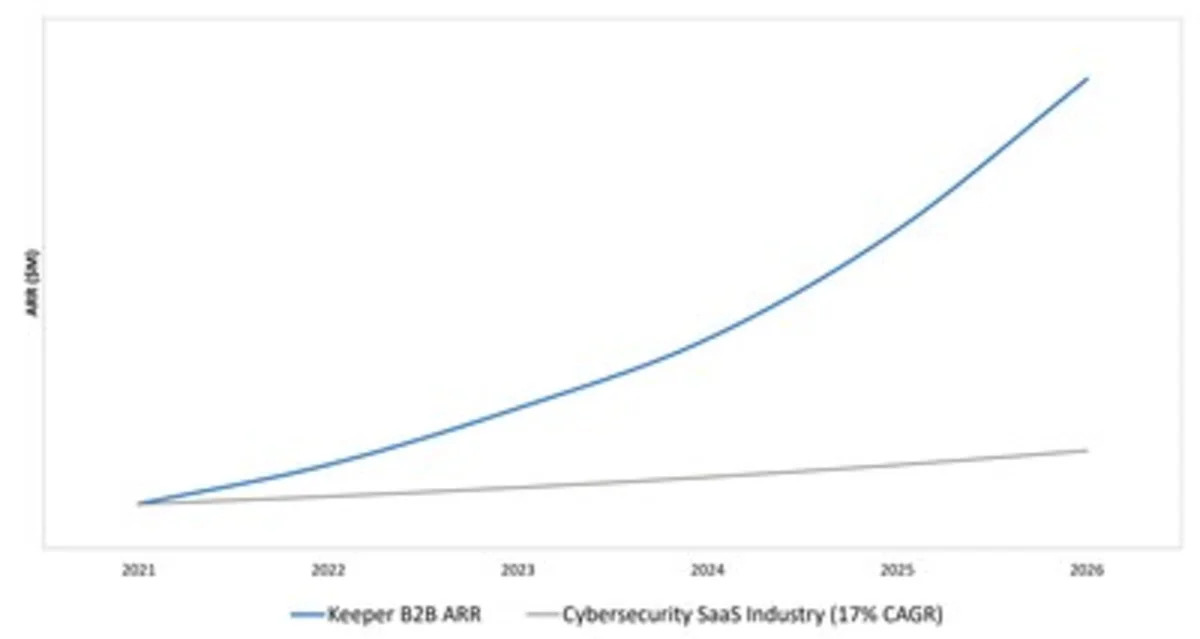
Keeper Security announced it has reached $225 million(約360億円) in Annual Recurring Revenue (ARR), with ARR having grown over 3× since 2021. The company now protects over 95,000 organizations and is adding an average of 850 new organizations every month. Its KeeperPAM product, launched in February 2025, has achieved 10× year-over-year growth.
Why it matters
Enterprises are deploying AI agents and autonomous systems that generate exponentially more machine identities and credentials—a security challenge traditional platforms were not built to handle. Keeper's unified approach to securing both human and non-human identities (service accounts, AI agents, databases) addresses this emerging threat directly, positioning it as a modern alternative in a market where identity security is becoming the central security concern.
What to watch
Keeper is growing at over 4× the industry average and was recognized by Gartner in 2025 as the second-fastest-growing security software competitor globally, second only to Google. The company has added over 400 innovative features and products to KeeperPAM in the last fifteen months.
Summaries like this, in your inbox every morning.
Keeper Security's $225 million(約360億円) ARR milestone marks a shift in how enterprises approach security as artificial intelligence adoption fundamentally changes their infrastructure. Traditionally, identity and privileged access management focused on human users; the emergence of AI agents and autonomous systems has created a new class of entities—service accounts, machine identities, and AI workloads—that require the same rigor of identity governance and credential management. This explosion of non-human identities has created both a business opportunity and a market gap, since legacy platforms designed around human-centric access control cannot easily extend to machine-scale environments.
Keeper's timing and product strategy appear to have captured this transition. The company's 10× year-over-year growth in KeeperPAM revenue since its February 2025 launch, combined with its 850-organization-per-month customer growth, suggests that enterprises are actively seeking a unified platform rather than cobbling together separate tools. The Gartner ranking—second-fastest-growing globally and ahead of most pure-play identity vendors—signals that the market recognizes Keeper's position. That said, the company's stated path to $1 billion(約1600億円) ARR and a public offering remains dependent on sustained growth as AI agent deployment scales across enterprise infrastructure, a still-emerging category where long-term customer retention and ROI narratives have yet to fully form.
Pick your industry and the AI tools you use, and get news related to your work every day.
Free · 30 seconds with Google · unsubscribe anytimeWhat is AIToday? →
Ask AI anything about this article. The AI reads this article, earlier AIToday articles, and Wikipedia, and cites its sources. Q&As are published on this page for other readers too.
Chunghwa Telecom president Rong-shy Lin said the shift from conversational AI to autonomous AI agents is resha…

Apple and Meta said they would jointly release a new open-weight AI model designed to run on high-end Macs, ai…

A writer and entrepreneur opened his daily to-do list and found 156 items, and concluded that an AI assistant…

A Zenn contributor sorted AI use into three modes — AI as an assistant, AI running alongside people, and AI th…

A non-engineer operator says one person ships four smartphone apps on Google Play, three on the App Store, wit…
The walkthrough points the CLI at a local mock via the ANTHROPIC_BASE_URL environment variable

