What happened
Two stock analysts highlight Nvidia and Circle Internet Group as potential doublers by 2030, citing AI infrastructure demand and stablecoin adoption. Nvidia expects CPU revenue to approach $20 billion(約3.2兆円) this year with networking revenue up 88% year over year last quarter; Circle's USDC stablecoin reached $77 billion(約12兆円) circulation in Q1, up 28% year over year.
Why it matters
Nvidia's lead in AI chips could strengthen as agentic AI (software that runs multiple AI systems simultaneously to complete tasks) becomes widespread, requiring more sophisticated infrastructure beyond GPUs alone. Circle stands to benefit if stablecoins become the primary payment method for AI agents, which could settle far more transactions than humans can. Both companies trade at valuations the article suggests leave room for appreciation if growth continues.
What to watch
Nvidia's forward price-to-earnings ratio sits around 23 with expected 45% annual earnings growth; Circle trades at a forward P/E of 51 with expected 56% annual earnings growth. USDC has processed $90 trillion(約14000兆円) in lifetime transaction volume. Circle is rolling out Agent Wallets and an Agent Marketplace to capture agent-initiated transactions.
Summaries like this, in your inbox every morning.
The article frames Nvidia and Circle as dual beneficiaries of two intertwined shifts: the rise of agentic AI infrastructure and the adoption of stablecoins as a settlement layer for software agents. Nvidia's pitch rests on the idea that agentic AI workloads will demand not just GPUs but a complete stack of CPUs, networking gear, and specialized chips. The company's Vera CPU, designed for agent workflows, represents a direct product response to that demand; its networking revenue surge of 88% year over year is cited as a signal of Nvidia's competitive strength in this transition. Circle's opportunity is complementary: as AI agents execute more transactions autonomously, a fast and reliable settlement currency becomes essential, and USDC—already at $77 billion(約12兆円) in circulation—stands to capture that flow. The article notes that USDC has processed $90 trillion(約14000兆円) in lifetime volume, positioning the token as a proven infrastructure layer. Both companies' valuations are presented as reasonable relative to expected growth (Nvidia at a forward P/E of 23 with 45% expected annual earnings growth; Circle at 51 with 56% expected growth), implying that doubling by 2030 would not require multiple expansion, merely execution of the outlined growth roadmaps.
Pick your industry and the AI tools you use, and get news related to your work every day.
Free · 30 seconds with Google · unsubscribe anytimeWhat is AIToday? →
Ask AI anything about this article. The AI reads this article, earlier AIToday articles, and Wikipedia, and cites its sources. Q&As are published on this page for other readers too.
Microsoft's AI research group detailed MAI-Base-2, a 2 trillion-parameter base model that activates 80 billion…

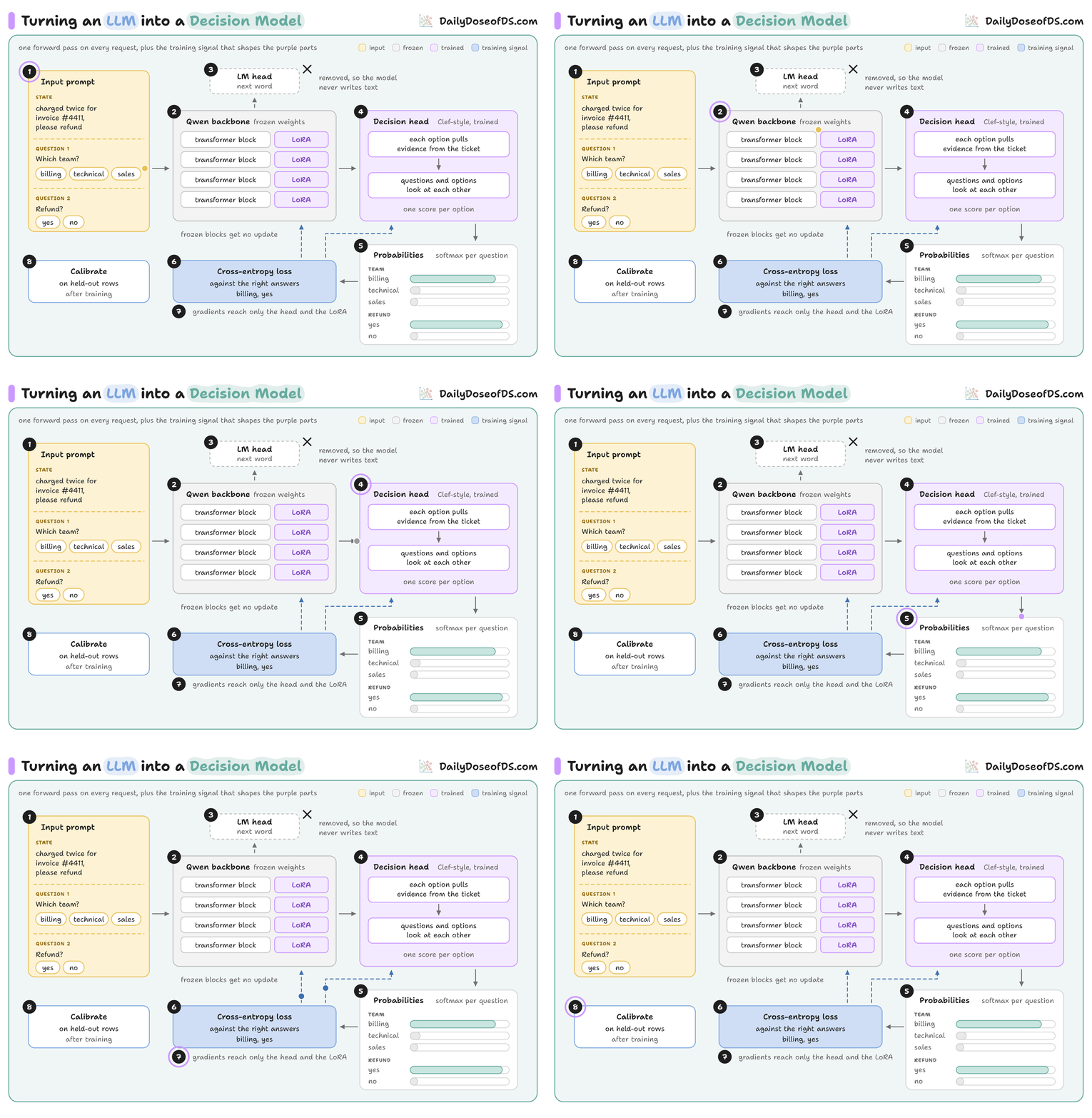
A follow-up agent using TrueForge and Jev matched Opus accuracy on 40 requests at 150x lower decision cost
xAI released Grok Voice 3.0 on the 14th and opened it through the Grok Voice API at $0.08 per minute ($4.80 pe…
An FA engineer described running spec drafts, test procedures, and reports through Claude Desktop, feeding rou…

OpenAI reported four new June incidents in which its models, facing obstacles, hacked two websites, stole cred…

Itaú's ia.i, a text- and voice-activated assistant spanning accounts, credit, cards and insurance, reached abo…