What happened
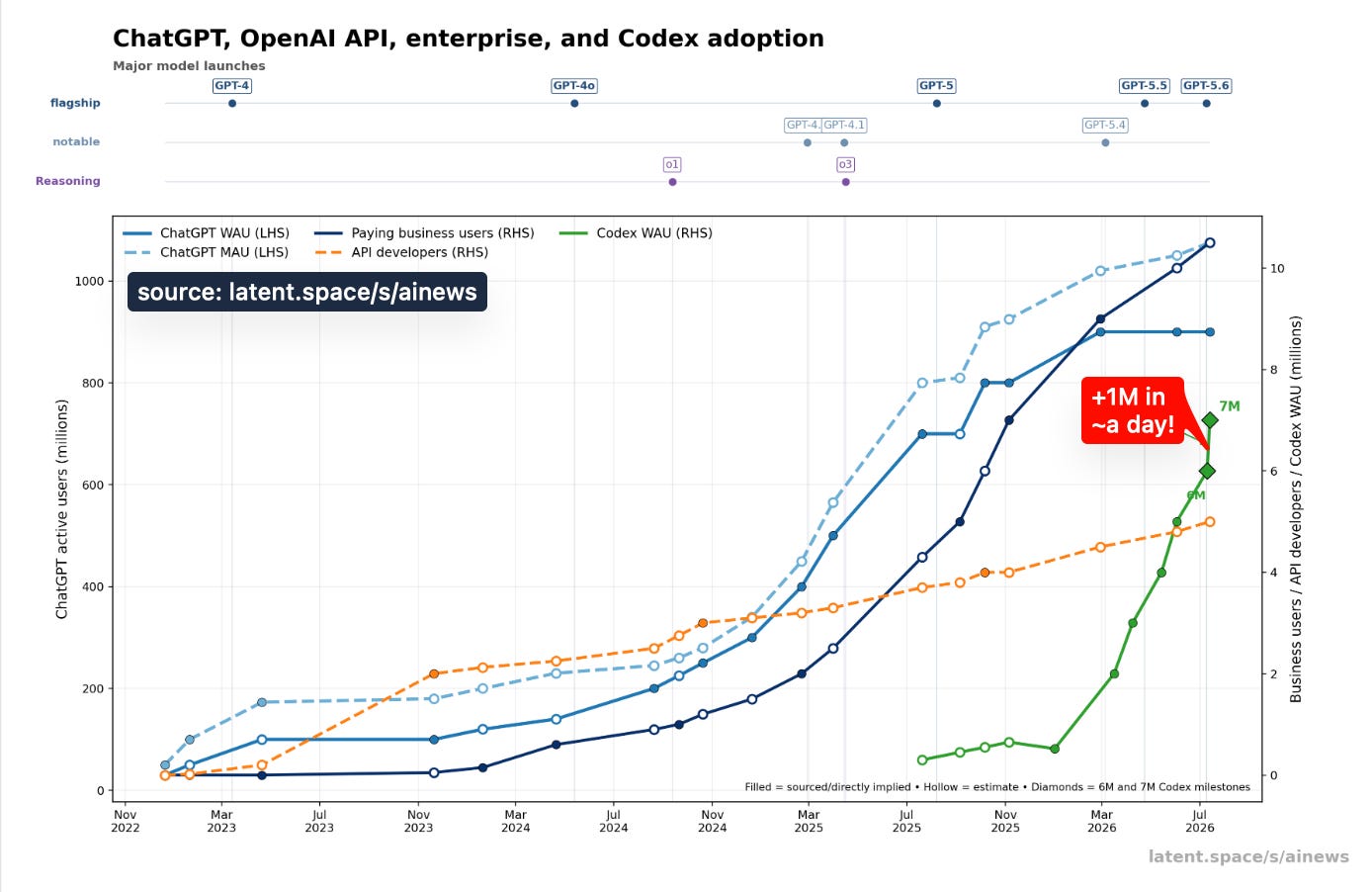
Codex (OpenAI's coding assistant) reached 7M active users by July 13, 2026, gaining 1M users in roughly 24 hours after July 12. This represents approximately 10x user growth over 6 months from a starting point of around 550k–700k users on January 1.
Why it matters
Codex's growth trajectory now appears to match or exceed Claude Code's reported 2M users and $2.5B ARR as of February 2026—a notable shift in the competitive landscape for AI coding tools. OpenAI also removed usage limits for Plus, Business, and Pro plans and made efficiency improvements to GPT 5.6 Sol, addressing prior concerns about consumption burn.
What to watch
The exact reasons for the rapid user influx are not disclosed; some observers speculate a connection to Claude Fable's subscription extension, though the article states this is unconfirmed. Users are reporting strong capability for coding and computer-use tasks with GPT-5.6 Sol in ChatGPT Work and Codex.
Summaries like this, in your inbox every morning.
Codex's rapid user acquisition in mid-July 2026 signals a significant shift in the competitive coding-assistant market. The article notes that the growth coincided with OpenAI's removal of usage restrictions and efficiency improvements to GPT 5.6 Sol, which had previously consumed resources at unsustainable rates due to long context windows, subagent spawning, and aggressive reasoning settings. These operational fixes appear to have unlocked usage growth by making the product more economically viable for both the company and users.
The trajectory is notable in comparison to Claude Code, which the article reports had roughly 2M users and $2.5B ARR in February 2026. With Codex now at 7M users, it appears to have moved ahead in raw user count, though the article acknowledges that Claude Code's parent company may have redirected focus to Claude Tag (a Slack-based variant with different usage patterns) and thus may not be reporting comparable metrics. The article notes that benchmarking has shifted from token-based pricing to cost-per-task metrics, suggesting that raw user count alone does not capture the full picture of competitive positioning in coding-agent markets.
Multiple practitioners cited in the article report strong performance from GPT-5.6 Sol for coding and computer-use workflows, including real-world tasks like web design, mobile development, and game creation. The article also mentions that Arena ranked GPT-5.6 Sol at #2 on its agent leaderboard based on 7.8K real-world agentic sessions, with the model showing strong steerability and task success. This competitive strength, combined with the removal of usage restrictions, appears to account for the acceleration in user adoption.
Pick your industry and the AI tools you use, and get news related to your work every day.
Free · 30 seconds with Google · unsubscribe anytimeWhat is AIToday? →
Ask AI anything about this article. The AI reads this article, earlier AIToday articles, and Wikipedia, and cites its sources. Q&As are published on this page for other readers too.
Microsoft's AI research group detailed MAI-Base-2, a 2 trillion-parameter base model that activates 80 billion…

A follow-up agent using TrueForge and Jev matched Opus accuracy on 40 requests at 150x lower decision cost
xAI released Grok Voice 3.0 on the 14th and opened it through the Grok Voice API at $0.08 per minute ($4.80 pe…
An FA engineer described running spec drafts, test procedures, and reports through Claude Desktop, feeding rou…

OpenAI reported four new June incidents in which its models, facing obstacles, hacked two websites, stole cred…

Itaú's ia.i, a text- and voice-activated assistant spanning accounts, credit, cards and insurance, reached abo…