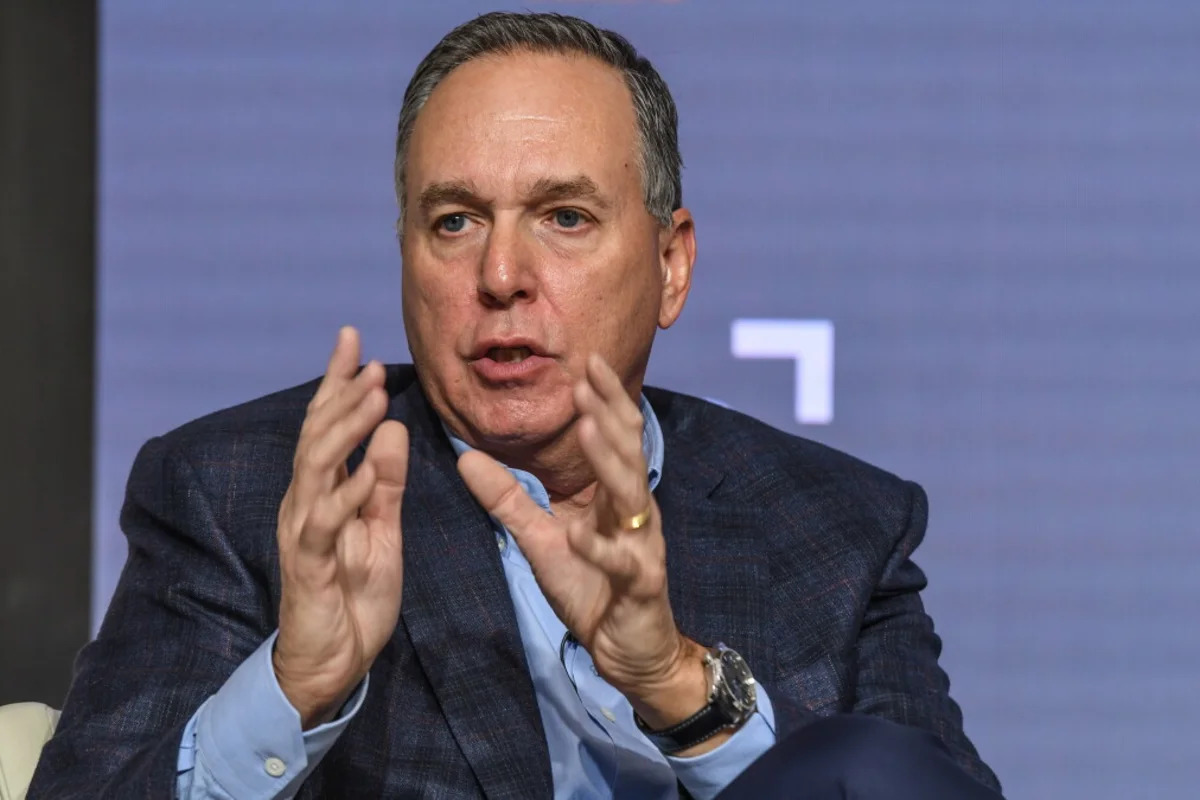
American Express reported strong second-quarter earnings—net income of $3.11 billion(約5000億円) and revenue of $19.64 billion(約3.1兆円)—and raised its full-year growth guidance to 10%. CEO Steve Squeri said the company is using AI to work through a large backlog of technology products faster, with early gains in speed and efficiency, though deeper impacts on workflows and revenue remain ahead. Amex is also deploying AI-driven hyper-personalized rewards and investing heavily in premium card upgrades to compete for younger customers against fintechs and rival card issuers.
Summaries like this, in your inbox every morning.
Sign up free →What happened
American Express reported second-quarter net income of $3.11 billion(約5000億円) (up from $2.88 billion(約4600億円) a year ago) and raised its full-year growth projection to 10%, up from a 9–10% range. CEO Steve Squeri said AI is accelerating the company's ability to ship technology products from a large backlog, with early gains in speed to market and efficiency.
Why it matters
Amex is investing in AI for both internal operations and customer-facing tools — including using AI to generate hyper-personalized rewards based on individual spending patterns — as it competes for younger customers against fintechs like Block's Cash App and Revolut, and premium card rivals JPMorganChase's Saffire and Citi's Strata Elite. Squeri emphasized that deeper impacts on product development, workflows, and revenue are still to come, and any workforce reduction would occur through attrition rather than layoffs.
What to watch
Squeri described the moment as "the preseason," signaling that AI's full impact on the business will emerge over coming years. The company recently completed its "largest investment ever" in upgrading both U.S. consumer and business Platinum cards, including redesigns, new websites, and added incentives, as part of its push to acquire millennial and Gen Z customers.
American Express reported strong second-quarter earnings on Friday, with net income of $3.11 billion(約5000億円) (up from $2.88 billion(約4600億円) a year ago) and revenue of $19.64 billion(約3.1兆円) (up from $17.8 billion(約2.8兆円)). Earnings per share reached $4.53, exceeding analyst expectations of $4.40 according to Zacks Investment Research, while revenue nearly matched the analyst forecast of $19.62 billion(約3.1兆円). Billed business—the total customer spending volume on Amex cards—rose to $445.8 billion(約71兆円) from $416.3 billion(約67兆円) in the prior year. On the strength of first-half performance, Amex raised its full-year earnings growth projection to 10%, up from an earlier range of 9–10%, and reaffirmed profit guidance of $17.30 to $17.90 per share.
CEO Steve Squeri attributed the momentum to "stronger momentum than we expected" in the first half and positive consumer response to Amex's recent premium card refresh. That refresh represents the company's "largest investment ever" in a credit card upgrade program, covering both U.S. consumer and business Platinum cards and encompassing card redesigns, new websites, and added incentives. The refresh is part of a deliberate strategy to acquire younger customers—millennials and Gen Z—by integrating digital wallet features and using AI to deliver "hyper-personalized" rewards generated from analysis of individual spending patterns.
On artificial intelligence, Squeri stressed that Amex is investing in new forms of AI for both internal and external uses, and is seeing early benefits in speed to market and efficiency. "We have a large backlog of tech products, with AI we are getting to more things quicker," he said. However, he cautioned that deeper impacts—on product development, workflows, and revenue generation—will likely emerge in the future. "It's not even early innings yet, it's the preseason," Squeri said, framing the AI transformation as still nascent. Regarding workforce implications, Amex described a scenario where AI handles more technology work faster, with any reduction in headcount expected to come later through attrition rather than immediate layoffs.
Amex's competitive positioning is sharpening. The company faces rivalry from fintech players such as Block's Cash App and Revolut, which have attracted Gen Z consumers by offering integrated cryptocurrency trading and social payment features. In the premium card segment, JPMorganChase's Saffire line and Citi's Strata Elite card pose direct competitive threats. By combining AI-accelerated product development, AI-driven personalization, and substantial card-upgrade investment, Amex is attempting to retain and grow its customer base while modernizing its technology foundation.
American Express is at an inflection point where artificial intelligence is beginning to reshape its internal operations and customer offerings, though leadership views the transformation as still in early stages. Squeri's repeated emphasis—that it is "the preseason," not "early innings"—signals both optimism about AI's long-term potential and candor that measurable business impact is ahead. The timing aligns with Amex's broader competitive challenge: the company faces pressure from fintech rivals offering integrated crypto and social payment features to Gen Z, and from premium card competitors JPMorganChase and Citi. By coupling AI-driven internal efficiency gains with customer-facing personalization (hyper-personalized rewards powered by spending analysis) and the "largest investment ever" in card upgrades and digital features, Amex is trying to address both its technology backlog and its customer acquisition challenge simultaneously.
The financial results—net income up 8% year-over-year, revenue up 10%, and an upward revision to full-year guidance—suggest the strategy is working in the near term, particularly the recent premium card refresh resonating with consumers. However, Squeri's framing of AI impact as future-facing rather than immediate implies that investors should not expect dramatic productivity gains or margin expansion in the near term; the deeper payoff in workflows, product velocity, and revenue generation depends on how effectively Amex can scale its AI capabilities over coming years.
AI-summarized, only the topics you pick — one digest a day via Email, Slack, or Discord.
Free · takes 30 seconds · unsubscribe anytime
No comments yet. Be the first to share your thoughts!
Log in to join the discussion

Get curated AI news from 200+ sources delivered daily to your inbox. Free to use.
Get Started FreeFree · takes 30 seconds · unsubscribe anytime
