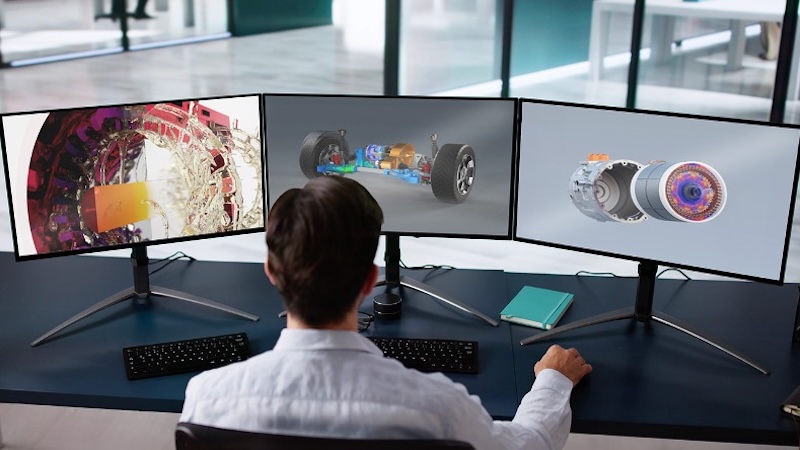
Siemens has unified its simulation software portfolio by combining its own technology with Altair's, adding AI-powered features that speed up engineering workflows. The flagship innovation, Simcenter PhysicsAI, can evaluate design concepts up to 1,000 times faster than traditional simulations, while new integration with CAD software reduces analysis time from hours to minutes. The release is intended to help manufacturers reduce development risk and accelerate product innovation.
Summaries like this, in your inbox every morning.
Sign up free →What happened
Siemens launched a new release of Simcenter engineering simulation software that combines Siemens' and Altair's simulation technologies into a unified portfolio. The release introduces AI-powered capabilities including Simcenter PhysicsAI (which converts simulation data into predictive models), GPU acceleration, and multiphysics workflows that connect electromagnetic, thermal, and system simulation tools.
Why it matters
The unified portfolio is designed to help engineering teams work faster and with more confidence. Simcenter PhysicsAI can evaluate design concepts up to 1,000 times faster than traditional solver-based simulations, and a new integration with Designcenter reduces structural analysis times from hours to minutes by allowing simulations directly on CAD geometry without creating a mesh. This earlier insight into product performance helps engineers make better design decisions sooner in the development process.
What to watch
The release includes Simcenter PhysicsAI Generate, a new generative AI capability that creates design concepts based on target dimensions, performance requirements, and historical engineering data. These capabilities are part of the Siemens Xcelerator portfolio and target manufacturers seeking to reduce development risk and bring products to market more quickly.
Siemens has released the latest version of Simcenter, its flagship engineering simulation software, integrating Altair's simulation capabilities into a unified portfolio for the first time. The release introduces multiple AI-driven features designed to compress engineering timelines and expand design exploration. The core innovation is Simcenter PhysicsAI, a geometric deep learning technology that converts simulation data into predictive AI models. According to Siemens, this technology can evaluate design concepts up to 1,000 times faster than traditional solver-based simulations. Simcenter PhysicsAI has been embedded into additional products across the portfolio, including Simcenter Inspire and Simcenter Hypermesh. Multi-GPU support in Simcenter STAR-CCM+ (a computational fluid dynamics tool) enables AI models trained from simulation data to be generated significantly faster.
A new feature called Simcenter PhysicsAI Generate applies generative AI to the design phase, automatically creating design concepts based on target dimensions, performance requirements, and historical engineering data. The release also pushes simulation earlier in the development workflow through integration of Simcenter Simsolid with Designcenter, Siemens' CAD software. This integration allows engineers to perform structural simulations directly on CAD geometry without mesh creation, compressing analysis time from hours to minutes. Sam Mahalingam, executive vice president of simulation at Siemens Digital Industries Software, stated: "The future of engineering depends on an organization's ability to turn insight into action faster than ever before. We have brought together industry-leading simulation capabilities across physics domains, connected them in shared workflows and made simulation more accessible."
The release also strengthens multiphysics simulation by deepening connections between electromagnetic, thermal, and system simulation tools. Siemens highlights applications such as electric powertrains, motor cooling, and battery thermal management as key beneficiaries of these enhancements, which are intended to support cross-disciplinary collaboration. The company frames these capabilities as part of its Siemens Xcelerator portfolio, designed to help manufacturers reduce development risk, improve engineering productivity, and accelerate time-to-market.
Siemens' latest Simcenter release marks a consolidation of the company's simulation strategy following its combination of its own and Altair's technologies into a single portfolio. The move reflects a broader shift in engineering software toward earlier simulation in the product development cycle—Designcenter integration now allows CAD-based analysis that previously required time-consuming mesh generation. The integration of geometric deep learning (Simcenter PhysicsAI) across multiple tools and the expansion of multiphysics workflows (connecting electromagnetic, thermal, and system simulation) suggest that Siemens is positioning simulation as a collaborative, cross-disciplinary activity rather than a specialist task performed late in design. The generative AI capability—creating design concepts from requirements and historical data—addresses a practical pain point: engineers can now explore more options in less time. For manufacturers, especially those developing complex systems like electric powertrains and battery thermal management, the unified portfolio and GPU acceleration may offer a competitive advantage in reducing time-to-market.
AI-summarized, only the topics you pick — one digest a day via Email, Slack, or Discord.
Free · takes 30 seconds · unsubscribe anytime
No comments yet. Be the first to share your thoughts!
Log in to join the discussion




Get curated AI news from 200+ sources delivered daily to your inbox. Free to use.
Get Started FreeFree · takes 30 seconds · unsubscribe anytime
