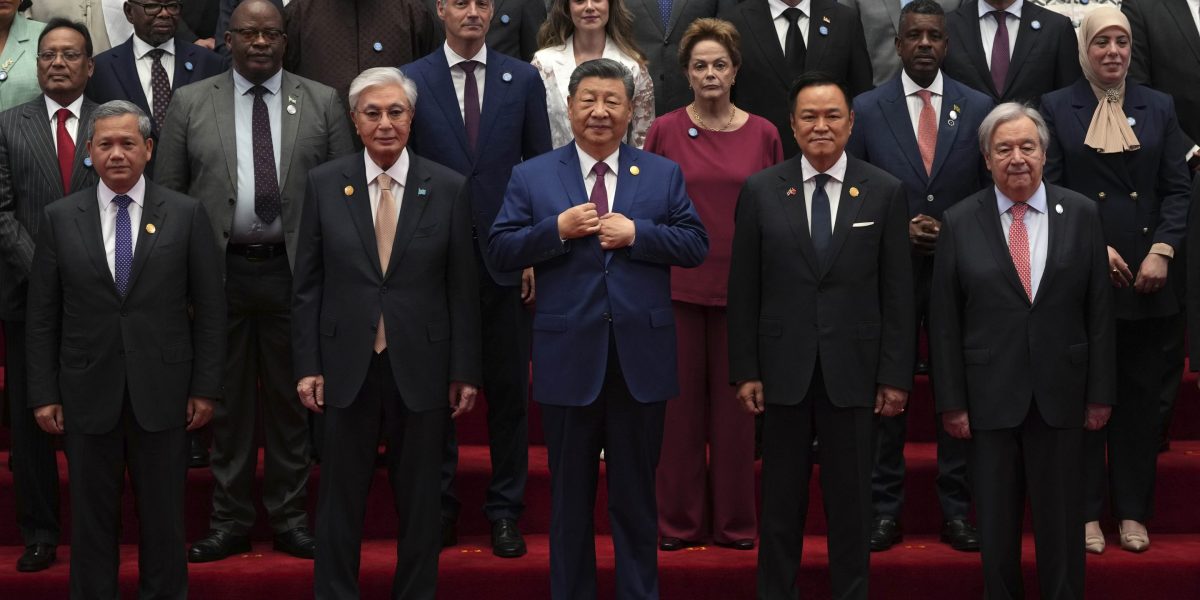
China is deploying low-cost AI models from companies like DeepSeek to undercut U.S. competitors and capture global market share, using the same industrial playbook—scale, subsidies, and price pressure—that once dominated the steel industry. The U.S.-China AI capability gap had nearly closed by spring 2026 despite larger U.S. private investment, threatening the profit margins and market control that have made today's tech billionaires extraordinarily wealthy.
Summaries like this, in your inbox every morning.
Sign up free →What happened
China is deploying low-cost AI alternatives from labs like DeepSeek, Kimi, and Qwen to capture market share globally, mirroring its historical strategy of using scale and subsidies to undercut rivals in steel. By spring 2026, the U.S.-China AI gap had nearly vanished, even as U.S. private investment remained far larger than China's.
Why it matters
Today's tech billionaires—Elon Musk and others—have built fortunes by controlling infrastructure layers (chips, clouds, AI models, data), much as steel barons did a century ago. China's price pressure and market flooding threaten to collapse AI profit margins and consolidate the sector, potentially dismantling the wealth concentration that defines the current tech oligarchy, just as industrial consolidation did in the Gilded Age.
What to watch
Scott Galloway warned in a May 2026 podcast interview that China's goal is to push cheap AI into the U.S. market, force prices down, consolidate the market, and eventually gain margin power—and noted that America's billionaire class is already preparing for the collapse of the AI boom.
The article opens with a striking historical comparison: America's first billionaire class—steel barons like Andrew Carnegie and J.P. Morgan—accumulated their fortunes at the turn of the 20th century by controlling critical infrastructure: mines, mills, and railroads. Their power was dual-edged: they were celebrated as nation-builders and condemned as robber barons, and both characterizations were true. Their fortunes came from owning chokepoints, and those chokepoints let them influence labor, markets, and policy.
Today's tech oligarchs are repeating that playbook with a different technological stack. Instead of blast furnaces and railroads, figures like Elon Musk (who Fortune notes has flirted with trillionaire status following the historic SpaceX IPO) own the cloud, the app ecosystem, the advertising machine, and increasingly the AI layer that sits atop all of it. This ownership has made them both fabulously wealthy and structurally embedded in the economy: AI is now driving capital spending, market valuations, and expectations about the next era of growth. As in the Gilded Age, the uncomfortable truth is that the people building the future are also concentrating control over it.
But now China is preparing to disrupt that concentration using the playbook from the steel era. In July 2024, Susan Ariel Aaronson wrote in Fortune that AI could become the "new steel" if governments overbuilt capacity and created a glut. By 2026, China was following that script exactly: backing industrial scale, favoring deployment over glamour, and pushing cheaper supply into the world market until competitors absorbed the pressure. The Washington Examiner called China's approach a "TikTok playbook" for AI; Bloomberg and The New York Times reported that Beijing's goal is to expand global share, even if profits come later. Chinese labs such as DeepSeek, Kimi, and Qwen are deployed as low-cost, widely available alternatives designed to win users fast, squeeze margins, and make it harder for U.S. firms to sustain premium pricing. The U.S.-China Economic and Security Review Commission describes China's AI strategy as a familiar industrial playbook now applied to open-source software, embodied AI, and the wider industrial base.
In a May 2026 interview on The Diary of a CEO podcast, NYU Stern professor Scott Galloway described China's tactic as "modern-day steel dumping." He explained that China's goal would be to push cheap AI into the U.S. market, force prices down, consolidate the market, and eventually gain margin power. He added, ominously, that America's billionaire class is already preparing for the collapse of the AI boom. Fortune's own reporting revealed that by spring 2026, the U.S.-China AI gap had nearly vanished, even as U.S. private investment remained far larger than China's. This mirrors the old steel dynamic: America won the first-mover story but China eventually won on volume. The consequence is a fight not merely over industrial rivalry but over the sector minting today's fortunes and the architecture of the next economy. If steel built America's first billionaire class, AI is building its second—and China is using the same kind of industrial force that once crushed steel to test whether it can weaken the wealth machine at the center of the new Gilded Age.
The article draws a historical parallel between America's original billionaire class—steel barons like Andrew Carnegie and J.P. Morgan in the late 19th century—and today's tech oligarchs like Elon Musk, who have accumulated comparable wealth by controlling critical infrastructure layers. In both eras, those chokepoints (then: mines, mills, railroads; now: chips, clouds, AI models, data) enabled extraordinary wealth, political influence, and market-shaping power. The parallel extends to China's strategy: just as China used industrial scale and subsidies to undercut and reshape global steel pricing, it is now deploying low-cost AI models from labs such as DeepSeek, Kimi, and Qwen to flood the market, pressure margins, and erode U.S. firms' premium pricing power.
The stakes are structural and historical. By spring 2026, Fortune's reporting showed the U.S.-China AI capability gap had nearly closed, despite larger U.S. private investment—a dynamic that echoes the steel era, where America won the first-mover advantage but China eventually dominated on volume and price. Scott Galloway's May 2026 warning frames this not as mere competition but as a potential collapse: China's goal is to consolidate the AI market and capture margin power, while America's billionaire class is already preparing for the AI boom to implode. The article suggests that just as dominant infrastructure eras create both extraordinary wealth and a target for disruption, so too does AI: the men who believed they were building the future may instead be inheriting the vulnerabilities of an earlier age.
AI-summarized, only the topics you pick — one digest a day via Email, Slack, or Discord.
Free · takes 30 seconds · unsubscribe anytime
No comments yet. Be the first to share your thoughts!
Log in to join the discussion


Get curated AI news from 200+ sources delivered daily to your inbox. Free to use.
Get Started FreeFree · takes 30 seconds · unsubscribe anytime
