What happened
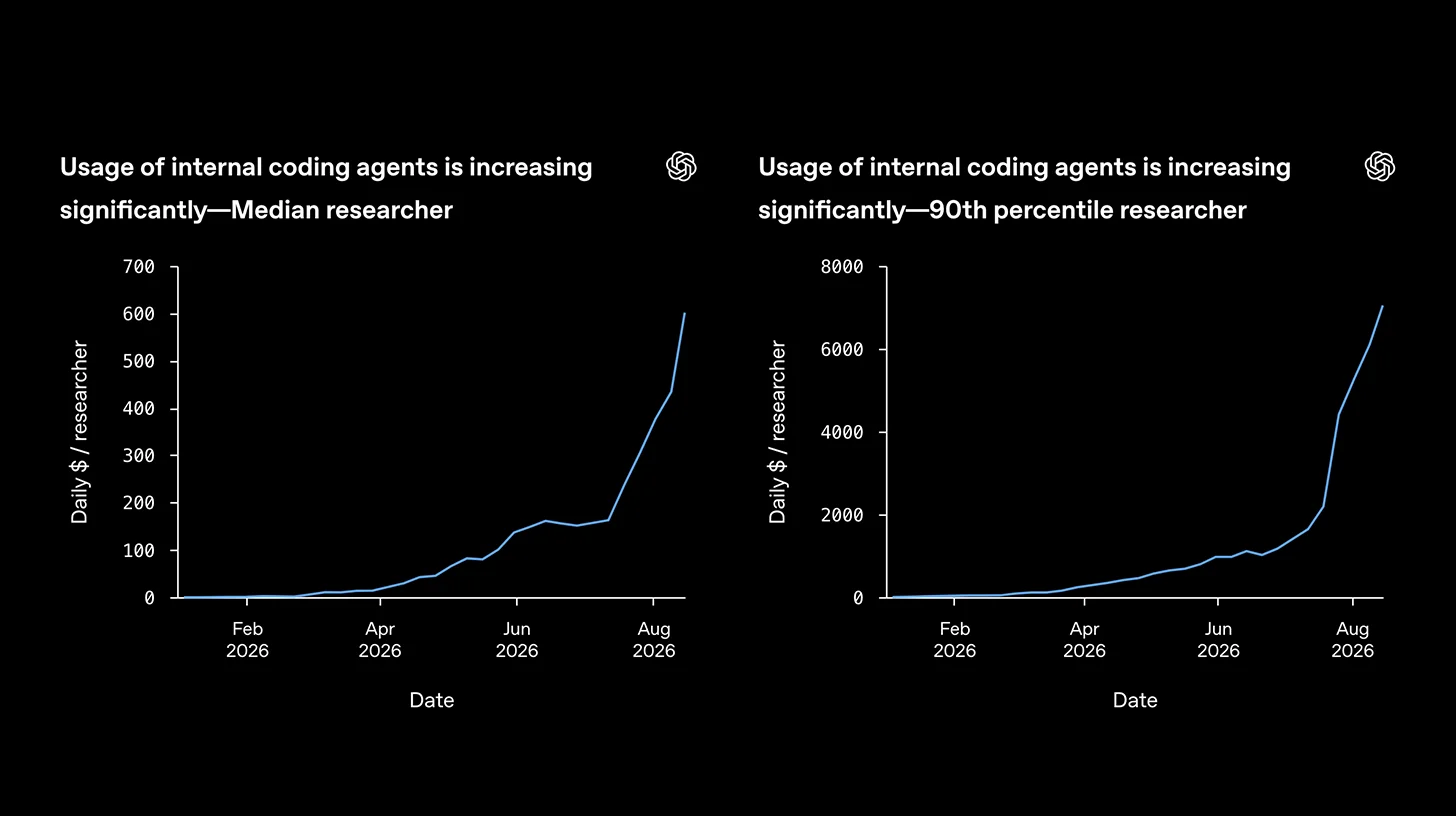
OpenAI's internal report says its coding agents now run 3.1 workdays for every human workday in its research operation, and that it achieved its September goal of an automated research intern. By mid-August, median daily researcher inference consumption exceeded $600 at API prices, with the 90th percentile above $7,000.
Why it matters
Early access to powerful models lets frontier labs develop workflows and spend heavily on inference before others, potentially compounding their advantage, though the report gives no measured lead or quantified rate of compounding. OpenAI announced GPT-6 Astra on September 3, with rollout beginning by September 8.
What to watch
The test is whether labs convert agent activity into useful research, since more than half of successful tasks lasting four to eight hours required human intervention. A fully automated researcher remains a target for March 2028.
WHO IT HITSCompeting labs and smaller research organizations face a challenge that extends beyond obtaining a model: they would need to develop effective workflows, fund repeated runs, and provide enough human oversight to turn agent activity into useful experiments. OpenAI's spending figures illustrate the intensity of its deployment but do not establish a necessary budget for others.
Ask the AI about this article →
Summaries like this, in your inbox every morning.
OpenAI's internal report, covered in The Rundown's September 8 newsletter, offers a look at the resources behind its push toward automated research. The figures point to a potential competitive advantage for frontier labs: early access to powerful models gives them time to develop research workflows, while large inference budgets let them put those workflows into practice at scale. The report also shows why the size of that advantage remains difficult to measure.
The report's own numbers carry caveats. The 3.1 agent-workdays figure measures runtime, not productive output, and the researcher population includes support roles. Monitoring overhead adds another cost: OpenAI estimated it at roughly 20% of the inference compute being monitored, with substantial variation. An August 18 disclosure revealed a two-week pause in reinforcement learning training to strengthen safeguards.
The competitive payoff likely hinges on how reliably labs convert all that activity into useful research. Public access to GPT-6 Astra may spread capability without immediately erasing experience accumulated inside a lab — researchers who have already learned to assign tasks, preserve context, and manage interventions may hold a practical head start. Privileged access and deep budgets could reinforce one another, but the report provides no measured lead over rivals or quantified rate of compounding.
For example, today's edition would include:
AI-summarized, only the topics you pick — one digest a day via Email, Slack, or Discord.
Free · 30 seconds with Google · unsubscribe anytimeWhat is AIToday? →
Ask AI anything about this article. Q&As are published on this page for other readers too.
Lightsage announced it raised $4 million in seed funding, led by Nexus Venture Partners, to help software comp…

Appaloosa Management, run by billionaire David Tepper, bought SpaceX and CoreWeave shares during Q2
Palantir has chosen Nebius as its preferred sovereign AI infrastructure partner, bringing Nebius computation a…

In a midstage study, Insilico Medicine’s drug rentosertib reduced biological age, measured by six aging clocks…
Bankers for OpenAI and Anthropic, both headed toward IPOs, are pressing for quick investment-grade credit rati…
Maggie Appleton explains how generative AI like ChatGPT and image generators will expand the web's 'dark fores…