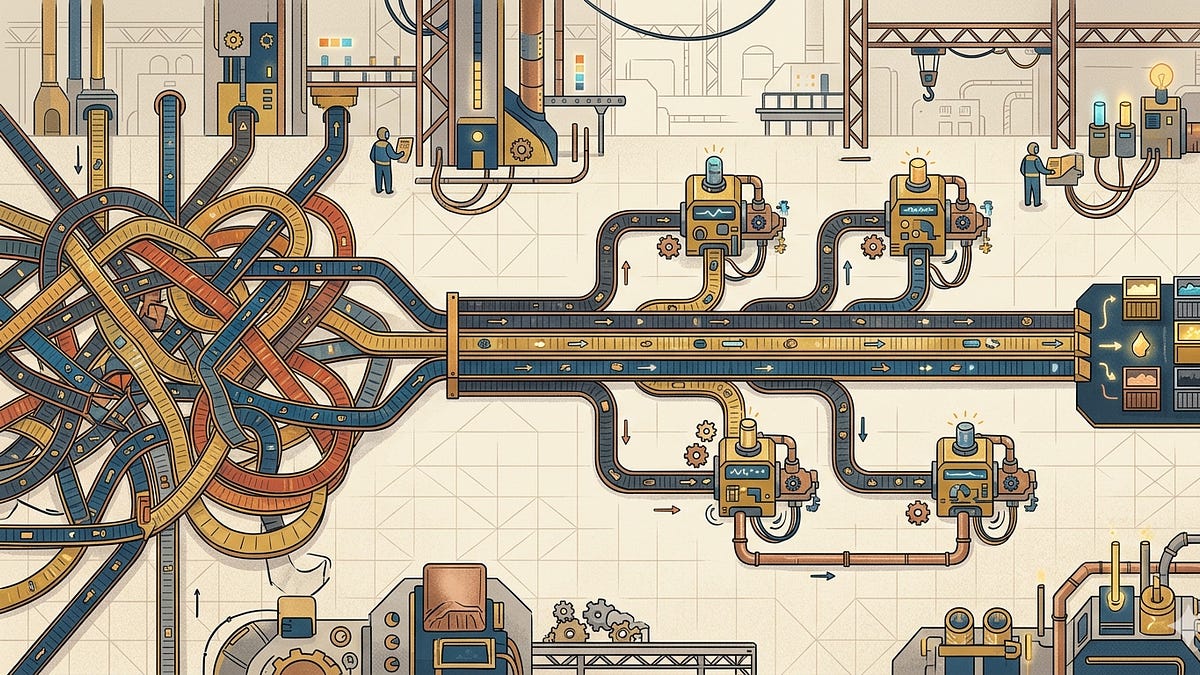
The orchestrator originally mixed state transitions, conditional logic, and side effects in imperative code across multiple functions. Problems included silently dropped issues, stuck states, workers losing state during retries, and infinite ping-pong cycles between workflows due to mismatched conditions—burning precious Claude tokens.
The new architecture uses a pure function called a "reducer" (the bus) that takes current state and an event, then outputs the next state and a list of side effects as data. A separate interpreter performs those side effects. The bus makes decisions without checking the clock or calling external systems; the interpreter only executes what the bus prescribes.
Debugging became traceable: bugs are now either bus bugs (wrong decision) or interpreter bugs (wrong execution). The reducer is deterministic—given the same state and event, it always produces the same output—making issues reproducible by replaying an append-only event log against initial state.
Ask the AI about this article →
For example, today's edition would include:
AI-summarized, only the topics you pick — one digest a day via Email, Slack, or Discord.
Free · takes 30 seconds · unsubscribe anytimeWhat is AIToday? →
Ask AI anything about this article. Q&As are published on this page for other readers too.
Walmart settled opioid dispensing claims for $50 million

Tim Cook's legacy as Apple CEO is now tied to the company's push into artificial intelligence, according to a…

CrowdStrike is introducing Falcon Guardian, its flagship solution for the AI Detection and Response (AIDR) cat…

AT&T, Dell Technologies, and AMD have announced OTel 2.0, the largest and best-performing open-source model bu…

AT&T's legal department built an in-house center of expertise called Legal Edge, described as an AI-first lega…

John Deere introduced JD, an AI assistant designed to help farmers manage and interpret their farm data, as re…