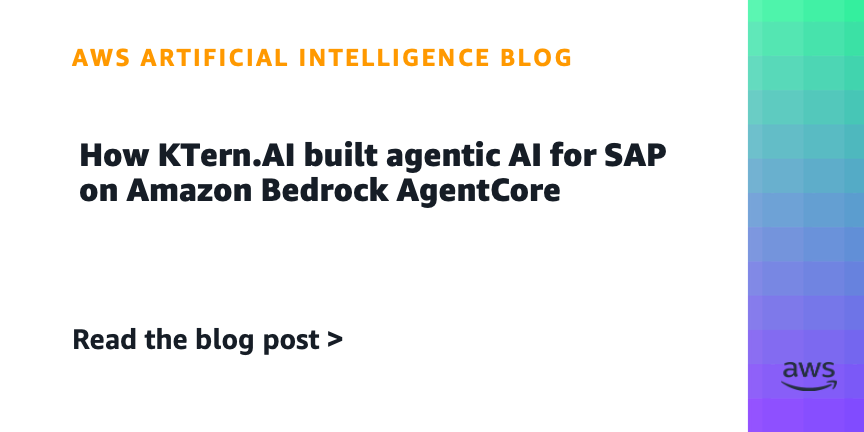
KTern.AI built agentic AI (self-managing AI systems) on Amazon Bedrock AgentCore to automate complex SAP digital transformations, reducing project timelines by 45 percent and discovery time by 60–70 percent in production. The configuration-driven approach cut agent deployment from 2–3 weeks to 4–6 hours, freeing engineering time and reducing infrastructure costs by 70 percent while maintaining 99.8 percent uptime.
Summaries like this, in your inbox every morning.
Sign up free →What happened
KTern.AI, an SAP digital transformation platform, deployed agentic AI (self-directed AI systems) on Amazon Bedrock AgentCore to automate SAP transformation workflows. In production, the agents reduced overall SAP project timelines by 45 percent, discovery and assessment time by 60–70 percent, and surfaced 90 percent of Finance and Sales operational exceptions autonomously. The company also reclaimed 480 engineering hours per month.
Why it matters
SAP transformations are complex, multi-month programs that traditionally required large consultant teams and manual analysis. By shifting to configuration-driven agents hosted on AWS infrastructure, KTern.AI freed its engineering team from building custom orchestration and observability tools, allowing them to focus on SAP domain expertise. The first production agent deployed in 4–6 hours with zero custom code, an 85 percent reduction in development cycle compared to the previous 2–3 weeks per agent.
What to watch
Operational metrics show 99.8 percent agent uptime sustained across production deployments and a 70 percent reduction in infrastructure costs versus the self-managed container stack previously used. KTern.AI uses Strands Agents SDK with three orchestration patterns (swarm for parallel discovery, workflow for sequential phases, and graph for conditional pipelines) and deploys through configuration only, with no infrastructure provisioning or pipeline engineering required.
KTern.AI faced a scaling challenge inherent to enterprise AI: traditional SaaS platforms cannot handle the persistent context, multi-tenant isolation, and production-grade observability that long-running SAP transformation programs demand. Building that infrastructure in-house consumed engineering cycles better spent on SAP domain expertise. By adopting Amazon Bedrock AgentCore and the Strands Agents SDK, the company delegated infrastructure concerns—hosting, scaling, memory management, tool access, identity, and logging—to AWS, reducing operational overhead from initial infrastructure setup time by 95 percent.
The measured outcomes reflect a fundamental shift in how KTern.AI deploys automation. Agents now persist context across hundreds of interactions, coordinate securely across customer ERP systems and SAP APIs through authenticated gateways, and route all activity through CloudWatch for audit trails. Each customer's tenant runs isolated on AgentCore runtime with session separation, satisfying enterprise security posture. The three Strands orchestration patterns—swarm, workflow, and graph—allow agents to be configured per workload without bespoke engineering, meaning a new capability ships the same day.
The 480 engineering hours reclaimed per month and 99.8 percent uptime sustained in production indicate that the operational model has stabilized. KTern.AI's internal measurements across its production SAP transformation engagements show that the shift from consultant-led discovery to autonomous exception mining (surfacing 90 percent of Finance and Sales operational exceptions) and fit-to-standard workflows has compressed project duration and reduced manual effort significantly, suggesting that agentic AI on managed infrastructure may reduce the barrier to large-scale enterprise transformation engagements.
No comments yet. Be the first to share your thoughts!
Log in to join the discussion
Get curated AI news from 200+ sources delivered daily to your inbox. Free to use.
Get Started FreeFree · takes 30 seconds · unsubscribe anytime
1 minute a day. The AI essentials.
200+ sources · Email / LINE / Slack
