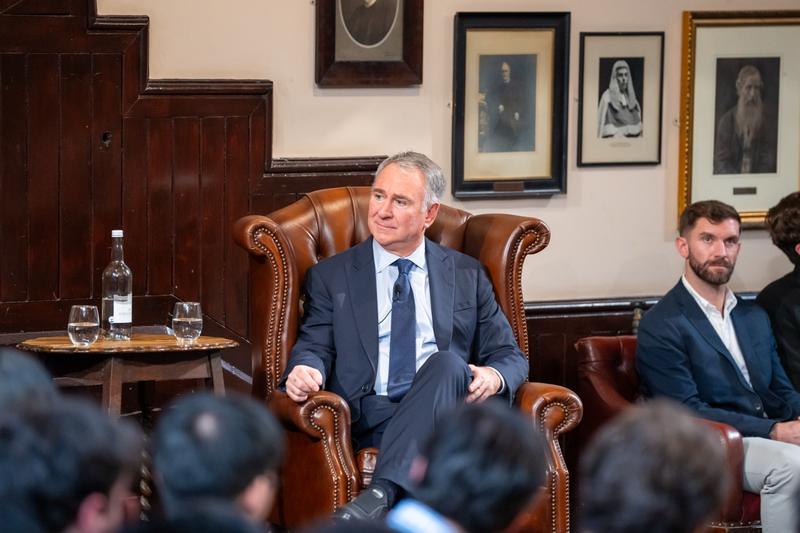
Ken Griffin's Citadel bought Situational Awareness's portfolio for more than $10 billion on Thursday after the AI hedge fund faced margin calls and was forced to sell.
The rescue triggered an 8.5% jump in the iShares Semiconductor ETF and lifted many AI stocks by more than 20%, reversing weeks of losses.
The move demonstrates how AI stocks are now driven by short-term sentiment and distressed sales rather than fundamentals.
What happened
Situational Awareness, an AI-focused hedge fund, faced margin calls and was forced to sell most of its holdings to Ken Griffin's Citadel for more than $10 billion on Thursday. The sale sparked a sharp rally: the iShares Semiconductor ETF (SOXX) jumped 8.5%, and many of Situational Awareness's top holdings rose more than 20%, including IREN, SanDisk, and CoreWeave.
Why it matters
The move reversed months of AI stock weakness—SOXX had fallen 11.8% through the first three sessions of the week and remained down 29% from its end-June peak. Citadel's purchase removed a major distressed seller from the market, restoring investor confidence and signaling a potential bottom in the recent downturn. The reversal highlights how sentiment and short-term trading now dominate AI stock price action.
What to watch
Thursday's after-hours gains suggest momentum may continue, but the sector remains highly volatile and disconnected from fundamentals. Long-term investors should monitor whether the rally holds or whether future shocks—similar to Situational Awareness's blowup—will trigger fresh swings. Nvidia, which trades at a forward P/E of 22, exemplifies a quality name investors can target when valuations compress.
On Thursday, stocks surged as Microsoft delivered a blockbuster earnings report, finishing the day up 15.5% and adding more than $400 billion in market value—the single biggest one-day market-cap gain from any stock. The Nasdaq Composite rose 2.8%. But the headline story masked a more dramatic development: Situational Awareness, an AI-focused hedge fund founded by 24-year-old Leopold Aschenbrenner, had faced margin calls from its lenders Wednesday night and was forced to sell most of its public holdings to Ken Griffin's Citadel, valued at more than $10 billion.
Situational Awareness had been one of the biggest winners in the AI boom but had operated with high leverage—a strategy that worked during the rally but became untenable when AI stocks plunged in July. The fund had spent Wednesday night searching for another fund to purchase its portfolio; Citadel emerged as the winning bidder. As news of the $10 billion deal broke Thursday morning, investor confidence returned to the AI sector. Many read the rescue as a sign of a market bottom. The iShares Semiconductor ETF (SOXX), which holds many of the top AI stocks, jumped 8.5%, reversing recent losses. The ETF had fallen 11.8% through the first three sessions of the week and remained down 29% from its end-June peak; Citadel's purchase of Situational Awareness's portfolio sparked a sharp rebound. Many of the fund's top holdings—IREN, SanDisk, and CoreWeave—rose more than 20%.
The move marked a dramatic reversal for Ken Griffin, who had recently dismissed AI technology and called some of it "garbage." By purchasing Situational Awareness's holdings at a deep discount, Griffin became one of the biggest holders of AI stocks. The rescue also removed a major distressed seller from the market, allowing other investors to re-enter with confidence. AI stocks traded higher after hours, suggesting the rally could extend into the coming days.
Yet the volatility underscores a fundamental challenge: AI stocks have become dominated by short-term traders and sentiment rather than long-term value. The article notes that price action is now "divorced from fundamentals," a byproduct of massive recent gains, the transformative potential of AI technology, and intense media attention. Long-term investors should prepare for continued swings, as it is "impossible to predict when a fund like Situational Awareness will blow up or when a turnaround like Thursday's will take place." The recommendation is to focus on quality companies trading at attractive valuations—such as Nvidia, which continues to grow rapidly at a forward P/E of 22—rather than chasing daily sentiment moves.
Situational Awareness's collapse and Citadel's opportunistic purchase reveal the fragility beneath the AI stock boom. Leopold Aschenbrenner's fund had been one of the biggest winners in the rally but used heavy leverage—a bet that worked during the bull phase but became lethal when AI stocks plunged in July. The forced sale itself became market-moving news: investors interpreted Citadel's $10 billion lifeline as a signal that the sector had found a floor, reversing the negative momentum that had crushed SOXX 11.8% through the week's first three sessions.
What makes this story notable is not the rescue itself but what it exposes about AI stock behavior. The article emphasizes that price action in the sector has become "divorced from fundamentals," driven instead by sentiment swings and short-term traders. A single large transaction—whether a margin call forcing a fire sale or a well-timed rescue by a major player—can now swing the index by hundreds of basis points. This stands in stark contrast to the technical health of underlying companies: Nvidia, for instance, continues to grow rapidly at a forward P/E of just 22, yet it remains caught in the daily whiplash.
AI-summarized, only the topics you pick — one digest a day via Email, Slack, or Discord.
Free · takes 30 seconds · unsubscribe anytime
Amazon reported second-quarter revenue of more than $200 billion (up 20 percent year-over-year), with Amazon W…
Amazon reported second-quarter net sales up 20%, with AWS cloud revenue rising 37% year over year to $42 billi…
Andrew Ho left OpenAI after eight months and publicly advised colleagues to sell equity in tender offers, warn…
Amazon reported second-quarter net sales growth of 20% and AWS cloud revenue growth of 37% year over year to $…
Situational Awareness, the hedge fund founded by 25-year-old former OpenAI researcher Leopold Aschenbrenner, s…
Oracle announced today that Google's Gemini AI models are coming to Oracle AI Agent Studio for Fusion Applicat…

The AI news that matters, in one minute each morning.
Sign up free